


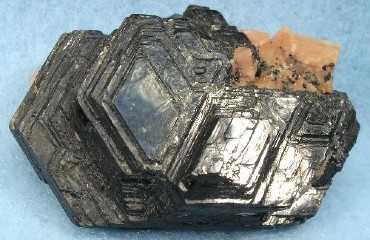
Epidote, Andradite, Biotite Image Credits – Gleb Korovko CC BY 4.0, Moha112100 CC-BY-SA-3.0, Robert M. Lavinsky CC-BY-SA-3.0
Silicate minerals form by far the largest and most diverse group in the mineral kingdom, accounting for roughly 90–95 percent of Earth’s crust. Their remarkable abundance and variety arise from the flexibility of their basic building block – the silicon–oxygen tetrahedron – a molecular structure in which one silicon atom sits at the centre of four oxygen atoms arranged at the corners of a tetrahedron. The many ways these tetrahedra combine – from isolated units to vast three-dimensional frameworks – give rise to the countless silicate species that dominate the Earth’s rocks and soils and shape much of its surface geology.
Nesosilicates
The simplest silicates are the nesosilicates, in which individual tetrahedra remain independent of one another, linked only by metallic cations such as magnesium, iron, or calcium. Typical examples are olivine ((Mg,Fe)₂SiO₄) and garnet, both common in igneous and metamorphic rocks. Olivine, a major constituent of Earth’s upper mantle, was once called chrysolite when of gem quality. Its green colour gives rise to the gemstone peridot. Garnet, long confused with spinel and ruby in ancient times, actually represents a large family of related silicate minerals differing in composition and colour.
Sorosilicates
When two tetrahedra share an oxygen atom, sorosilicates (from the Greek soros, meaning “heap”) are formed. The epidote group is a typical example. These minerals often develop in metamorphosed limestone and are valued by collectors for their pistachio-green crystals.
Inosilicates
Still more polymerisation results in inosilicates, where tetrahedra link into long chains. The single-chain pyroxenes (such as augite, diopside, and spodumene) and double-chain amphiboles (like hornblende and tremolite) are essential rock-forming minerals in basalts and schists. The name asbestos, now infamous for health reasons, was originally applied to several fibrous amphiboles, most notably chrysotile, a form of serpentine.
Cyclosilicates
Cyclosilicates, or ring silicates, are built from silicate tetrahedra linked into closed rings, most commonly of three, four, or six units. This structure produces distinctive crystal habits and, in some species, notable optical effects. Key cyclosilicates include beryl, tourmaline, and cordierite. Beryl yields gemstones such as emerald and aquamarine, while tourmaline is famed for its wide colour range and can become electrically charged when heated or stressed. Cyclosilicates commonly form in granitic pegmatites and high-grade metamorphic rocks.
Phyllosilicates
With further linkage, silicate tetrahedra create broad sheets in the phyllosilicates, or sheet silicates. These include the familiar mica group (muscovite, biotite, and lepidolite), talc, and chlorite. The Greek word “phyllon” means “leaf,” referring to their perfect cleavage that allows them to split into thin, flexible layers. The old term 'isinglass' was once used for clear sheets of mica, which served as early windowpanes in stoves and lanterns. Phyllosilicates form mainly during metamorphism and hydrothermal alteration and play important roles in soils, clays, and industrial products such as ceramics, cosmetics, and lubricants.
Tectosilicates
The most complex silicate structures are the tectosilicates, where every oxygen atom is shared among other tetrahedra, producing an infinite three-dimensional framework. This group includes quartz and the feldspars, the two most abundant minerals in Earth’s continental crust. Quartz, once called 'rock crystal' by the ancients, occurs in a vast range of forms – from colourless crystals to violet amethyst, yellow citrine, and dark smoky quartz. Feldspars, derived from the German feldspat, meaning “field stone”, are subdivided into potassium feldspars (orthoclase, microcline) and plagioclase feldspars (albite–anorthite series). Orthoclase of gem quality is known as moonstone, famous for its shimmering play of light called adularescence.
Zeolites
A distinctive subgroup of tectosilicates is formed by the zeolites, a family of hydrated framework silicates notable for their open, cage-like crystal structures. These frameworks contain channels and cavities that can hold water molecules and loosely bound cations such as sodium, calcium, or potassium, which can be reversibly exchanged without destroying the crystal lattice. Because of this property, zeolites were once poetically described as “boiling stones”, as they release water when gently heated. Forming mainly in low-temperature volcanic and sedimentary environments, zeolites such as stilbite, heulandite, and chabazite are prized by collectors for their delicate crystal forms, while industrially they are invaluable as molecular sieves, catalysts, water softeners, and environmental clean-up agents.
Chemical Variability and Substitution
The chemical adaptability of the silicate framework allows many substitutions: aluminium for silicon, iron for magnesium, or sodium for potassium. This flexibility explains the vast range of compositions, colours, and physical properties found among silicate minerals. It also enables geologists to use silicates as indicators of the temperature, pressure, and chemical conditions under which rocks formed. The slow conversion of feldspar into mica and quartz during metamorphism, or the crystallisation of pyroxene and olivine from molten magma, provides essential clues about the planet’s deep processes.
Applications and Uses
Silicates are not only geologically significant but also central to human culture and industry. The entire ceramic and glass industries rely on silicate chemistry. Quartz provides the silica for glassmaking and the piezoelectric crystals used in watches and electronics. Clay minerals form the basis of bricks and pottery, while asbestos, despite its hazards, was historically valued for its fire resistance. Some silicates are prized gemstones – emerald and aquamarine are varieties of the silicate beryl, while tourmaline, topaz, and zircon (once known as hyacinth) have adorned jewellery for centuries.
Beyond their practical uses, silicate minerals play a vital role in Earth’s long-term climate regulation. The weathering of silicate rocks removes carbon dioxide from the atmosphere, locking it away as carbonate sediments in the oceans – a natural thermostat that has moderated global temperatures for billions of years.
Conclusion
From the glittering facets of quartz and topaz to the deep green of olivine and the delicate shimmer of mica, the silicate group showcases the ingenuity of nature in arranging a few simple elements – silicon and oxygen – into nearly endless combinations. The study of silicates not only explains the composition of our planet’s crust but also reveals a connection between Earth’s geology, its atmosphere, and human civilisation itself. Their variety, history, and beauty make the silicate group both the foundation of the solid Earth and one of the most fascinating subjects in all of mineralogy.
For more information about specific groups of silicates, please see their respective pages by clicking the following links:
Nesosilicates - Sorosilicates - Inosilicates - Cyclosilicates - Phyllosilicates - Tectosilicates - Zeolites - Feldspars & Feldspathoids
If you are interested in adding specimens of silicate minerals to your collection, click HERE.
If you are interested in adding specimens of zeolite minerals to your collection, please click HERE.


