


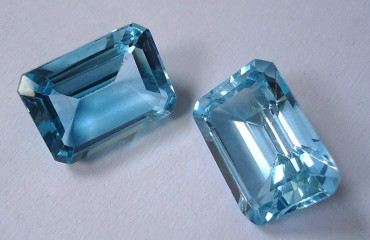
Uvarovite, Nesosilicate Structure, Cut Blue Topaz Image Credits – Parent Géry CC BY-SA 3.0, The Asaay House, MAURO CATEB CC BY-SA 2.0
Nesosilicates - formerly also called orthosilicates or island silicates - are one of the fundamental silicate groups in mineralogy and geology. Their defining feature is the presence of isolated SiO₄ tetrahedra, each consisting of a central silicon atom bonded to four oxygen atoms. Unlike other silicate groups, these tetrahedra do not share oxygen atoms with neighbouring tetrahedra. Instead, they are held together in the crystal lattice by various cations such as Fe²⁺, Mg²⁺, Ca²⁺, Mn²⁺, and Al³⁺. This structural independence gives nesosilicates their distinctive properties: high density, generally robust hardness, and well-developed crystal forms.
Atomic Structure
The SiO₄ tetrahedron carries a 4- charge because each oxygen has one unshared bond not linked to another silicon atom. To maintain charge balance, the tetrahedra bond to metal cations that occupy interstitial sites in the structure. This arrangement gives nesosilicates strong Si–O bonds and often results in compact, tightly bonded crystals with high melting temperatures and good resistance to weathering.
Formation Environments
Nesosilicates occur in a wide range of geological settings:
1. Igneous Environments
They commonly crystallise from high-temperature magmas rich in magnesium and iron. For example:
Olivine, abundant in basalt and peridotite, forms during early cooling of mafic and ultramafic melts.
Almandine garnet can form in granitic pegmatites under suitable pressure-temperature conditions.
2. Metamorphic Terranes
Regional and contact metamorphism generate many nesosilicates:
Garnet (almandine, pyrope, grossular) develops during medium to high-grade metamorphism of pelitic or calcareous rocks.
Staurolite, known for its twinned crystals, forms under medium-grade metamorphic conditions.
3. Hydrothermal and Skarn Systems
Calcium-rich nesosilicates such as vesuvianite or zircon can crystallise where silica-bearing fluids react with limestone or dolomite.
Important Examples of Nesosilicates
Olivine (Mg,Fe)₂SiO₄ – Earth’s upper mantle major mineral; green, high-temperature stability.
Garnet group – Includes pyrope, almandine, spessartine, grossular, and andradite; widely used in geology as pressure-temperature indicators.
Zircon ZrSiO₄ – Highly durable and hosts uranium; crucial for radiometric dating.
Topaz Al₂SiO₄(F,OH)₂ – A well-known gemstone with perfect basal cleavage.
Kyanite, Sillimanite, Andalusite – Al₂SiO₅ polymorph series used to interpret metamorphic conditions.
Uses of Nesosilicates
Nesosilicates play significant scientific and industrial roles:
Petrological indicators: Garnet, zircon, and Al₂SiO₅ minerals reveal metamorphic histories and crustal evolution.
Gemstones: Peridot (gem olivine), topaz, garnet, and zircon are valued in jewellery for their colour and durability.
Industrial abrasives: Garnet’s high hardness makes it ideal for sandblasting and water-jet cutting.
Geochronology: Zircon is a premier mineral for U-Pb dating, enabling reconstruction of Earth’s early history.
Conclusion
Nesosilicates provide a good introduction to the silicate class of minerals: their isolated SiO₄ tetrahedra make the link between atomic structure and mineral properties especially easy to see. Because the tetrahedra are held together by different metal cations, the group also showcases how changing chemistry produces very different minerals—from mantle-forming olivine to metamorphic index garnets and time-capsule zircon.
For collectors, nesosilicates are particularly rewarding. Many species form well-shaped, aesthetically strong crystals (garnet dodecahedra, sharp zircon prisms, classic topaz), often with rich colour and high lustre. They also carry strong “story value”: garnets and Al₂SiO₅ minerals can indicate metamorphic conditions, olivine links directly to basalts and the deep Earth, and zircon is famous for preserving deep-time geological history. Add their generally good durability and display stability, plus the abundance of classic localities and gem varieties, and nesosilicates become a cornerstone group in any serious mineral collection.
If you are interested in adding specimens of nesosilicate minerals to your collection, click HERE.


