

Elbaite, Cyclosilicate Structures, Benitotite Image Credits – Géry PARENT CC BY-SA 3.0, The Assay House, James St. John CC BY-SA 2.0
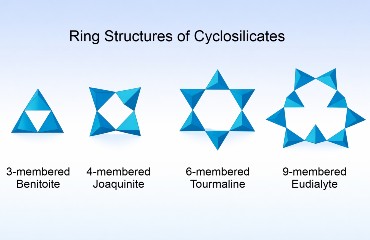
Cyclosilicates – also known as ring silicates – form one of the most elegant and visually distinctive classes of silicate minerals. Their defining feature is the arrangement of SiO₄ tetrahedra linked into closed rings, most commonly containing three (Si₃O₉), four (Si₄O₁₂), or six (Si₆O₁₈) tetrahedra. The six-membered rings are by far the most widespread in nature and form the structural foundation of some of mineralogy’s most prized gemstones, including beryl and tourmaline. Although there are rings with a higher number of tetrahedra, or other complex arrangements, there are no known minerals with five-membered rings. These ring structures generate unique optical, chemical, and crystallographic properties, contributing to the diversity and complexity found within this mineral group.
Atomic Structure
The building block of cyclosilicates is the polymerised silicate ring, in which each tetrahedron shares two oxygen atoms with its neighbours, forming a complete loop. This produces characteristic structural units:
Si₃O₉⁶⁻ (three-membered rings – rare)
Si₄O₁₂⁸⁻ (four-membered rings – uncommon)
Si₆O₁₈¹²⁻ (six-membered rings – common and stable)
These rings stack and arrange themselves in various configurations, often creating channels, tunnels, or frameworks that allow for the incorporation of large cations, anions, or even water molecules. For example, the beryl structure contains hexagonal channels large enough to host alkali metals, water, or trapped gases. The presence of these structural cavities significantly influences mineral chemistry and colouration.
Formation Environments
Cyclosilicates form under a wide range of geological conditions, though their occurrence is strongly influenced by the interplay of aluminium, beryllium, boron, and alkali elements.
1. Pegmatites
The most spectacular cyclosilicates—beryl and tourmaline—commonly develop in granitic pegmatites, where slow cooling and volatile-rich melts promote the growth of large, well-formed crystals. Trace elements such as Fe, Mn, Cr, and Li often colour these minerals dramatically.
2. Metamorphic Settings
Cyclosilicates may form in aluminium-rich metamorphic rocks such as schists and gneisses. Cordierite, for example, appears in low- to medium-pressure metamorphic environments where magnesium and aluminium are abundant.
3. Hydrothermal and Alpine Veins
Tourmaline is a common accessory mineral in hydrothermal deposits and Alpine fissure veins, often produced by boron-rich fluids interacting with surrounding rock.
4. Skarn and Contact Metamorphism
Certain cyclosilicates, such as axinite, form in calcium- and boron-rich skarn environments.
Examples of Cyclosilicates
Beryl Be₃Al₂Si₆O₁₈ – includes emerald, aquamarine, heliodor, and morganite.
Tourmaline group – general formula XY₃Z₆(Si₆O₁₈)(BO₃)₃V₃W (where X, Y, Z, V and W can be any one of a number of metallic cations) – extremely diverse group, with complex chemistry and vivid colours.
Cordierite (Mg,Fe)₂Al₄Si₅O₁₈ – known for strong pleochroism; includes the gem iolite.
Axinite group Ca₂(Mn,Fe,Mg)Al₂BSi₄O₁₅(OH) – typically brown, violet, or blue crystals in skarn deposits.
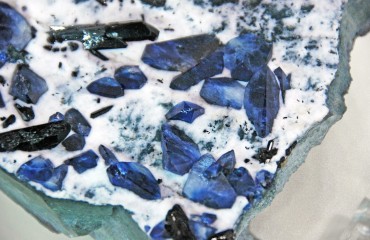
Benitoite BaTiSi₃O₉ – rare blue gemstone found primarily in California.
Uses of Cyclosilicates
Cyclosilicates hold significant scientific and commercial value:
Gemstones: Emerald, aquamarine, morganite, tourmaline, iolite, benitoite, and several others are among the most desirable coloured gems.
Geological indicators: Tourmaline is a powerful tracer mineral for fluid pathways and geochemical conditions.
Industrial and technological uses: Beryl is historically important as a source of beryllium for aerospace and nuclear industries.
Petrology: Cordierite helps geologists interpret pressure–temperature conditions in metamorphic terrains.
Conclusion
Cyclosilicates stand out for the elegance of their ring structures, where linked SiO₄ tetrahedra form closed loops that can stack into channels and complex frameworks. This architecture helps explain why many cyclosilicates show distinctive crystal habits, strong optical effects, and wide chemical flexibility—making them an important group for understanding how subtle structural changes can produce dramatically different minerals and colours.
For collectors, cyclosilicates are a headline group because they include some of the world’s most prized and visually striking specimens. Beryl alone offers an entire spectrum – emerald, aquamarine, morganite and heliodor – often in superb hexagonal crystals, while tourmaline provides unmatched variety in colour zoning, elbaite 'watermelon' slices, and highly aesthetic pegmatite associations. Add pleochroic iolite (cordierite), rare classics like benitoite, and attractive skarn species such as axinite, and the cyclosilicates become a cornerstone for both beauty and geological 'story value'. Their combination of gem-grade varieties, classic localities, and recognisable structural themes makes them especially satisfying to collect and display.
If you are interested in adding specimens of cyclosilicate minerals to your collection, click HERE.


