
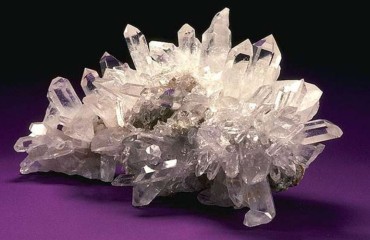
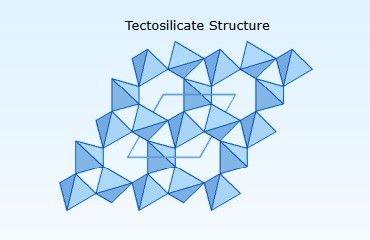

Quartz, Tectosilicate Structure, Sodalite Image Credits – The Assay House, The Assay House, Parent Géry CC BY-SA 2.0
Tectosilicates – also known as framework silicates – form the most abundant and structurally complex class of silicate minerals. Their defining characteristic is a three-dimensional framework of SiO₄ tetrahedra, in which each tetrahedron shares all four of its oxygen atoms with neighbouring tetrahedra. This complete polymerisation generates a very rigid, interconnected lattice that produces minerals with exceptional physical stability, hardness, chemical durability, and great abundance in Earth’s crust. Quartz and the feldspar group – two tectosilicate families – together make up more than 70% of the continental crust.
Atomic Structure
The tetrahedral bonding in tectosilicates gives rise to a fully linked framework, creating the general formula (SiO₂) for pure silica phases and more complex compositions when aluminium substitutes for silicon.
Aluminium substitution and charge balance
When Al³⁺ replaces Si⁴⁺ in the framework (a very common phenomenon), the resulting charge imbalance is corrected by the incorporation of alkali or alkaline earth metals such as K⁺, Na⁺, Ca²⁺, or Ba²⁺. This process produces the diverse feldspar, feldspathoid, and zeolite families.
Key structural characteristics
- High polymerisation produces robust, low-compressibility frameworks.
- Framework openness varies: quartz is tightly packed, whereas zeolites contain open channels capable of hosting water and large cations.
- Cleavage varies from poor (quartz) to good (feldspars), reflecting differences in framework distortion.
Formation Environments
Tectosilicates crystallise and transform across virtually all geological environments, from deep igneous processes to surface weathering.
1. Igneous Rocks
Quartz, alkali feldspar, and plagioclase are essential constituents of granites, rhyolites, basalts, and gabbros. Their compositions reflect magma chemistry, cooling rates, and fractionation processes.
2. Metamorphic Rocks
Quartz remains stable across an enormous pressure–temperature range, making it a dominant mineral in metamorphic rocks such as gneisses, quartzites, and schists. Feldspars recrystallise or transform into polymorphs (e.g., microcline, orthoclase) as conditions change.
3. Sedimentary Systems
Tectosilicates play a central role in sedimentary environments:
Quartz is the dominant component of sands and sandstones owing to its exceptional weathering resistance.
Feldspars weather rapidly to clays, influencing soil formation and sediment chemistry.
4. Hydrothermal and Low-Temperature Settings
Zeolites and feldspathoids crystallise in volcanic cavities, alkaline magmas, and hydrothermal environments where silica activity is low and volatile content is high.
Examples of Tectosilicates
- Quartz SiO₂ – includes varieties such as amethyst, smoky quartz, citrine, and rose quartz.
- Feldspar group - Orthoclase, Microcline, Albite, Anorthite
- Zeolite group – heulandite, stilbite, natrolite, chabazite
- Feldspathoids – nepheline, leucite, sodalite
- Scapolite group – marialite–meionite series
Uses of Tectosilicates
Tectosilicates have immense geological, industrial, and economic significance:
Gemstones: Amethyst, citrine, amazonite, and sunstone are prized quartz and feldspar varieties.
Industrial minerals: Quartz is critical in glassmaking, electronics, optics, abrasives, and silicon metal production.
Construction materials: Feldspars are essential in ceramics, glazes, and fillers.
Catalysts and molecular sieves: Zeolites are indispensable in water purification, gas separation, and petroleum cracking.
Geological indicators: Quartz and feldspars reveal pressure–temperature histories, magmatic differentiation, and provenance in sedimentology.
Conclusion
Tectosilicates represent the culmination of silicate polymerisation, with their fully interconnected three-dimensional frameworks forming the structural backbone of Earth’s crust. This architecture explains their exceptional stability, abundance, and wide chemical range, from pure silica frameworks to aluminium-rich networks balanced by alkali and alkaline-earth cations. As a group, tectosilicates neatly tie together igneous, metamorphic, and sedimentary processes, making them essential for understanding crustal evolution and rock-forming systems.
For collectors, tectosilicates are both foundational and endlessly varied. Quartz alone offers an extraordinary range of habits, colours, and classic localities, while feldspars provide everything from sharp alpine crystals to colourful gem varieties such as amazonite and sunstone. Zeolites add a contrasting aesthetic with delicate, complex crystal forms and dramatic cavity associations, often in spectacular clusters. Beyond their visual appeal, tectosilicates are typically durable, stable, and display-friendly, making them ideal long-term cabinet specimens. Their sheer diversity, global occurrence, and central role in geology make tectosilicates an indispensable – and highly rewarding – group in any mineral collection.
If you are interested in adding specimens of tectosilicate minerals to your collection, click HERE.
If you are specifically interested in adding quartz specimens to your collection, click HERE.
If you are specifically interested in adding zeolite specimens to your collection, click HERE.


