
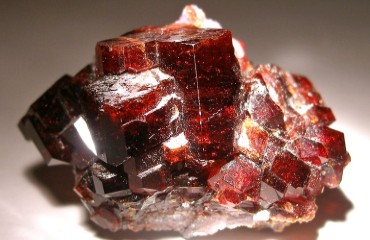

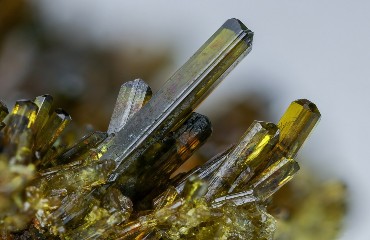
Vesuvianite, Sorosilicate Structure, Epidote Image Credits – Robert M. Lavinsky CC-BY-SA-3.0, The Assay House, Gleb Korovko CC BY 4.0
Sorosilicates – formerly also known as disilicates – form one of the key subclasses of the silicate minerals. Their defining structural feature is the presence of paired SiO₄ tetrahedra, linked together by sharing a single oxygen atom. This produces the characteristic Si₂O₇⁶⁻ group. These linked tetrahedral pairs, often called double tetrahedra or bow-tie units, give sorosilicates distinctive structural, chemical, and optical properties that set them apart from other silicate groups.
Atomic Structure
In sorosilicates, two SiO₄ tetrahedra are joined at one corner, producing a bent, V-shaped arrangement. The shared oxygen atom reduces the overall negative charge, but the Si₂O₇ cluster still carries a strong 6- charge, requiring a variety of metal cations – commonly Ca²⁺, Fe²⁺, Mg²⁺, Al³⁺, and Mn²⁺ – to stabilise the structure.
Although the fundamental building block is the Si₂O₇ group, some sorosilicates incorporate additional structural components such as isolated tetrahedra, chains or sheets of octahedra, or even partial polymerisation depending on pressure–temperature conditions during crystallization. These variations contribute to the rich diversity of sorosilicate minerals.
Formation Environments
Sorosilicates occur in a wide range of metamorphic and igneous environments, though they are less common than framework or chain silicates. Their formation typically requires specific pressure–temperature conditions and chemically compatible host rocks.
1. Regional Metamorphism
Many sorosilicates are classic indicators of particular metamorphic grades:
Epidote, among the most widespread sorosilicates, forms in medium-grade metamorphic rocks such as greenschist and amphibolite facies.
Clinozoisite and allanite occur in altered volcanic rocks and pelitic schists enriched in rare-earth elements.
2. Contact Metamorphism & Skarns
Calcium-rich sorosilicates often develop where magmatic fluids interact with carbonate rocks:
Vesuvianite, a complex sorosilicate, forms in skarn deposits and impure limestones subjected to thermal metamorphism.
Zoisite, the parent species of tanzanite, grows in high-temperature, aluminium-rich environments.
3. Igneous Systems
Some sorosilicates appear in granites and syenites where fluids alter earlier minerals, especially in late-stage hydrothermal zones.
Examples of Sorosilicates
Epidote Ca₂(Al,Fe)₃Si₃O₁₂(OH) – pistachio-green crystals found in metamorphic terrains worldwide.
Clinozoisite Ca₂Al₃Si₃O₁₂(OH) – similar to epidote but with minimal Fe content.
Allanite (Ce-La-Y-rich epidote-group minerals) – important carriers of rare-earth elements.
Zoisite Ca₂Al₃Si₃O₁₂(OH) – includes the gem variety tanzanite, prized for its blue-violet pleochroism.
Vesuvianite Ca₁₉(Al,Mg,Fe)₁₃Si₁₈O₆₈(OH)₁₀ – complex sorosilicate with dramatic prismatic crystals in skarns.
Uses of Sorosilicates
Sorosilicate minerals serve important roles in both scientific and commercial settings:
Geological indicators: Epidote and its relatives help geologists interpret metamorphic conditions, fluid compositions, and reaction histories.
Gemstones: Tanzanite (zoisite) is one of the most valuable modern gemstones; vesuvianite (idocrase) and allanite also yield attractive collectors’ pieces.
Rare-Earth Resources: Allanite and related minerals host valuable REEs used in electronics, magnets, and green technologies.
Petrology: The epidote group provides vital clues about fluid flow, metasomatism, and crustal evolution
Conclusion
Sorosilicates neatly bridge the gap between isolated and fully polymerised silicate structures, with their distinctive paired Si₂O₇ tetrahedra providing an elegant example of intermediate structural complexity. As a group, they are especially valuable for understanding metamorphic processes, fluid interaction, and chemical mobility, with minerals such as epidote and zoisite acting as sensitive indicators of pressure, temperature, and rock composition.
For collectors, sorosilicates offer a compelling mix of scientific interest and visual appeal. Many species form sharp, well-developed crystals in classic metamorphic and skarn localities, often with striking colours – pistachio-green epidote, honey-to-violet vesuvianite, and the intense blue-violet of tanzanite. Several sorosilicates are also geologically diagnostic, making them excellent “teaching specimens” that link crystal form to formation environment. Their relative durability, wide global distribution, and inclusion of both common rock-forming minerals and world-class gemstones make sorosilicates a rewarding and intellectually satisfying group for any mineral collection.
If you are interested in adding specimens of sorosilicate minerals to your collection, click HERE.


