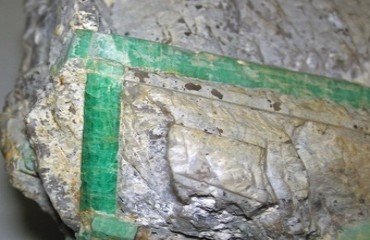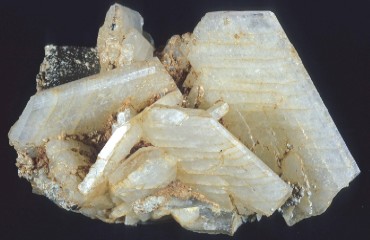


Albite, Feldspar Structure, Microcline var. Amazonite Image Credits – Rock Currier CC BY 3.0, The Assay House, James St. John CC BY-SA 2.0
Feldspars and feldspathoids together are the most important group of rock-forming silicate minerals in the Earth’s crust. Feldspars alone make up roughly 50–60% of all crustal rocks, occurring in nearly all igneous, metamorphic and many sedimentary environments. Feldspathoids are closely related minerals that form under silica-poor conditions, replacing feldspars when there is not enough silica to form them.
Although similar in appearance and chemistry, feldspars and feldspathoids almost never occur together. Their mutual exclusivity makes them especially valuable to geologists, as their presence reveals much about magma chemistry and geological history.
Atomic Structure and Chemistry
Both feldspars and feldspathoids are tectosilicates, built from three-dimensional frameworks of corner-sharing SiO₄ and AlO₄ tetrahedra. Aluminium substitution creates a negative charge in the framework, balanced by large alkali or alkaline-earth cations which sit in the lattice between the tetrahedra.
Feldspars have relatively dense frameworks with a silicon-to-aluminium ratio that requires sufficient silica to remain stable. Their general formula can be expressed as:
- KAlSi₃O₈ (potassium feldspar)
- NaAlSi₃O₈ (albite)
- CaAl₂Si₂O₈ (anorthite)
Feldspathoids, by contrast, have more open frameworks and lower silica content. Their structures cannot accommodate as much SiO₂, so they crystallise only from silica-undersaturated magmas. This fundamental difference controls where they form and why they exclude feldspars.
Feldspar Groups
Feldspars are divided into two main families:
Alkali Feldspars
These include potassium- and sodium-rich species, such as orthoclase, microcline, sanidine, and albite. They dominate granites, syenites and many felsic volcanic rocks. Microcline is notable for its cross-hatched 'tartan' twinning, while sanidine forms glassy crystals in volcanic environments.
Plagioclase Feldspars
Plagioclase forms a continuous solid-solution series between albite (Na-rich) and anorthite (Ca-rich). Intermediate members (oligoclase, andesine, labradorite, bytownite) are among the most widespread minerals in basalts, gabbros, diorites and andesites. Characteristic fine twinning gives plagioclase its distinctive striated crystal faces.
Feldspathoids
Feldspathoids are less abundant but geologically distinctive. Important members include:
- Nepheline – common in silica-poor igneous rocks such as nepheline syenite
- Leucite – a potassium-rich mineral typical of certain volcanic lavas
- Sodalite – famous for its deep blue colour and ornamental use
- Cancrinite, hauyne, nosean – often brightly coloured and associated with alkaline igneous complexes
Their open frameworks may also host additional anions such as chloride, sulfate, or carbonate, making them structurally and chemically more diverse than feldspars.
Formation and Geological Settings
Feldspars crystallise directly from magma over a wide range of temperatures and compositions. They are major constituents of:
- Granites and pegmatites
- Basalts, gabbros and diorites
- Gneisses and schists derived from feldspar-rich protoliths
They also dominate many sedimentary rocks, especially sandstones, where they survive erosion as feldspar grains.
Feldspathoids form only in alkaline, silica-undersaturated magmas, typically associated with:
- Continental rift zones
- Intraplate volcanic provinces
- Alkaline igneous complexes
Their presence immediately signals unusual magma chemistry and low silica availability.
Physical Characteristics and Crystal Habits
Feldspars are typically hard (Mohs ~6), with two good cleavages at nearly right angles. They range from colourless and white to pink, grey, green, or blue, depending on composition and inclusions. Crystal habits are usually blocky or tabular.
Feldspathoids are generally softer and less dense, often with more vivid colours. Many show greasy to vitreous lustre and form well-shaped crystals or massive aggregates. Some, such as sodalite and nepheline, are valued as ornamental stones.
Uses and Economic Importance
Feldspars are among the most economically important industrial minerals. They are essential in:
- Glass and ceramics manufacturing
- Porcelain and sanitary ware
- Fillers and fluxes in industrial processes
Feldspathoids have more specialised uses, including:
- Decorative stone and carvings
- Scientific and industrial research into framework silicates
- Collector and museum specimen
Conclusion
For collectors, feldspars and feldspathoids offer a blend of fundamental geology and aesthetic appeal. Feldspars tell the story of Earth’s crust itself – igneous crystallisation, metamorphism, erosion and recycling – while fine pegmatite crystals and twinned specimens can be visually striking and technically impressive.
Feldspathoids, though rarer, are prized for their unusual chemistry, bold colours and restricted geological settings. Their presence marks exotic alkaline magmatism and makes them highly informative specimens. Together, these minerals form a cornerstone of any serious collection, linking everyday rock-forming minerals with some of the most distinctive and revealing products of Earth’s internal processes.
If you are interested in adding specimens of feldspar or feldspathoid minerals to your collection, click HERE.