
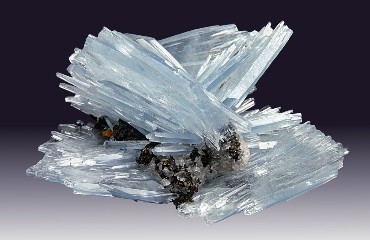
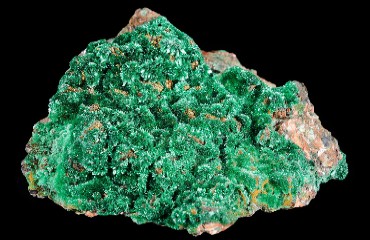
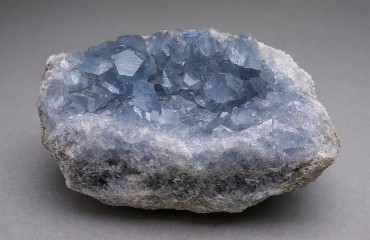
Baryte, Brochantite, Celestine Image Credits – Jamain CC BY-SA 3.0, Zbynek Burival CC-BY-SA-4.0, Raimond Spekking CC-BY-SA-4.0
The sulfate group is a large and diverse class of minerals containing the sulfate anion [(SO₄)²⁻]. These minerals are characterised by the combination of sulfur and oxygen, with the sulfur atom at the centre of a tetrahedron surrounded by four oxygen atoms. The group includes many colourful and often beautifully crystallised species that form primarily through the evaporation or oxidation of sulfate-bearing solutions near the Earth’s surface. Their striking hues and interesting origins have long fascinated both mineralogists and collectors.
Structure and Composition
In the sulfate group, the [(SO₄)²⁻] tetrahedron acts as the basic building block, bonded to various metallic cations such as calcium, barium, strontium, lead, copper, iron, or aluminum. The sulfate ion’s high symmetry allows the formation of a wide range of crystal structures, from simple orthorhombic systems to complex monoclinic and triclinic arrangements. Many sulfate minerals also contain water molecules within their crystal lattices, forming hydrated species that may lose water easily when exposed to heat or dry air. This hydration makes some sulfates unstable under low humidity, while others, such as barite, are remarkably stable.
Formation and Geological Occurrence
Sulfate minerals typically form in the near-surface environment where oxidation, evaporation, and interaction between atmospheric water and sulfide minerals occur. One of the most common geological settings for their formation is in evaporite deposits, where seawater or saline lake water evaporates, concentrating dissolved ions until minerals such as gypsum (CaSO₄·2H₂O) and anhydrite (CaSO₄) crystallise. Gypsum is often the first to form, followed by anhydrite as dehydration progresses with increasing temperature and depth.
Another important environment is the oxidised zone of sulfide ore deposits, where sulfide minerals like pyrite or galena are altered by oxygenated groundwater. The oxidation of sulfides produces sulfuric acid, which reacts with metal ions to create colourful secondary sulfate minerals such as chalcanthite (CuSO₄·5H₂O), anglesite (PbSO₄), or melanterite (FeSO₄·7H₂O). These minerals often appear as delicate crystals, crusts, or efflorescences, forming striking blue, green, or white coatings in mine tunnels and old workings.
Notable Members of the Group
Gypsum is the best-known sulfate mineral and one of the most widely distributed minerals on Earth. It forms massive deposits and transparent crystals known as selenite and fibrous forms called satin spar. Gypsum is essential in the manufacture of plasterboard, making it one of the most economically important non-metallic minerals.
Anhydrite, the anhydrous form of calcium sulfate, commonly occurs with gypsum in evaporite sequences. It forms blocky, often colourless or grey crystals, and can convert to gypsum when hydrated. This reversible relationship between gypsum and anhydrite is a classic example of mineral transformation due to environmental changes.
Barite (BaSO₄) is another significant sulfate mineral, recognized for its high specific gravity and attractive tabular crystals, often white, blue, or honey-coloured. Barite commonly forms in hydrothermal veins, sedimentary rocks, and residual deposits. Because of its density, it is used as a weighting agent in drilling muds for oil and gas exploration.
Celestine (SrSO₄) and anglesite (PbSO₄) are closely related to barite in structure and appearance. Celestine’s delicate sky-blue crystals from Madagascar and Ohio are popular among collectors, while anglesite, an alteration product of galena, forms brilliant transparent crystals, notably from Tsumeb, Namibia, and Monteponi, Sardinia.
Alunite (KAl₃(SO₄)₂(OH)₆) represents the hydrated aluminum sulfates that form through alteration of feldspar-rich volcanic rocks by acidic sulfate solutions. Related species include jarosite and natroalunite, which often occur as earthy yellow coatings in oxidized ore zones or geothermal areas.
Other members include chalcanthite, with its vivid blue colour; melanterite, epsomite (MgSO₄·7H₂O, or Epsom salt), and the rare brochantite (Cu₄SO₄(OH)₆), which bridges the sulfate and hydroxide groups. Some, like halotrichite and copiapite, form striking fibrous or yellow crusts in mine dumps, though they can dehydrate quickly in dry air.
Stability and Collecting Considerations
Because many sulfate minerals are soluble or hygroscopic, collectors must take care in their preservation. Minerals like chalcanthite and melanterite can lose water or dissolve in moist air, while others such as barite and gypsum remain stable indefinitely. Proper storage in sealed containers with consistent humidity helps preserve these delicate specimens. Old collections often show dehydrated or altered sulfates, testifying to their sensitivity to environmental conditions.
Conclusion
The sulfate group provides valuable insights into low-temperature geochemistry, hydrothermal processes, and the Earth’s evaporitic history. On a planetary scale, sulfate minerals have been detected on Mars, offering evidence of ancient water activity. From the huge gypsum crystals in Mexico’s Cueva de los Cristales to delicate alunite crusts on volcanic peaks, sulfates demonstrate the remarkable diversity and beauty produced by simple chemical combinations of sulfur, oxygen, and various metal ions.
If you are interested in adding specimens of sulfate minerals to your collection, click HERE.
If you are specifically looking for Baryte specimens, click HERE


