
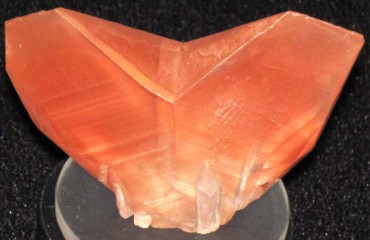


Calcite, Rhodochrosite & Smithsonite Image Credits – James St. John CC BY 2.0, Parent Géry CC BY 2.0, Sanjay Acharya CC BY-SA 3.0
The carbonate group of minerals forms one of the most important and diverse families in mineralogy, both scientifically and economically. These minerals are united by the presence of the carbonate ion (CO₃)²⁻, in which a single carbon atom is surrounded by three oxygen atoms arranged in a triangular pattern. When combined with metals such as calcium, magnesium, iron, copper, zinc, or lead, the result is a wide variety of carbonate minerals that display an impressive range of colours, crystal forms, and geological settings.
Composition and Structure
In all carbonates, the basic structural unit – the carbonate ion – is strongly bonded internally, but the bonds connecting it to the surrounding metal cations are weaker. This gives rise to certain diagnostic properties typical of the group. Carbonates are relatively soft, usually between 3 and 4.5 on the Mohs scale, and they cleave easily in one or more directions. The most characteristic feature of nearly all carbonates is their reaction with dilute acids. When even a drop of cold, dilute hydrochloric acid is placed on a carbonate mineral, carbon dioxide gas is released, producing the familiar effervescence or “fizz.” This simple test has long been a fundamental tool for field geologists and mineral collectors.
Subgroups of Carbonates
The carbonate group is divided according to chemical composition and symmetry.
1 - The Calcite Group
The calcite group includes calcite (CaCO₃), magnesite (MgCO₃), siderite (FeCO₃), rhodochrosite (MnCO₃), and smithsonite (ZnCO₃). All of these crystallise in the trigonal system and are isostructural, meaning that their crystal forms are similar and they readily form solid-solution series with one another. For example, small amounts of magnesium often substitute for calcium in calcite, giving rise to the mineral dolomite when substitution becomes regular and complete.
2 - The Aragonite Group
The aragonite group, also composed of simple carbonates, crystallises in the orthorhombic system. Aragonite (CaCO₃) is the most common member, but witherite (BaCO₃) and strontianite (SrCO₃) are closely related. Aragonite and calcite share the same chemical composition but have different crystal structures, making them polymorphs of calcium carbonate. Aragonite is less stable and frequently alters to calcite over geological time.
3 - Complex or double carbonates
More complex are the double carbonates, such as dolomite (CaMg(CO₃)₂) and ankerite (CaFe(CO₃)₂), where two different metals are present in the structure. Still other species contain hydroxyl or water molecules, like malachite and azurite, the striking green and blue copper carbonates that adorn mineral collections worldwide.
Occurrence and Formation
Carbonate minerals form in many geological environments. The most widespread are the sedimentary carbonates, deposited chemically or biologically from marine waters. Limestone, composed mainly of calcite, and dolostone, composed primarily of dolomite, make up vast sequences of the Earth’s crust and preserve an invaluable fossil record. Many carbonates also occur in hydrothermal veins, where hot solutions rich in carbon dioxide react with limestone or other carbonate rocks. Smithsonite, rhodochrosite, siderite, and cerussite (PbCO₃) commonly form in such deposits, especially as secondary minerals in the oxidation zones of ore bodies.
Carbonates can also crystallise from metamorphic processes, producing marbles of outstanding beauty and commercial value. When limestone is subjected to heat and pressure, it recrystallises into coarse-grained calcite or dolomite marble. Some of the world’s most famous decorative stones, such as the white marble of Carrara in Italy, are composed almost entirely of calcite.
Identification and Properties
Most carbonates are easily recognised by their reaction with acid, their relatively low hardness, and their perfect rhombohedral cleavage. Calcite, the most abundant, forms a variety of crystal habits – from scalenohedra and rhombohedra to complex twins – and is transparent to translucent with a vitreous lustre. A distinctive optical property of calcite is double refraction, easily seen when a printed line viewed through a clear crystal appears doubled. Aragonite forms slender prismatic crystals or fibrous aggregates, while dolomite typically develops curved rhombohedral forms. Copper carbonates such as malachite and azurite are valued both for their vivid colours and as important copper ores.
Economic and Scientific Importance
Carbonates are among the most useful of all minerals. Calcite and dolomite are principal raw materials for cement, lime, and agricultural soil treatment. Iron carbonate (siderite) has been mined as an iron ore, and zinc carbonate (smithsonite) and lead carbonate (cerussite) are important secondary ores of zinc and lead. Rhodochrosite and azurite are prized gemstones and collector minerals. From a scientific perspective, carbonate minerals record the chemistry of ancient seas and the evolution of the Earth’s atmosphere through their isotopic compositions.
Conclusion
The carbonate group combines beauty, variety, and significance in equal measure. From the dazzling crystals of rhodochrosite from Argentina to the delicate blue azurites of Morocco and the stalactitic calcites in caves, carbonates illustrate the elegance of simple chemistry transformed by nature into endless diversity. Whether as decorative stones, industrial materials, or objects of scientific study, carbonate minerals continue to fascinate geologists and collectors alike – a reminder that even the most common substances can yield extraordinary forms.
If you are interested in adding specimens of carbonate minerals to your collection, click HERE.
If you are specifically looking for Calcite specimens, click HERE


