
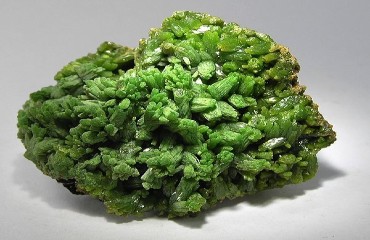
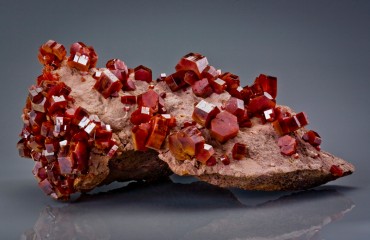
Pyromorphite, Group Structure, Vanadinite Image Credits – Robert M. Lavinsky CC-BY-SA-3.0, The Assay House, Robert M. Lavinsky CC-BY-SA-3.0
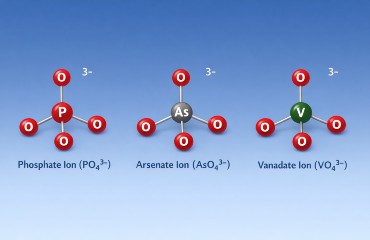
The phosphate, arsenate, and vanadate minerals form a trio of closely related groups united by chemical analogy. Each is built around a tetrahedral anion of the form XO₄³⁻, where X represents arsenic (As), phosphorus (P), or vanadium (V). Though these elements differ chemically, they substitute readily for one another in natural systems, giving rise to mixed-anion minerals with a remarkable diversity of colours and crystal forms. These groups include some of the most brilliantly coloured secondary minerals found in the oxidised zones of ore deposits and are of great importance to both collectors and mineralogists. Which of these mineral types forms preferentially to the others depends to a large degree on the relative availability and ratios of phosphorus, arsenic, or vanadium in the environment at the time of formation.
Chemical and Structural Relationships
All three groups are characterised by the tetrahedral XO₄ group, with the central atom surrounded by four oxygen atoms. The overall charge of –3 requires bonding to metallic cations such as copper, lead, zinc, iron, calcium, or aluminium to make the mineral structure electrically neutral. Other anions can also be present in addition to XO₄, including one or more of the halogens (F or Cl) or hydroxide (OH), making for some quite complex combinations. Despite this, the overall similarity of the three XO₄ anions explains why many of these mineral species form complete solid-solution series between arsenates and phosphates or between phosphates and vanadates. For example, mimetite (Pb₅(AsO₄)₃Cl) is the arsenate analogue of pyromorphite (Pb₅(PO₄)₃Cl) and of vanadinite (Pb₅(VO₄)₃Cl). Together these three form one of the best-known mineral series, displaying vivid yellow, green, orange, and red colours depending on the dominant metal anion.
The Phosphate Group
Phosphate minerals are the most numerous of the three groups, with over 700 recognized species. They occur widely in igneous, metamorphic, and sedimentary rocks. The most familiar phosphate is apatite, Ca₅(PO₄)₃(F,Cl,OH), which forms as an accessory mineral in granitic rocks and as the principal component of phosphate rock deposits used for fertiliser production. Other important phosphates include monazite (Ce,La,Th)PO₄, a major source of rare earth elements and thorium, and turquoise, CuAl₆(PO₄)₄(OH)₈·4H₂O, prized since antiquity as a gemstone.
Phosphate minerals are also biologically significant. Apatite constitutes the mineral portion of bones and teeth in vertebrates, and its weathering releases phosphorus essential for plant growth. Pegmatites often yield spectacular phosphate species such as triphylite, lithiophilite, vivianite, and strengite, while sedimentary environments produce nodular phosphorites and fossils replaced by apatite.
The Arsenate Group
Arsenate minerals are typically secondary species formed by the oxidation of arsenic-bearing sulfides such as arsenopyrite, tennantite, or enargite. In the oxidised zones of hydrothermal veins they appear as brilliant green, blue, or yellow coatings and crystals. Notable arsenates include erythrite (Co₃(AsO₄)₂·8H₂O), whose crimson colour makes it a striking indicator of cobalt ores; adamite (Zn₂(AsO₄)(OH)), typically bright yellow-green; and scorodite (FeAsO₄·2H₂O), a common weathering product of arsenopyrite.
Many arsenates are isostructural with phosphates and vanadates, forming analogous series. Because arsenic is toxic, these minerals are of environmental interest, acting both as natural sinks for arsenic and as potential sources of contamination when they break down. Collectors prize the arsenates for their intense colours and crystal habits, particularly specimens from localities such as Tsumeb, Namibia; Laurion, Greece; Cornwall, England; and the Ojuela Mine, Mexico.
The Vanadate Group
Vanadate minerals are less abundant but no less attractive. They form mainly in the oxidised zones of lead, copper, and uranium deposits. Vanadinite, Pb₅(VO₄)₃Cl, is the best-known example, occurring as bright scarlet hexagonal crystals in the deserts of Morocco, Arizona, and Namibia. Descloizite and mottramite form striking brown to green crystals and masses, while carnotite, K₂(UO₂)₂(VO₄)₂·3H₂O, is an important uranium-vanadium ore mineral, responsible for the bright yellow stains seen in many Colorado Plateau sandstones.
Vanadium readily changes valence states, and this flexibility allows vanadate minerals to display a wide range of oxidation colours from yellow to deep red and green. Economically, vanadates serve as minor sources of vanadium used in steel alloys and batteries.
Geological and Collecting Significance
Because the arsenate, phosphate, and vanadate anions have similar sizes and charges, they often occur together and can substitute within a single mineral structure. This leads to mixed species such as dundasite or austinite, and to zoning in crystals where colour variations reflect changing fluid chemistry. These minerals commonly crystallise in the supergene environment – near-surface zones where circulating oxygen-rich waters alter primary sulfide ores. Their bright colours make them favourites among collectors and excellent indicators of ore oxidation processes.
Conclusion
In summary, the arsenate, phosphate, and vanadate groups exemplify how slight chemical differences among elements can yield families of minerals with parallel structures but remarkably varied appearances. From the utilitarian phosphate fertilisers that sustain agriculture to the exquisite vanadinite and erythrite crystals treasured by collectors, these groups connect the worlds of geochemistry, industry, and beauty - illustrating the richness of mineral diversity shaped by nature’s subtle chemistry.
If you are interested in adding specimens of phosphate or vanadate minerals to your collection, click HERE.
If you are interested in adding specimens of arsenate minerals to your collection, click HERE.


