
Scotland is surprisingly rich mineralogically for a country of such modest size, thanks to the fact that it packs an exceptional range of rock types and ages, tectonic boundaries and igneous intrusions into a relatively small geographical area. Across the region ancient metamorphic ‘basement’ rocks sit close to vast belts of younger folded, metamorphosed sediments, while major fault systems and granite intrusions cut across both. On the west coast and islands, younger volcanic provinces add yet another layer of complexity. This unique mix, rarely encountered elsewhere in the world, has created a multitude of different environments where minerals could form and survive.
Ultimately, Scotland’s geological patchwork is the result of ancient plate movements. The far northwest is dominated by the Lewisian basement – truly ancient metamorphic rocks (over 2.5 billion years old in places) exposed as gneiss and related rock types, later overlain by younger sediments. Moving east and south, the central Scottish Highlands are largely built from the Moine and Dalradian successions – thick assemblages of originally sedimentary and volcanic rocks that were later folded and metamorphosed during Caledonian mountain-building events (when the Iapetus Ocean closed, creating the Laurussia supercontinent). These metamorphic belts host veins, pegmatites and contact aureoles that can yield quartz, beryl, topaz, garnet and a range of accessory minerals.
Between the Highlands and the Southern Uplands lies the Midland Valley, a giant fault with major Devonian–Carboniferous sedimentary rocks and widespread volcanism – important for coal and ironstone historically and for understanding Scotland’s industrial geology. The Southern Uplands form an accretionary belt of strongly deformed marine sediments (greywackes, shales and cherts), cut by faults that later became pathways for mineralising hydrothermal fluids, thereby creating Scotland’s classic lead districts.
Finally, Scotland’s west-coast islands preserve young Palaeogene volcanic provinces (Skye, Mull, Rum), where basalt lavas and intrusive centres produced agates, zeolites, and other cavity minerals – spectacular, photogenic, and very different from the metallic vein fields of the south. Together, these varied domains have created one of the most diverse, interesting and abundant mineral assemblages on the planet. Subject to centuries of scientific study, mineral collecting or simply enjoying the stunning countryside and scenery.
For a Map of Mineral Locations in the Scotland click HERE
|
Leadhills & Wanlockhead (Lowther Hills, Southern Uplands), South Lanarkshire
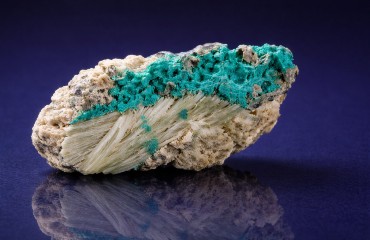
Lanarkite, Susannite and Macphersonite - Image Credit: Robert M. Lavinsky, CC-BY-SA-3.0 High in the Lowther Hills on the South Lanarkshire/Dumfries & Galloway border, Leadhills and Wanlockhead form Scotland’s most famous historic lead-mining district, now remembered by mining heritage sites such as the Museum of Scottish Lead Mining at Wanlockhead. The mineralisation occurs as hydrothermal Pb–Zn vein systems cutting Southern Uplands country rocks, an eroded mountain belt built largely from deep-marine Ordovician–Silurian sediments (greywacke sandstones, mudstones/shales and cherts) that were strongly deformed and uplifted during closure of the Iapetus Ocean. The mineralisation was discovered and worked since Roman times, passing through monastic ownership during the Middle Ages and peaking between the 17th and 19th centuries. Work eventually ceased in the 1950s after a considerable fall in lead prices, especially after World War I. The deposit was worked extensively along numerous exposures of the veins, leaving the terrain scarred by numerous dumps, trenches, adits and occasional deep mines, including the best-known Susanna Mine. While galena and associated sulfides drove the mining, the district’s real collector fame comes from its extraordinary range of secondary lead minerals. It is a world-class locality for rare species such as leadhillite and susannite (both closely linked to the district’s identity), alongside other notable lead minerals including lanarkite and caledonite, with many specimens showing classic 'Scottish” cabinet character: attractive, typically white, and often delicate secondary crystals from old mining activity. Leadhills is the type locality for nine minerals, including the already mentioned leadhillite, susannite, lanarkite, and caledonite, as well as chenite, macphersonite, mattheddleite, plattnerite and scotlandite. For a short time, Leadhills was renowned for its exceptionally pure gold (up to 22.8 carats), used for Scottish coinage and crowns for James V and Mary Queen of Scots, earning it the nickname ‘God's Treasure House in Scotland’. However, no new finds have come to light since the 18th century. The area is now a heritage site, with museums, a mineral railway and remnants of the mining industry, preserving the legacy of one of Scotland's most significant industrial sites. |
|
Strontian Mines (Loch Sunart, Lochaber), Fort William, Highland
Strontianite - Image Credit: The Assay House, Public Domain Above Strontian village overlooking Loch Sunart, the Strontian mines occupy remote ground in the West Highlands and are among the most historically significant mineral localities in Scotland, with lead mineralisation discovered in 1722 and worked most intensively through the eighteenth and nineteenth centuries. The veins are associated with fracture systems around the margins of a granite intrusion into surrounding metamorphic rocks of the Moine Supergroup metasediments (schists and gneisses). A number of named mines worked along a mineral vein cutting through the area, stretching from Corrantee mine in the west, to Whitesmith, Clashgorm and Bellsgrove mines in the centre, extending to Fee Donald mine in the east. These mines are celebrated for the discovery of the mineral strontianite, named after the nearby village, from which the new element strontium was eventually isolated. Notable specimens include pale green strontianite in matrix - often more historic than aesthetic - alongside the usual vein sulphides and gangue minerals typical of a lead mineralisation The location is also known for a number of minerals associated with metamorphism, including garnets, harmotome, heulandite and brewsterite. The local presence of strontium means that the heulandite and breswterite also appear as the strontium analogues heulandite-Sr and brewsterite-Sr. |
|
Cononish (Tyndrum) Gold–Silver Vein (Southern Highlands), Stirling
Cononish Gold Mine - Image Credit: Ashley Dace , CC BY-SA 2.0 Near Tyndrum in the central Highlands, the Cononish vein system is Scotland’s best-known modern hard-rock gold locality. Although the district has a lead mining history since at least the 16th century and was known for occasional finds of alluvial gold, the crucial breakthrough was the discovery of in situ gold in a quartz vein in the mid-1980s. The event triggered renewed exploration and ultimately modern mine development, placing Cononish at the centre of Scotland’s modern gold industry. Geologically, Cononish is a narrow quartz-vein system hosted within the Dalradian Supergroup – a body of sedimentary and volcanic rocks that were deformed and metamorphosed during the Grampian mountain-building phase. The deposit is dominated by a single composite vein, the Eas Anie Vein, up to 6 metres thick, close to the Cononish Fault (also referred to as the Eas Anie Fault). This fault diverges from the main Tyndrum Fault, providing a pathway for hydrothermal fluids, which led to vein formation. Two main phases of mineralisation are recognised: The first occurred about 410 million years ago, depositing gold and silver, alongside copper, lead and iron, which appear as galena and pyrite. The second, and later, mineralisation consists of quartz veins that cut across the earlier phase, depositing lead and zinc. For collectors, Cononish is notable not for these base-metal minerals, but for the rarity and provenance of Scottish specimen gold, mainly as native gold/electrum in quartz, sometimes accompanied by sulphides. In that sense, Cononish is a locality where the value is as much in showy crystallised gold specimens as in the area’s history of gold prospecting and discovery. |
|
Kilchoan, Ardnamurchan, Fort William, Highland
Kilchoan - Image Credit: Gordon Hatton, CC BY-SA 2.0 The Ardnamurchan Peninsula is the westernmost part of the British mainland. It is also a location of exposed Jurassic limestones that have undergone two periods of intense thermal metamorphism. The first was characterised by the loss of carbon from the carbonate rocks in the form of carbon dioxide, a process known as Bowen's decarbonation. This created minerals that were subsequently altered again in the presence of high-temperature water containing dissolved silica to form a large suite of rare and sometimes unique silicate minerals in the British Isles. These include åkermanite, cuspidine, foshagite, larnite, merwinite, plombiérite, rankinite, scawtite, spurrite, tilleyite, vesuvianiye and wollastonite. Among these are three type locality species: rustumite, dellaite, and kilchoanite, all characteristic and resulting from the second episode of metamorphism. |
|
Foss Baryte Mine, Aberfeldy, Perth & Kinross
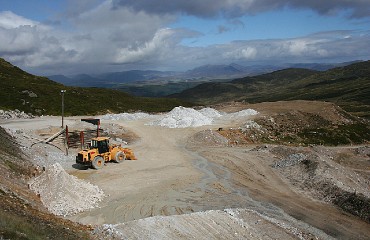
Foss Mine - Image Credit: Anne Burgess , CC BY-SA 2.0 Just outside Aberfeldy in Perthshire, the Foss baryte deposit is one of Scotland’s most important industrial mineral localities. Identified in the late 1970s by the British Geological Survey, it was developed from the early 1980s as a major UK source of baryte. The location is commonly divided into Foss West (the worked area) and Foss East (not exploited), with the mineralisation forming a structurally complex, folded and stretched orebody within Dalradian metasediments, consisting of altered schist and quartzite country rocks. It is estimated that at least seven separate pulses of hydrothermal circulation created these mineral veins, the fifth being the most abundant and the subject of the most intense mining activity at Foss West. The deposit is mainly worked as an open-cast operation by means of a number of surface excavations. The East Foss beds are occasionally thicker but are highly fragmented, consisting of multiple layers separated by thick wedges of rock. As a result, mining has been limited due to the difficulty and cost of separating the baryte. Although not a “show crystal” locality for baryte, Foss provides dense, clean specimens ideal for Scottish reference and teaching collections. It is also noted for several related barium minerals, some rare, including celsian, cymrite, barytocalcite, norsethite and witherite. A number of minerals associated with metamorphism are also present, including species of the amphibole, chlorite, feldspar, mica and garnet groups, which are difficult to narrow down to individual species due to their highly variable compositions. |
|
Duntanlich Baryte Mine, Aberfeldy, Perth & Kinross
Massive Baryte - Image Credit: The Assay House, Public Domain Also, in Perthshire and frequently discussed alongside Foss, the Duntanlich baryte deposit is another major resource within Scotland’s baryte belt, better known for its economic and regional significance than for a long tradition of specimen collecting. Like Foss, it sits within folded Dalradian metasediments, reflecting the wider baryte mineralisation in the same general province. However, unlike Foss, Duntanlich operates entirely underground, and the veins sit in mainly graphitic quartz muscovite schist due to slightly different metamorphic conditions. The overall mineralogy is again essentially baryte-led and notable specimens tend to be representative locality pieces – important because they document Scotland’s principal baryte district – rather than because they produce frequent top-tier crystals. In the vicinity of the deposits, the formation is also enriched in small amounts of zinc, lead and iron. |
|
Isle of Skye (Zeolites & Cavity Minerals), Highland
Analcime - Image Credit: The Assay House, Public Domain Skye in the Inner Hebrides is a classic Scottish destination for field collecting rather than mining anything of value apart from sand and aggregates. That fact is surprising because the island is large and its geology is varied and might be expected to have yielded useful metallic ores. However, due to long periods of tectonic activity, many of the island’s basement rocks that might once have held ore deposits are deeply buried beneath more recent volcanic rocks, such as the jagged Black Cuillin Hills at the centre of the island (largely gabbro) and the smoother Red Hills (granite) at the eastern, more rounded edge of the wider Cuillin range. The north and northeast of the island, especially the Totternish Peninsula, is built from thick stacks of Palaeogene basalt lavas resting on earlier Jurassic sedimentary rocks. In some places, like Strathaird, the lava flows can be hundreds of metres thick. As a result, the volcanic core and basaltic surface rocks of Skye mean that the island’s mineralogy is strongly silicate- and zeolite-driven. Minerals deposited by low-temperature silica-rich hydrothermal flows through open vesicles created by volcanic gases. Over time, these cavities became filled with species such as analcime, chabazite, thomsonite, heulandite, stilbite, levyne and phillipsite, and associated cavity minerals like calcite and apophyllite, depending on the exact site and horizon. There are literally hundreds of locations across the island where such minerals can be found. Most have the classic Hebridean ‘white-on-black. aesthetic – typically sparkling zeolite crystal groups lining cavities in dark basalt, often forming delicate sprays, sheaves or neat crystal clusters. The island is also known for some rare type location species, including ferrobustamite, gyrolite, harkerite and tacharanite. Notable mineral occurrences on Skye include: Moonen Bay: Known for a wide variety of species, including analcime, chabazite, heulandite, laumontite, stilbite, and the rare stellerite. Good specimens of pale green and clear apophyllite have also been found here. Oisgill Bay: This site is best known for finds of levyne, cowlesite, and fine sprays of natrolite. It also produces good analcime and chabazite specimens. Talisker Bay: A good location for analcime, chabazite, epistilbite, laumontite, mesolite, natrolite, stilbite, and thomsonite. Sgurr nam Boc and Sgurr nam Fiadh: These are more difficult beach locations to access, involving steep descents from high cliffs, but they have historically yielded some of the best stilbite and heulandite specimens on the island. Mordenite has also been recorded at Sgurr nam Boc. The Storr and Quiraing: These famous landscapes in the north of the island are known zeolite occurrences, with common finds including stilbite, chabazite, and apophyllite. Glen Brittle: Road cuttings and pits in the forest area have produced specimens of the relatively uncommon zeolite mordenite, often intergrown with quartz. Dunvegan, Duirinish: arguably the most diverse location, producing analcime, chabazite, cowlesite, errionite, garrionite, heulandite, laumontite, levyne, mesolite, offretite, phillipsite, stellerite, stilbite and thomsonite. |
|
Ballachulish Slate Quarries, Fort William and Ardnamurchan, Highland
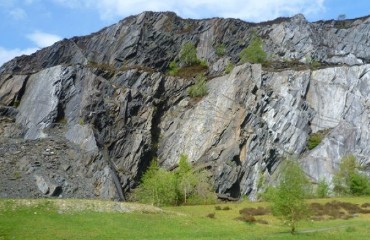
Ballachulish slate quarry - Image Credit: Kim Traynor, CC BY-SA 2.0 Around Ballachulish near Loch Leven, long-established slate quarrying (documented as working from at least the mid-1600s and later becoming a major producer until its closure in 1955) operated within one of Scotland’s most celebrated and studied geological features. Namely, the Ballachulish Igneous Complex and its contact metamorphic aureole. Geologically, the area began as a sequence of sedimentary and volcanic rocks laid down in the Precambrian (Neoproterozoic) era and known as the Dalradian Supergroup. Later, during the closure of the Iapetus Ocean and the accompanying uplift of the Scottish Highlands, these rocks were intruded by upwelling magma. The molten rocks baked the surrounding earlier sediment rocks into an aureole – an area that has been recrystallised and altered by the intense heat from the intrusion, forming new minerals and textures, with the metamorphic intensity decreasing further away from the magma body. In the case of Ballachulish, the intrusion resulted in the formation of high-grade metamorphic rocks (hornfels) containing cordierite, K-feldspars and various garnet- and mica-rich species. Notable specimens from Ballachulish therefore tend to be metamorphic and petrological – garnetiferous rocks, mica-rich hornfels and related contact rocks, as well as historically important slate material tied to Scotland’s industrial story. Among specific specimens from the quarry and other local exposures of the aureole are baddeleyite, corundum, diopside, edenite, forsterite, geikielite, kinoshitalite, periclase, phlogopite, serpentine-group, spinel, tremolite, tschermakite and zircon, all classic examples of contact-metamorphic minerals. |
|
Isle of Mull, Argyll and Bute
Corundum var. Sapphire - Image Credit: The Assay House, Public Domain Mull is the second largest of the Inner Hebrides islands (after Skye and the fourth largest in Scotland), whose rugged, fjord-like coastline is cut by sea lochs and jutting peninsulas. The interior is dominated by Ben More, the remnant of a 60-million-year-old volcano formed during the early stages of the opening up of the Atlantic Ocean. To the east lies the smaller Dùn da Ghaoithe, a prominent hill with complex geology, featuring Tertiary igneous dolerite sills and dykes intruding older Moine schists. To the north of the island lay extensive Paleogene basalt lavas and tuffs, some estimated at 1800 metres thick. The combined volcanic and igneous terrain of Mull has thus created a province full of cavities and fractures ideal for silica deposition. Consequently, zeolites like analcime, mesolite, thomsonite, scolecite, natrolite and various other unusual silicates are common throughout the lavas, showing zonation patterns comparable to Icelandic lava fields. Mull has also developed notable carbonate zones near Tobermory and widespread prehnite, kyanite and epidote in altered lavas and veinlets. Small, intensely blue sapphires have been recorded in the Loch Scridain area. Mull is also known for two type locality minerals, mullite and tobermorite, both named for the location. Overall, however, for many collectors, Mull is arguably best known for agates, with coastal exposures and beach material derived from thick sequences of the basaltic lavas. In mineralogical terms the focus is on specimens found as nodules and fragments, sometimes showing fortification banding, scenic patterning or rich colour depending on the original cavity history and subsequent weathering. The most notable specimens are therefore patterned Mull agates (often best appreciated cut and polished), which remain among the most recognisable Scottish lapidary materials. Although a handful of trials for base metals have been carried out, including zinc, lead and copper, little of value was ever found. The only commercially exploited deposits have been diatomite (a soft, powdery, siliceous sedimentary rock made from the fossilised remains of diatoms, microscopic algae with silica shells, used for filtration) near Loch Bà and lignite on the south coast of Ross of Mull. |
|
Isle of Arran, North Ayrshire
Arran Pitchtone - Image Credit: The Assay House, Public Domain The Isle of Arran in the middle of the Firth of Clyde is famous for its unusually diverse geology, and collector interest commonly centres on distinctive pitchstone (a volcanic glass long recognised from the island) and associated quartz occurrences reported from upland settings. These minerals arise from the northern part of the island, which features a large granite intrusion and many later igneous dykes that form the rugged peaks of Caisteal Abhail, Cir Mhór, Goatfell, and Beinn Tarsuinn. The south of the island is separated by the Highland Boundary Fault, consisting of layered sedimentary rocks and occasional volcanic units that create gentler landscapes and superb coastal scenery. In many respects, many geologists refer to Arran as a mini version of Scotland, with harder ‘Highland’-type rocks and mountains in the north and generally younger ‘Lowland’-type rocks in the south divided by a major fault that resembles the Great Glen further north on the Scottish mainland. The island’s signature specimens are typically Arran pitchstone – an iconic Scottish volcanic glass – and, more rarely, smoky quartz of ‘cairngorm’-type character, greatly prized as a gemstone. Other minerals of igneous origin include epidote, orthoclase, various pyroxenes, topaz and occasional zeolites. |
|
Isle of Rum (Rùm), Caol and Mallaig, Highland
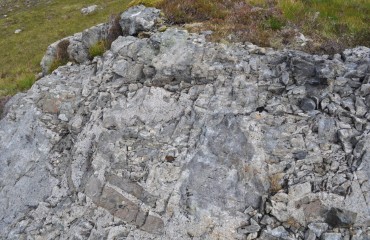
Porphyritic rhyolite plug - Image Credit: Ashley Dace , CC BY-SA 2.0 The Isle of Rum (Rùm) is located in the Inner Hebrides as part of a group called the ‘Small Isles’, a remote, mountainous island best known to geologists for the Rum Igneous Complex – one of the world’s classic examples of a layered mafic–ultramafic intrusion formed during Palaeogene volcanism in northwest Scotland. This is best observed around the dramatic ridges and peaks of Hallival and Askival, where the Eastern Layered Intrusion is exposed at the surface and where repeated magma pulses have created striking, stacked layers made largely of interbedded peridotite and troctolite (often described in Rum literature as ‘allivalite’), producing textbook ‘rhythmic’ layering and clear evidence for magma chamber processes such as replenishment, crystal accumulation and internal deformation. The complex also includes other overlapping intrusive centres (including a Central Intrusion) that cut and disrupt earlier layered units, adding breccias and a wider range of igneous structures to the story. Mineralogically, the ultramafic layers are dominated by Mg-rich olivine with chrome spinel/chromite, while the mafic feldspathoid layers bring in plagioclase and related silicates. Rather than a traditional ore-mining island, Rum is prized for petrological specimens, especially olivine-rich peridotites, distinctive textured ultramafics, and chromite/chrome-spinel-bearing layers that make superb teaching and reference material for collectors who like localities with both classic and complex geological formations. |
|
Cairngorms (Grampian Highlands)
Cairngorm Smoky Quartz - Image Credit: The Assay House, Public Domain The Cairngorms sit in the central-eastern Scottish Highlands, forming Britain’s largest area of high mountain ground and the core of the Cairngorms National Park, with a distinctive high plateau cut by deep glens and corries. Their mineral fame is inseparable from the region’s rocks. Much of the massif is built around the Cairngorm granite intrusion, one of the ‘newer granites’ emplaced late in the Caledonian mountain-building history and surrounded by older Dalradian metamorphic rocks that were folded and altered during the same events. This granite-and-metamorphic setting, combined with later faulting and hydrothermal fluid movement, created pockets and veins where well-formed crystals could grow and survive later glacial conditions. Mineralogically, the Cairngorms are best known for the smoky quartz variety traditionally called ‘cairngorm quartz’. Its colour was possibly created by radiation-related defects (and sometimes heat history), a process particularly associated with quartz around the margins and upper parts of granite. Classic collecting areas include the wider Loch Avon (Loch A'an) district, long celebrated for especially gemmy smoky quartz crystals. Alongside quartz, the region has produced notable topaz and beryl, giving Scottish collections their highlight minerals, and Victorian-era crystal hunting became famous enough to be described as a local pastime and ‘cottage industry’. The most sought-after specimens, however, remain the clean, lustrous smoky quartz crystals, with rarer topaz and beryl providing the ‘special occasion’ finds that keep Cairngorm mineral hunting alive. A particularly good example of the fine minerals occurring in the Cairngorms can be viewed in the Farquharson of Invercauld Mineral Collection display at Braemar Castle. |
|
Dunure and Lunan Bays, South Ayrshire & Angus
Ayrshire Agate - Image Credit: The Assay House, Public Domain Dunure (Ayrshire) on the west coast and Lunan Bay (Angus) on the east are two of Scotland’s classic ‘beach mineral’ destinations, favoured by lapidary-minded collectors because wave action naturally concentrates polished, hard, dense, silica-rich pebbles without any mining or digging required. At Dunure, the shingle beach below the village lies along a rugged volcanic coastline where Devonian andesitic and basaltic lavas of the Carrick Volcanic Formation are exposed. This volcanic belt runs for roughly 8 km from the Heads of Ayr in the north to Croy Bay in the south. The lavas occur as hundreds of successive flows, ranging from only a few centimetres thick to more than 30 metres. When the flows formed, they contained gas bubbles, fractures and small cavities. Later, silica-bearing hydrothermal fluids circulated through the rocks and deposited silica in those spaces, creating the raw material for agate and jasper. Dunure has been a centre for collecting these minerals since at least the early nineteenth century, and Victorian writers often mentioned the colourful stones found there. Agates and jaspers from Dunure were widely used in Scottish pebble jewellery, and by the 1970s the area’s easy access made it a popular destination for collectors and lapidary club trips. Lunan Bay, an east-facing sweep of sand dunes and low cliffs near Montrose, offers a similar collecting experience, and local reports note that the sands yield plentiful agates and gemstones, especially after rough weather. Geologically, these are linked to Early Devonian volcanic rocks in the wider Angus coastal strip – ideal source terrain for durable pebbles that survive transport and rounding. In mineralogical terms, both beaches are about silica varieties. Agate and jasper are quartz-rich materials that form in cavities or veins within rocks and later weather out, becoming rounded into beach pebbles by wave action, with banding, fortification patterns and rich reds, browns and greys. The best finds are often kept as natural water-worn specimens or cut and polished to reveal their internal patterns and striking colours. |
|
Unst, Shetland Isles
Chromite - Image Credit: The Assay House, Public Domain Unst lies at the far north of the Shetland Islands, a rugged, treeless landscape of low hills, peat and dramatic cliffs, and it is one of the best places in Britain to see pieces of ancient ocean floor exposed on land. The eastern side of the island is dominated by the Shetland (Unst–Fetlar) Ophiolite Complex, formed when oceanic crust and upper mantle were obducted (pushed up and over) during Caledonian mountain building, rather than being pulled back into the mantle as normally happens. On Unst, the ophiolite sequence is especially famous for its ultramafic mantle rocks, including harzburgite containing dunite lenses, and it is within these dunite bodies that podiform chromitite (chromite-rich seams and pods) commonly occurs. Some parts of the full ‘oceanic crust’ sequence are missing on Unst, likely removed by later erosion. This geology underpins Unst’s mineral story. Chromite (the ore of chromium) was worked most notably in the Baltasound–Hagdale area, where the Hagdale quarry became the largest chromite working in 19th-century Britain. Later, activity shifted toward serpentinite (including quarrying close to the chromite workings) for industrial uses, and although parts of the quarry are now infilled, the remaining dumps can still yield representative material. For collectors, the key specimens are massive to banded chromite/chromitite in dunite or serpentinite host, plus attractive serpentinite and lizardite pieces that neatly capture Unst’s status as a rare, accessible fragment of Britain’s obducted oceanic mantle. Other rare, interesting minerals from Unst include dozyite, dypingite, honessite, maucherite, nakauriite, and approximately 50 other minerals, the majority associated with the alteration of ancient oceanic crust. There are also some minerals containing the highly unusual elements iridium, rhodium, platinum, palladium, ruthenium and osmium, in minerals that include irarsite, genkinite, geversite and laurite, which are reported as occurring at Cliff Quarry, located above the inland lake of Loch of Cliff. |








Scotland is remarkably rich mineralogically for such a small country thanks to its complex geological history and the fact that it packs so many geological settings into such a tight area. The mix of ancient crust, metamorphic belts, granite intrusions, pegmatites and volcanic activity has led to an unusually wide palette of collectible minerals, ranging from metallic ores of the Southern Uplands to contact-metamorphic minerals in the Highlands, pegmatite and granite-related species, and striking zeolites and agates in volcanic rocks. Even so, commercial success was rare, as the occurrences were more important geologically and scientifically than economically valuable. The best-known exceptions were the historic lead districts of Leadhills–Wanlockhead and Strontian, but even then, these were too small or irregular to work for long. Nevertheless, along with the other Scottish mineral locations, although limited in size, these mines were hugely significant mineralogically, yielding rare secondary minerals and key 'firsts', including strontianite, which led to the recognition of the element strontium. Added together, these factors make Scotland an outsized contributor to mineral collecting, geology and mineralogy.
If you are interested in adding specimens from Scotland to your collection, click HERE

