
England’s mineralogy is unusually concentrated. Within a few hours’ drive, it is easy to pass from the granite-driven tin-copper systems of Cornwall to the classic lead-fluorite vein districts of the Pennines and Peaks and then onto the complex skarn-and-vein mineralisation of the Lake District. The reason why England delivers such variety arises from its concentrated patchwork of geological domains assembled over hundreds of millions of years as oceans opened and closed, continents shifted, mountains rose and wore away, and landscapes were repeatedly buried and re-exposed.
At the deepest level are ancient foundations – Precambrian basement rocks and early sediments, most influential in the north and west – hardened and transformed during very old tectonic episodes into a tough core that now lies partially concealed beneath younger cover. Over this, long periods of Palaeozoic seas (Cambrian to Devonian) laid down thick successions of mudstones, sandstones and limestones in ocean basins. Compression later uplifted, folded and faulted these rocks, creating the fractures and fluid pathways that would become critical to mineral formation.
For collectors, the Carboniferous is especially important because so much ‘classic’ English mineral ground sits on Carboniferous strata. Warm shallow tropical seas deposited thick limestones – ideal hosts for later veins – while nearby deltas and swampy lowlands produced sandstones, shales and coal measures. Later still, Permian–Triassic arid basins spread red sandstones and evaporitic sequences across parts of central and eastern England, forming cover rocks and adding to the broader structural story. Much of southern and eastern England was then blanketed by younger Jurassic–Cretaceous marine sediments, including clays, limestones and chalk, with Ice Age tills, sands and gravels draped over large areas and often controlling what bedrock is visible today.
This extended build-up matters because hydrothermal ore-bearing fluids need faults, joints and fractures to deposit their mineral content, and England has plenty of these. The host rocks then dictate what those fluids do – limestones encourage open spaces, replacement textures and certain mineral suites, while harder igneous and metamorphic rocks focus mineralisation into veins and lodes. In practice, England’s best-known mineral localities cluster into two broad settings. The first is the granite-related mineralisation in the South-West (the Cornubian Orefield), where hot, metal-rich fluids produced tin–copper–arsenic lodes and spectacular secondary minerals in oxidation zones. The second are the carbonate-hosted vein systems in the Pennines, Peak District and Mendips, where fluids exploited faults in Carboniferous limestones to form classic fluorite–barite–calcite–galena–sphalerite assemblages and their oxidation products.
Taking the country’s long and diverse geology coupled with the many different types of rock and mineralisation processes means that England has produced minerals from world-famous cabinet specimens to highly prized, ultra-rare micromount ‘bucket-list’ species.
For a Map of Mineral Locations in England click HERE
|
St Day / Gwennap, Redruth, Cornwall
Liroconite - Image Credit: Marie-Lan Taÿ Pamart, CC BY 4.0 The St Day–Gwennap district sits at the heart of Cornwall’s historic copper boom and remains one of England’s most celebrated sources of oxidation-zone rarities. Mining here surged in the 18th and early 19th centuries as rich copper lodes were worked on an increasingly industrial scale, with engine houses and deep shafts transforming what had been small, scattered workings into a globally significant mining landscape. As copper grades fluctuated and costs rose, parts of the district shifted emphasis through time toward mixed ores and, in places, arsenic-rich zones that later became famous among mineral collectors. Geologically, St Day and Gwennap lie within the wider Cornubian mineral province, where granite-driven hydrothermal fluids exploited a dense network of fractures and lodes in the surrounding ‘killas’ (metamorphosed sedimentary rocks) and related structures. The primary mineralisation was dominated by copper sulfides and associated tin–arsenic minerals, but it is the near-surface alteration that made the district legendary. In the oxidation zones, surface waters reacted with copper- and arsenic-bearing ores to produce an extraordinary suite of secondary minerals, often forming vivid, sharply crystallised species in vugs and along gossanous lode material. Collectors prize the area for classic ‘museum’ copper arsenates and phosphates, with localities such as Wheal Gorland becoming synonymous with world-class micromounts and miniatures. Minerals recorded from the district include showy blue and green species such as liroconite (a celebrated type-locality mineral), olivenite, clinoclase, chalcophyllite, cornwallite, scorodite, and pharmacosiderite, alongside more common companions like malachite, azurite, cuprite, and iron oxides/hydroxides in the vein matrix. The result is a compact district whose geology and mining history combine to produce some of the most collectible secondary copper minerals in Britain. |
|
St Just, Penzance, Cornwall
Cassiterite - Image Credit: Robert M. Lavinsky, CC-BY-SA-3.0 The St Just Mining District, on Cornwall’s far western granite uplands and Atlantic coast, is another of Britain’s most iconic and probably the country’s oldest mining landscape. Here, tin streaming was taking place 4,000 years ago during the Bronze Age, subsequently following the metal underground. Evidence for this early activity includes the Trenear Stone, a flat rock with mortar holes at the Poldark Mine Museum, which was used to pulverise tin ore thousands of years ago, demonstrating early processing technology. Many historians assert that tin served as the primary catalyst for the Roman invasion of Britain. Although uncertain, it is widely believed that the name ‘Cassiterides’, meaning the ‘places of tin’, referred to the British Isles since at least the 5th century BC, which might have spurred the Romans on. Mining declined in the Middle Ages, but the district’s defining era came from the 18th century onwards, when increasingly deep and engineered mines worked tin and copper lodes on an industrial scale. Coastal giants such as Botallack and Levant mines became internationally famous for driving shafts and stopes beneath the seabed, while dozens of inland mines across the moorland fed a regional economy built on hard-rock mining, dressing floors, and export. However, by the late 19th and early 20th centuries, fluctuating metal prices, flooding, and rising costs led to closures and reworkings. Nevertheless, the district’s legacy remains visible in engine houses, ruined arsenic works, and a complex web of named lodes that still appear on old labels. Geologically, St Just lies within the same Cornubian Orefield as St Day/Gwennap, just further to the west, where mineralising fluids related to the Cornubian granites exploited fractures in granite and surrounding 'killas' (metamorphosed sedimentary rocks). The principal ore bodies are steeply dipping lodes and cross-courses, with classic Sn–Cu–As associations. The primary minerals include cassiterite, chalcopyrite, arsenopyrite, pyrite, and locally sphalerite and galena, commonly with quartz and tourmaline gangue. Near the surface, subsequent oxidation and weathering produced a rich suite of secondary species, including malachite, azurite, cuprite, chrysocolla, and locally arsenates such as olivenite and scorodite, alongside iron oxides in gossans. For collectors, St Just is prized not only for individual species but also for the way its mine names, lode systems, and coastal setting encapsulate ‘classic Cornwall’ – dramatic geology, serious mining history, and a mineral list broad enough to reward both cabinet-specimen collectors and micromounters. |
|
South Terras Mine, St Stephen-in-Brannel, Cornwall
Torbernite - Image Credit: The Assay House, Public Domain Although Cornwall is much better known for copper, tin, arsenic and lesser amounts of zinc and iron, there is also a notable uranium mineralisation at Wheal Edward and West Wheal Owles mines on the coast west of Botallack and also at South Terras Mine near St Stephen-in-Brannel at the centre of the county. The Botallack occurrence was only regarded as incidental to tin mining, and consequently little attention was paid to it by the miners, and most finds were simply dumped. The ore consisted of uraninite with its associated vivid green and yellow secondary uranium oxidation products like zeunerite, zippeite, autunite, torbernite and saléeite, which can sometimes be seen on dumps throughout the area, although permission must be sought for collecting. Historic specimens are highly prized, but the deposit was of little importance except for its geological and mineralogical interest. The South Terras occurrence, however, became one of two British examples of a mine that actively produced uranium (and later radium) as a principal commodity. The mine itself began in the 1870s as a small venture raising ochre and iron ore (with minor tin). Pretty soon a layer of bright green torbernite was discovered, which the miners called ‘Green Jim’. Pitchblende was found at greater depth and in later years became the backbone of the mine until closure in 1930. South Terras was unique in that the lode was almost 500 metres long and was the only such concentrated deposit in Cornwall. In the early 20th century, the focus shifted to radium recovery, notably for Marie Curie's research. Another notable site was Wheal Trenwith near St Ives, which also supplied pitchblende for radium extraction in the early 20th century, making these key locations for early British radioactive history. Specimens from South Terras include torbernite, related altered uranium phases (metatorbernite/metazeunerite), and primary uranium oxide ores along with quartz–sulfide vein material. |
|
Weardale, County Durham
Fluorite and Galena - Image Credit: Géry Parent, CC BY-ND 2.0 Weardale sits in the heart of the North Pennine Orefield, a classic British vein province where mineralising fluids exploited faults and fractures through carboniferous rocks, especially limestone. The area is closely linked to the underlying Weardale Granite (part of the North Pennine batholith), which provided heat to drive hot hydrothermal circulation during late Palaeozoic tectonism associated with the Variscan mountain-building episode. Because Weardale lay near the thermal centre of this system, the fluids here were comparatively hot, and the dominant deposit suite became galena (lead ore) with abundant fluorite, as well as calcite and quartz. Farther from the granite centre, cooler conditions produced a noticeably different assemblage, with sphalerite (zinc ore) becoming more significant and barite increasingly common. Later weathering of these primary ores created classic oxidation minerals. In Weardale itself, the lead-rich zones commonly yielded cerussite, anglesite and mimetite, while the zinc-rich ground outside the core more often produced smithsonite and hydrozincite. Mining in Weardale and the surrounding Pennines is recorded over many centuries, with large-scale development accelerating in the 18th and 19th centuries, when lead was the main objective. By the late 19th century, however, the district became increasingly important for fluorspar (industrial fluorite), with lead increasingly treated as a by-product. Commercial fluorspar working continued into the modern era but ended in the 1980s as demand fell alongside changes in the steel-making industry. A distinctive local feature is the presence of mineralised, near-horizontal bodies sandwiched between sedimentary beds, known to miners as 'flats'. For collectors, Weardale is famous for specimens from these cavities, especially fluorite, in colours ranging from colourless and yellow to green and purple, typically as sharp cubic crystals (often twinned or zoned) on matrix. The fluorite is commonly associated with cubic galena and white calcite or quartz and is often fluorescent under UV light – showing a deep-blue colour even in daylight, linked to trace elements. The district’s modern reputation was boosted by the modern Rogerley mine, operated specifically for specimen recovery and celebrated for its intensely green fluorite. Among the historic and highly sought-after sources are: Boltsburn Mine – Typically rich purple fluorite in sharp cubic crystals, often from cavity “flat” material; many pieces show strong phantoms and multi-colour zoning within the same cube. Frazer’s Hush Mine – Produces both twinned dark-green cubes (commonly with a fine quartz coating) and superb glassy, transparent purple cubes, often with strong fluorescence. Heights Mine / Heights Quarry – Famous for emerald-green, lustrous, often interpenetrant twinned cubes (commonly transparent with pale purple centres/phantoms); pale purple to colourless material is also recorded, and occasional very large/flattened cubes are noted. Cambokeels Mine – Best known for rich purple-zoned fluorite, commonly as interpenetrant twinned cubes on white quartz, sometimes with a later drusy quartz overgrowth; large, classic pieces include big purple cubes with sparkling quartz microcrystals. Groverake Mine – Typically pale green cubic clusters, often with minor quartz; some specimens show green cubes with a purple core and/or preferential quartz coatings on faces. Greenlaws Mine – Renowned for deep purple and amber/purple-zoned fluorite, with yellow considered especially sought-after; forms range from gemmy purple twinned crystals to very large opaque purple cubes from specific flats. West Pasture Mine – Instantly recognisable for pale apple-green to pale wine-yellow fluorite, usually as glassy, gemmy cubes often showing green zoning/phantoms (a colour style regarded as distinctive for this mine). |
|
Nenthead mine, Alston Moor, Alston, Cumbria
Alstonite and Witherite - Image Credit: Robert M. Lavinsky, CC-BY-SA-3.0 Nenthead lies within the same geological province as Weardale, but being further out from the hot central hydrothermal zone, the cooler conditions led to a mineralisation consisting mainly of sphalerite and barite, with only small amounts of lead and fluorite. Nevertheless, lead mining gathered pace here after the discovery of the Rampgill Vein in 1690, and by the mid-18th century the area had become a key holding of the London Lead Company, with lead production peaking in the 1820s before entering a long period of decline. In the late 19th century, the emphasis shifted increasingly toward zinc (from sphalerite-rich ground), and mining is commonly cited as ending around 1920. Geologically, the mineralisation occurs as steep veins and, importantly, 'flats' within Carboniferous limestones (notably the Great Limestone), where ore-bearing fluids exploited bedding and fractures. The principal ore minerals are sphalerite and galena, with gangue and accessory species including barite, calcite, quartz, fluorite and locally abundant witherite (a signature mineral of the Alston Moor area). The underground workings of the mine are well-preserved, and joining guided trips with the Nenthead Mines Conservation Society (NMCS) offers access to historically rich, mineralised areas like Nentsberry Haggs, where baryte, sphalerite, galena, calcite, and fluorite, with recent finds including stunning ruby sphalerite and barytocalcite, can be seen. |
|
Hilton Mine, Scordale, Eden, Cumbria
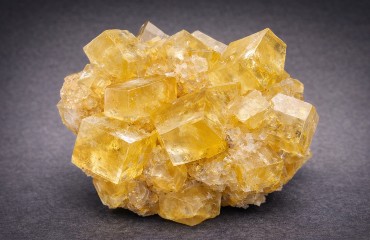
Fluorite - Image Credit: The Assay House, Public Domain The Hilton is a classic North Pennine locality in the general Weardale area, worked chiefly for lead in the 19th century, notably by the London Lead Company (1824–1867), with later phases targeting barium minerals. Geologically, the workings follow ore-bearing veins and 'flats' developed near the top of the Melmerby Scar Limestone, part of the Alston Moor orefield system. For collectors, it is best known for gemmy yellow to amber fluorite, commonly as sharp cubic crystals and penetration twins, often with barite. Associated minerals include galena, calcite, quartz, and locally witherite and zinc-lead oxidation species. |
|
Cumbrian Iron deposits, Egremont, Cumbria
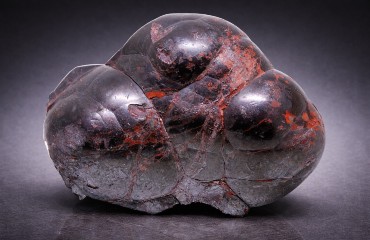
Kidney Ore - Image Credit: The Assay House, Public Domain The Frizington–Cleator Moor–Egremont region in west Cumbria is the heart of the historic West Cumberland hematite ore field, where exceptionally high-grade iron ore fed local furnaces and later the great coastal iron and steel works. Mining is recorded from at least medieval times, expanding rapidly in the 18th–19th centuries, and continuing into the 20th century in large modern operations. The largest producer, the Florence Mine (opened 1914), worked just outside Egremont and ultimately extracted over 100 million tonnes of iron ore before large-scale production wound down in the 1970s. Other mines in the area include Ullcoats and Beckermet mines, which connected with the Florence mine underground. Eventually, Florence Mine was forced to close in 2007 due to the cost of pumping. At the time of its closure, it was the last deep-working iron ore mine in Europe. Geologically, the ores occur mainly as replacement and cavity-fill bodies in Lower Carboniferous limestones, strongly guided by faults, fractures and karstic permeability, thereby creating ideal pathways for iron-rich fluids. The high purity of the deposit meant that the ore was not only smelted for iron but was also in high demand for the manufacture of paints, dyes and cosmetics. Collectors are particularly interested in the area's classic haematite samples, especially the 'kidney ore' or round forms, as well as specularite, which is known for its shiny, mirror-like appearance from tiny flakes or flat crystals Accessory minerals include goethite and limonite, common as weathering products, and barite, calcite and quartz as frequent associates. The region is also particularly notable for transparent crystals of cubic fluorite, which are commonly sky-blue in colour, creating a striking contrast when set against dark red hematite. |
|
Coniston copper mines, Coniston, Cumbria
Coniston Mines - Image Credit: Ian Taylor, CC BY-SA 2.0 The copper deposits around Coniston (Coppermines Valley, Tilberthwaite and the high fells above the town) form one of the Lake District’s classic metal-mining districts. Working is recorded from the Elizabethan period, when the Company of Mines Royal began driving levels on the Coniston copper veins around 1590, leaving distinctive narrow ‘coffin levels’ in some early workings. Archaeological and documentary evidence also points to repeated phases of mining, ore dressing and processing here through the 17th–19th centuries, as ownership and technology changed. Geologically, the ores occur mainly as copper-bearing veins within Lower Palaeozoic rocks, especially the Borrowdale Volcanic Group, with vein structures guided by faulting and fracturing across the district. Mineralogically the mines are noted for primary copper sulfides such as chalcopyrite and bornite, commonly with arsenopyrite and chlorite, as well as local barite on dumps. Close to the surface, the process of oxidation has created well-known collector minerals like cuprite and secondary copper carbonates such as malachite and azurite, along with vein quartz. |
|
Caldbeck Fells, Caldbeck, Cumbria
Hemimorphite - Image Credit: Robert M. Lavinsky, CC-BY-SA-3.0 The Caldbeck Fells are a small upland district with an outsized reputation for many collectors as the leading English locality for rare species and superb micromount specimens. Mining here was never dominated by one operation but instead evolved as a patchwork of small workings, hushes and trials spread across valleys, gills and fells, with repeated phases of activity from the 17th to 19th centuries as lead and copper were sought wherever veins could be profitably followed. Names such as Red Gill, Roughton Gill, Driggith, Potts Gill and Mexico appear repeatedly on historic labels, reflecting how locality precision is part of the district’s collecting culture. Geologically, Caldbeck’s mineralisation is closely tied to the Lake District’s Lower Palaeozoic rocks and the influence of intrusive bodies. Veins and related replacement zones cut through slates and volcanics and in places develop skarn-like assemblages where hot fluids interacted with reactive host rocks. This produced a highly varied assortment of mineral environments – primary sulfides in quartz veins, oxidised gossans, and secondary-rich pockets that can yield exceptional micro-crystals. The mineral list is famously broad. Classic ore and gangue minerals include galena, sphalerite, chalcopyrite, pyrite, quartz, calcite and baryte. What makes Caldbeck special, however, is the secondary suite consisting of beautifully crystallised lead species such as pyromorphite and mimetite, plus oxidation minerals including cerussite and anglesite, and a long tail of approximately 150 rarities, including the type location mineral redgillite, that reward locality-specific collectors. Unfortunately, due to the overzealous efforts of some field collectors, further collecting here has been severely restricted. |
|
Carrock Mine, Mungrisdale, Eden, Cumbria
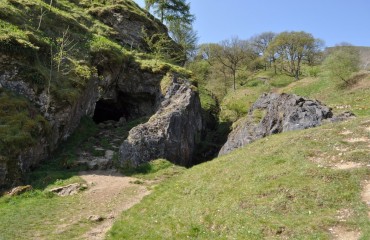
Carrock Mine Entrance - Image Credit: Adrian Taylor , CC BY-SA 2.0 The Carrock Mine is also located within the wider region of the Caldbeck Fells but deserves special attention as England’s only other tungsten occurrence outside Cornwall. Originally prospected as a lead deposit, the mining of tungsten began as soon as ores of this metal were discovered in the mid-1850s. However, work was only carried out intermittently when prices or strategic demand justified it, for instance, during the two World Wars. The most recent phase ended in 1981, and afterwards the site was landscaped by 1988. Geologically, the deposit consists of east-west lead veins that are intersected periodically by north-south tungsten-bearing veins linked to the Skiddaw/Grainsgill granite system. The main tungsten ores are scheelite and wolframite, accompanied by arsenopyrite, pyrrhotite and pyrite in quartz–muscovite–apatite veins. Where the two sets of veins intersect, the interaction between the two mineralisations has resulted in the formation of many interesting supergene minerals, including stolzite and respite, as well as a number of minerals also containing bismuth, including cosalite, ingodite, hedleyite, joséite, krupkaite and even native bismuth itself. |
|
The Peak District, Derbyshire
Odin Mine - Image Credit: Ashley Dace, CC BY-SA 2.1 Derbyshire’s Peak District represents one of Britain’s longest mining histories. Lead has been worked here since at least Roman times, and by the medieval period the area had become a major European producer, regulated under the distinctive Barmote Court mining laws that granted rights to claim and work ore veins. The mineral wealth comes from the White Peak limestones – thick Carboniferous beds laid down in a warm tropical sea. Later, mineral-rich hydrothermal fluids rose through fractures and fissures, locally called rakes, depositing galena (the main lead ore) with common associates such as fluorite, baryte, calcite and quartz, and locally sphalerite and chalcopyrite. Most extraction was from shallow workings, quarries and surface rakes rather than deep mines. When the lead declined, attention increasingly moved toward fluorspar (fluorite) and baryte. Derbyshire fluorite has its own character distinct from other British locations, including Weardale. Crystals are often modest in size, commonly pale, colourless or yellow, with occasional blue-purple or pink-violet tones and edge-concentrated colour zoning. Collectors also value Derbyshire’s oxidised lead-zone minerals, including pyromorphite, cerussite, anglesite, smithsonite and witherite, and local curiosities such as stalactitic ‘oakstone’ baryte. The landscape still preserves iconic sites and ruins, notably the Odin and Magpie Mines, as well as the famous Dirtlow Rake, reminders of a once-booming industry that declined in the late 19th century. |
|
Castleton, Derbyshire
Carved Blue John Bowl - Image Credit: Pasicles, CC0 1.0 Castleton, in the heart of Derbyshire’s Peak District, is famous for Blue John, a banded variety of fluorite found almost exclusively in the local limestone hills. Mining here has a long story. The area was worked for lead since at least mediaeval times (and likely earlier), while Blue John was extracted more selectively from the 18th century onwards for ornamental stone and turned into vases, bowls, and jewellery. Four occurrences were actively mined: Peak Cavern, Treak Cliff Cavern, Speedwell Cavern and the Blue John Cavern. The last location is still open for occasional extraction and allows visitors to visit the underground workings. Specimens and carved pieces are usually available for sale from the gift shop. Geologically, the deposits occur in hydrothermal veins and cavity systems cutting thick Carboniferous limestones, locally influenced by nearby volcanic ‘toadstone’ layers that helped channel fluids. The key mineral is fluorite – often banded purple-blue, cream and honey-yellow as Blue John – commonly associated with calcite, baryte and quartz, with galena and sphalerite as classic companions. The origin of the name is uncertain, but the most likely source comes from the French ‘bleu et jaune’, meaning blue and yellow, used to describe the stone’s typical colour banding. The precise cause of the banding is uncertain, but it is most commonly thought to be the result of organic oil inclusions. |
|
The Mendip Hills, Somerset
Mangano-Calcite - Image Credit: The Assay House, Public Domain The Mendip Hills of Somerset form one of England’s smaller lead districts. Even so, it has been worked since antiquity and is strongly associated with Roman mining, with later medieval and post-medieval phases centred on places like Charterhouse near Priddy. Mining expanded and contracted with demand and technology, leaving a landscape of hushes, pits, dumps and smelting remains that still mark the main ore grounds. Since the deposits were shallow, apart from a few trials, there were no deep mines. Geologically, the Mendip mineralisation lies within faults and fractures cutting Carboniferous limestones, where mineralising fluids deposited vein and cavity-fill ores. Galena was the principal ore, with gangue minerals, including calcite, baryte, and quartz. Significantly, in modern times, the Mendips have also become renowned for their manganese occurrences. Two locations are particularly notable for this – the Higher Pitts Mine and the Torr Works Quarry, better known to mineral collectors as Merehead Quarry. Higher Pits was an ancient, possibly Bronze Age, lead mine where manganese was discovered in the 1880s. This metal was extracted for a short time before ending in 1893. Nevertheless, considerable dumps were left behind, where many minerals, like goethite, hematite, calcite and malachite, could be found, as well as those of manganese, including manganocalcite, rhodochrosite, manganite, and pyrolusite. The mine is also the type locality for the minerals mendipite, chloroxiphite, and diaboleite, and it has also produced some of the largest known crystals of hydrocerussite and crednerite. Recently, plattnerite and kentrolite have also been identified in old specimens. The Torr Works Quarry is a still-working limestone quarry halfway between Shepton Mallet and Frome. Besides producing aggregates, it is mineralogically renowned for several reasons. First, it is another of Somerset's manganese occurrences, including coronadite, manganocalcite, crednerite, kentrolite, manganite, pyrolusite and rhodochrosite. Second, it is particularly diverse, having nearly 60 other mineral species. And finally, most importantly, it is a source of numerous very rare lead oxide and oxychloride minerals, which are often found as yellow to white, powdery, or platy crystals in or near the manganese-rich pods. Among these are eight type locality species first discovered here, which are mereheadite, parkinsonite, plumbonacrite, rickturnerite, rumseyite, somersetite, symesite and yeomanite. Although this is a working quarry, collecting is occasionally allowed for organised groups such as mineral clubs and societies. A final mention must go to the Dulcote Quarry near Wells. While mineralogically unremarkable, this limestone quarry and its surrounding fields are famous for a type of agate known as ‘potato stones’. While the outer shell does indeed resemble a potato, once cut, these geodes internally display an almost endless variety of white and red circles and bands that make each one of these specimens unique. |
|
Snailbeach, Worthen with Shelve, Shropshire
The Remains of the Crusher House - Image Credit: Espresso Addict, CC BY-SA 2.0 Snailbeach, on the western flank of the Shropshire Hills, is one of England’s lesser-known lead districts. However, lead was worked here from at least the medieval period, and the industry reached its peak in the 18th and 19th centuries, when the mine grew into a major enterprise with deepened shafts, extensive dressing floors, and large spoil heaps. By the late 19th century, falling prices and rising costs led to decline, though parts of the field were later reworked for baryte. Geologically, the mineralisation is hosted within Lower Palaeozoic rocks (notably shales and quartzites) and focused along veins and fractures related to regional faulting around the Stiperstones Ridge. The main mineral mined here was galena, which is usually found with sphalerite and chalcopyrite, while the waste material mostly consists of quartz and sometimes baryte and calcite. The oxidised zones and dumped material can still yield specimens such as cerussite, occasional erythrite, witherite, and hydrozincite, along with iron oxides and gossanous vein material. |
|
Boulby Mine, Loftus, Redcar and Cleveland, North Yorkshire
Boracite - Image Credit: Robert M. Lavinsky, CC-BY-SA-3.0 The Boulby Mine is Britain’s major evaporite mine, developed for potash, with commercial production beginning in the early 1970s and later expanding into rock salt and polyhalite (Polysulphate). Being one of the deepest mines in Britain at 1400 metres, it also plays host to the Boulby Underground Laboratory, where science experiments can be carried out almost without interference from natural background radiation. Geologically, the deposit beds lie within the Permian Zechstein Supergroup, a cyclic carbonate-evaporite succession formed as an ancient sea repeatedly evaporated, leaving thick layers of halite and potash salts. Typical commercial minerals include halite, potash salts (commonly sylvite), anhydrite and polyhalite. The locality is also noted for a suite of rarer evaporite-associated species such as blue boracite, ericaite, carnallite, congolite, magnesite, trembathite, volkovskite and hilgardite. |
|
Hope’s Nose, Torquay, Devon
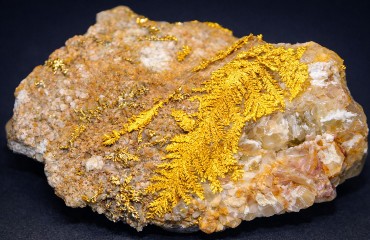
Native Gold on Calcite - Image Credit: James St. John, CC BY-SA 2.0 Hope's Nose is a rocky coastal headland about 3 km east of Torquay, separating Tor Bay from Babbacombe Bay. It hosts one of Britain’s rare gold occurrences, first discovered here in 1922 in a calcite-bearing vein but not confirmed until 1927. Following disappointing trials, the site never became a viable mine but remains a mineralogical curiosity, especially because, apart from containing gold, the calcite veins cutting through local Devonian limestones also carry a unique to Britain gold-palladium-selenide association. Significantly, only a few of the veins in the wider area contain these minerals, in each case within a few yards of the base of the low cliff. Even then, they are difficult to see because the foreshore is usually covered with algae, stones, and other seaborne debris. On rare occasions, erosion of the surrounding rock during stormy sea conditions exposes some of the calcite veins, which may reveal some gold. Generally, such specimens typically appear as delicate, frond-like crystalline masses, usually within the calcite matrix and rare selenides. One of these is chrisstanleyite, for which Hope’s nose is the type location. Others include clausthalite, fischesserite, penroseite, tiemannite and about 10 others. However, most appear as undifferentiated microscopic grains, and identification is mostly impossible without specialist equipment. Since the site has been given Site of Special Scientific Interest status, it is protected, and all collecting is forbidden. All gold specimens in circulation therefore come from old collections. |
|
Coldstones Quarry, Greenhow, Harrogate, North Yorkshire
Smithsobite on Fluorite - Image Credit: The Assay House, Public Domain Coldstones Quarry on Greenhow Hill is primarily a working limestone quarry, but it also cuts through the district’s historic lead–fluorspar veins, periodically exposing former mine levels from earlier lead working. Geologically, the mineralisation occurs as veins within Carboniferous limestones of the Greenhow area, part of a long-worked Pennine-style vein province. For collectors, the mine is noted for galena and fluorite (with calcite/barite) and a surprisingly rich secondary suite where veins are oxidised. Minerals recorded include anglesite, cinnabar, doyleite, rosasite, pyromorphite and cerussite, as well as smithsonite and hemimorphite (both as pale-yellow coatings or small crystals on vein material, especially on fluorite). |
|
Lizard, Landewednack, Cornwall
Serpentinite ('Lizardite') - Image Credit: The Assay House, Public Domain The Lizard Peninsula is geologically unique in Britain, featuring the Lizard Complex ophiolite – a slice of former oceanic crust and upper mantle thrust on top of continental rocks. The core rock types of this exposure are serpentinite derived from ultramafic mantle rocks, together with dark gabbros and banded metamorphic rocks such as amphibolite. Their striking dark green and red-brown colours can be seen all around the coast, especially at the tip of the peninsula and at Kynance Cove, another easily accessible site. Mining activity has been taking place here for hundreds of years, where the colourful rock known interchangeably as Lizard Serpentinite, Cornish Serpentine or Lizardite has been extracted in quantity as an attractive ornamental stone. The peninsula’s best-known industrial relic is the Poltesco Serpentine Works on the east coast, built around cutting and polishing this material for decorative wares. Mineralogically, the district is defined by serpentine-group minerals (often with talc and amphiboles such as tremolite/actinolite in altered zones), plus accessory oxides such as magnetite and chromite in ultrabasic rocks. The Lizard area is also the type locality for the complex phyllosilicate saponite, which commonly occurs as brown, greasy nodules, from which the mineral gets its name, alluding to its greasy or soapy feel and appearance. |








England’s dense patchwork of rock types in a small area, together with a mix of early scientific interest, the industrial mining boom that made specimens widely available, and a strong network of local societies, museums, and Victorian curiosity cabinets, made the country one of the earliest to take up mineral collecting. Cornwall became a standout destination because it offered so many attractively coloured copper secondary minerals but not forgetting the Northern Pennines for their remarkable fluorites, the Caldbeck Fells for their rare species and micromounts, and a multitude of other locations. Today the passion hasn’t faded. Even though many classic mines are long closed, their specimens, labels, and stories still circulate through collections, museums, and the collector community – turning England’s mining past into a living mineral heritage that continues to inspire and educate new generations.
If you are interested in adding specimens from England to your collection, click HERE

