
Pakistan is one of the world’s most exciting and geologically diverse sources of mineral specimens on Earth, shaped by its position at the collision zone between the Indian and Eurasian tectonic plates. This immense geological force created the towering ranges of the Himalaya, Karakoram and Hindu Kush, and with them a remarkable variety of mineral-forming environments. From the granitic pegmatites of Gilgit-Baltistan to the marble-hosted ruby deposits of Kashmir and the ophiolite complexes of Baluchistan, Pakistan offers an exceptional range of mineralogical settings.
Mining and mineral extraction in Pakistan have a long and varied history. Emeralds from the Swat Valley are believed to have been worked for over two thousand years, while the wildly remote northern areas remained largely unexplored until the late twentieth century. Since the 1970s and 1980s, increased access and local expertise have led to the discovery of world-class specimen deposits, particularly in the pegmatite fields around Skardu and Shigar. Much of the mining remains small-scale and artisanal, with local miners extracting specimens from high-altitude pockets using traditional methods. This approach, while challenging, has helped preserve the integrity and aesthetic quality of many specimens.
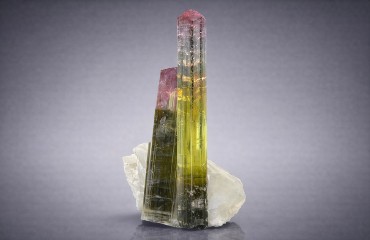
Pakistan is especially renowned for its superb aquamarine, topaz, tourmaline and fluorite from granitic pegmatites, as well as emeralds from Swat, ruby and spinel from marble-hosted deposits, and rarer species such as brucite, brookite and titanite. Many specimens are highly aesthetic, often combining sharp crystal form with contrasting matrix, making them particularly desirable to collectors.
For mineral collectors, Pakistan represents a unique combination of beauty, geological significance and relatively recent discovery. Many localities are still producing new finds, while others are already considered classic sources. As a result, specimens from Pakistan often carry both scientific interest and a sense of ongoing exploration, making them an essential component of any serious mineral collection.
For a Map of Mineral Locations in Pakistan click HERE
Note on Collecting Mineral Specimens from Pakistan
Historically, mineral collecting in Pakistan was driven largely by the extraction of gem material rather than the preservation of fine specimens. Local miners working in highly remote, high-altitude environments often transported their finds in sacks on the backs of pack animals, with little emphasis on protecting delicate crystal forms or matrix pieces. As a result, many early specimens were damaged during extraction and transport, arriving on the market in less-than-ideal condition. In recent years, however, the growth of the internet and global mineral markets has significantly changed this approach. Miners and local dealers are now far more aware of the premium prices that well-preserved, aesthetic specimens can achieve, leading to greater care in both recovery and handling.
Despite this improvement, challenges remain - particularly in the accurate labelling of specimens. Individual workings and pockets are rarely formally documented, and material is often sold under broad regional names such as “Skardu” or “Gilgit-Baltistan” without precise locality data. In some cases, traders purchasing from miners may not know the exact source, while in others, labels are simplified, confused, or even deliberately altered to protect productive sites or enhance saleability. Consequently, collectors should approach Pakistani specimens with a degree of caution, recognising that locality information may be imprecise and, occasionally, that mineral identifications themselves may require verification.
|
Stak Nala (Astak Nala Valley), Haramosh Mountains, Roundu District Gilgit-Baltistan
Elbaite - Image Credit: Robert M. Lavinsky, CC BY-SA 3.0 Stak Nala in the Nanga Parbat–Haramosh Massif, located in northern Pakistan at the western end of the Himalayas, is one of the most geologically dynamic regions on Earth. It sits where the Himalayan mountain range curves sharply towards the separate mountain range of the Hindu Kush and has been created by the collision between the Indian and Eurasian tectonic plates. This collision continues today, driving rapid uplift at rates of around 1 cm per year, among the fastest recorded globally. The region is characterised by extreme relief and erosion, with the massif rising dramatically above the deep Astak Nala River valley, a tributary of the Indus River to the south. Geologically, the rock fabric here consists mainly of high-grade gneiss and schist intruded by granitic bodies, together with exposures of exceptionally young metamorphic rocks - some less than one million years old - making them among the youngest on Earth. This intense tectonic and thermal activity has created ideal conditions for the formation of complex pegmatites, particularly miarolitic (cavity-bearing) granitic pegmatites formed by upwelling magmas. As a result, Stak Nala is one of Pakistan’s classic pegmatite provinces and a renowned source of fine mineral specimens. Among these are several varieties of tourmaline, along with beryl var. aquamarine, topaz, fluorapatite, fluorite, microcline, muscovite, pollucite, various micas, zircon and smoky quartz. Stak Nala is also the type locality for the rare tin-niobium tungstate, billwiseite. Overall, however, the region is most famous for its green to multi-coloured elbaite tourmaline and elegant pegmatite combinations on feldspar or mica matrix. Mining has been small-scale and selective, focused on pockets in high-altitude pegmatites rather than large industrial workings. Its importance comes from both quality and consistency. For many collectors, Stak Nala is the archetypal Pakistani pegmatite locality. |
|
Shigar Valley – Skardu mineral district, Skardu, Gilgit-Baltistan
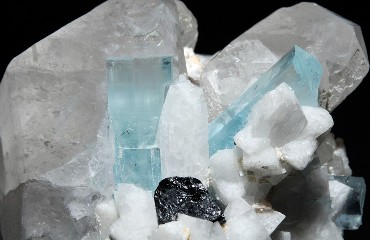
Beryl var. Aquamarine - Image Credit: Parent Géry, CC BY-SA 3.0 The Shigar-Skardu region is the great umbrella locality of northern Pakistani mineral occurrences and collecting. Its outcrops are widely scattered along the long Shigar River Valley and its tributaries, with the city of Skardu at the mouth of the valley being the area’s main population and specimen trading centre. Since few of the specific mineral locations along the valley have names or are not disclosed by the miners, many pieces are simply labelled as Shigar Valley and occasionally as Skardu, although the city itself has no mineral deposits of its own. Instead, the mineralised zones stretch along the slopes of the Shigar Valley and consist of numerous complex granitic pegmatites intruded into complex metamorphic rocks as well as some alpine-type deposits at roughly 2,500 to 4,000 metres elevation. These pegmatites produce aquamarine, colourless to yellow topaz, green fluorite, tourmaline, garnet, fluorapatite, quartz and many other species. To date, almost 80 different minerals have been recorded from the region including world-class, pale blue or pale green, transparent zoisite crystals. Mining history in the district has mostly been artisanal and pocket-driven, carried out in remote and difficult high-altitude terrain. Shigar’a mineralogical significance, importance and economic value to Pakistan is enormous. But it must be remembered that Shigar-Skardu is not just one locality, but the main specimen province from which much of Pakistan’s internationally known pegmatite material has emerged. |
|
Alchuri, Shigar Valley, Shigar District, Gilgit-Baltistan
Clinozoisite and Titanite - Image Credit: Robert M. Lavinsky, CC BY-SA 3.0 The slopes above Alchuri village in the Shigar Valley are particularly notable for their alpine-cleft minerals rather than the pegmatite species so much more typical of the region. These fissures have yielded some of Pakistan’s most celebrated metamorphic and alpine minerals, including epidote, fluorapatite, titanite, vesuvianite, quartz, axinite and chromium-rich diopside. It is, however, particularly prized for its clinozoisite and zoisite crystals, which are internationally regarded among the finest outside the classic East African deposits. Mining has been largely opportunistic and specimen-focused, with local miners working steep, difficult-to-reach, high-altitude clefts. Consequently, Alchuri continues to supply collectors with some of Pakistan’s most distinctive and desirable alpine minerals, especially zoisite and clinozoisite, epidote-group minerals and titanite, sourced from some of the world’s most dramatic mountain settings. |
|
Braldu Valley, Dassu and Goyungo, Shigar District, Gilgit-Baltistan
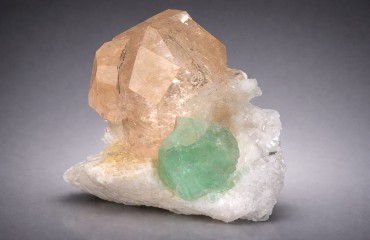
Topaz and Fluorite - Image Credit: Robert M. Lavinsky, CC BY-SA 3.0 The Braldu Valley and its river, fed by meltwater from the Baltoro Glacier, form an important tributary of the Shigar Valley. Most of its mineral localities occur along the lower valley slopes between Baha and Apo Ali Gun, where the terrain is composed of complex metamorphic rocks, including granodioritic augen gneiss, cut by gem-bearing pegmatites. The most notable area is around the village of Dassu, near the mouth of the valley, which is renowned for producing some of the world’s finest beryl var. aquamarine, often as large clusters of sharply terminated, transparent, blue crystals on pure white feldspar matrix. About 3 km upstream is the Namlook Mine, the source of striking pink crystals of the rare manganese phosphate, triplite. Then a further 4km upstream, and about 7km southeast of Dassu are the pegmatite dykes of Goyungo. These have produced some of Pakistan’s finest crystals of topaz, which occurs here as large, sherry-coloured, transparent crystals on matrix of white albite and muscovite. Mining in the valley is typically artisanal, seasonal and pocket-driven, with miners working remote, high-altitude pegmatites rather than a single defined mine. Overall, the reputation of the Braldu Valley rests on its exceptional aquamarine from Dassu and fine topaz from Goyungo, recovered with difficulty from rugged mountain environments. |
|
Basha Valley, Shigar District, Gilgit-Baltistan
Titanite, Quartz and Adularia - Image Credit: Robert M. Lavinsky, CC BY-SA 3.0 The Basha Valley sits at the north end of the Shigar Valley carrying meltwater from the Chogo Lungma Glacier. It descends for about 40 km from the base of the glacier to the village of Tissar, where it joins the Braldu river to form the Shigar river. Along the length of the valley are numerous pegmatite intrusions with alpine clefts higher up the valley sides. Geologically, the valley lies within a high-mountain belt affected by the Main Karakoram Thrust, where complex granitic pegmatites intrude gneiss and related metamorphic rocks. These pegmatites formed the pocket-bearing environments that made the district famous for specimen material. Mining has largely been small-scale, artisanal and pocket-driven, with local miners working remote, steep high-altitude outcrops rather than large, mechanised mines, a pattern typical of the entire Gilgit-Baltistan gemstone and mineral region. The most notable specimens from the Basha pegmatites include aquamarine, topaz, albite, lepidolite, microcline, orthoclase, smoky quartz and other pegmatite minerals, whereas parts of the valley where alpine clefts occur yield actinolite, epidote, hedenbergite, ilmenite, rutile, titanite and tremolite. |
|
Chumar Bakhoor, Nagar District, Gilgit-Baltistan
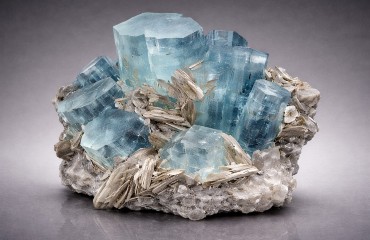
Beryl var. Aquamarine on Muscovite - Image Credit: The Assay House, Public Domain Chumar Bakhoor, in Nagar District, is one of Pakistan’s most famous aquamarine localities. While other locations produce larger or more intensely coloured specimens, this location produces pale blue crystals associated with brown, tabular, muscovite crystals forming the matrix, which are probably the best known of all Pakistani aquamarines. The host rocks for these specimens are granitic pegmatites near the village, which studies have shown to be unzoned, containing patches, pods, lenses and dykes within calc-silicate rocks and amphibolite of the Karakoram Metamorphic Complex, close to the Sumayar pluton. That geological setting helps explain the locality’s reputation for clean, aesthetic pocket minerals rather than only gem rough. Mining has largely been small-scale extraction from individual pegmatite bodies, but the locality has become internationally famous through high-quality aquamarine matrix specimens. In addition, these pegmatites also yield very fine specimens of world-class octahedral pink fluorite, as well as rose-coloured, gemmy, tabular hexagonal crystals of fluorapatite. Both minerals occur on a similar matrix of muscovite crystals as the aquamarine crystals, or alternately, on lustrous white albite. Overall, among Pakistani pegmatites, Chumar Bakhoor stands out for refinement and display quality rather than sheer production volume. |
|
Shengus (Shingus), Roundu District, Gilgit-Baltistan
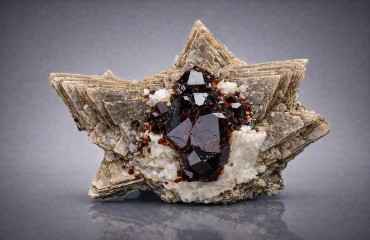
Spessartine Garnet on Muscovite - Image Credit: The Assay House, Public Domain Shengus lies along the Gilgit–Skardu Road in Roundu District, between Gilgit and Skardu. It is another of northern Pakistan’s important pegmatite districts. However, some specimens sold as Shengus are actually mined in nearby areas such as Sabsar or the Baralooma Valley. Geologically, the wider locality is known for numerous complex granitic pegmatite exposures that commonly produce gem and specimen pockets. The area is especially noted for topaz, tourmaline (elbaite, schorl & indicolite), aquamarine (aquamarine, goshenite and morganite), fluorapatite and rarer phosphates such as väyrynenite, which gives Shengus added importance beyond the better-known gem species. Mining has generally been small-scale and specimen-driven rather than heavily mechanised, with work focused on pockets in remote mountain pegmatites. Collectors value Shengus for well-formed topaz and tourmaline in matrix, attractive pegmatite associations, and its role as one of the leading secondary pegmatite localities after the more famous Shigar and Stak Nala fields. |
|
Aliabad (Ali Abad) marble deposits, Nagar District, Gilgit-Baltistan
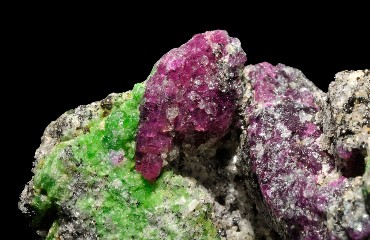
Ruby on Pargasite - Image Credit: Parent Géry, CC BY-SA 3.0 The Aliabad area in Nagar District is the principal Pakistani source for ruby and spinel specimens from marble-hosted deposits. The town of Aliabad itself lies on the alluvial terrace of the Hunza River and has no mineral occurrences of its own. Instead, the mineralized marble levels lie high above the village, and the deposits were discovered during construction associated with the Karakoram Highway in the late 1980s. Since then, many digs have targeted ruby, sapphire, spinel and pargasite. Geologically, this is a different environment from the pegmatites of Shigar and Nagar, where the minerals are hosted in marble rather than granitic bodies. The marbles are of marine origin and consist of highly metamorphosed limestones altered by forces that uplifted the area into the present-day Himalayan mountain chain. Specimen mining is difficult because the outcrops are steep and remote, which has limited extraction and so far, helping to preserve the deposits from over-exploitation. The best-known specimen minerals are ruby and spinel, with pargasite also noted. Although the locality faces competition in the gem market from Afghan sources, it remains Pakistan’s classic marble-hosted ruby/spinel district. Other, similar Pakistani marble deposits occur at Ganish, approximately 5 kilometres to the west along the same Hunza River. These also produce specimens of ruby, sapphire, spinel and pargasite, and again occur on the steep hillsides above the town. |
|
Muslim Bagh ophiolite deposit, Killa Saifullah District, Balochistan
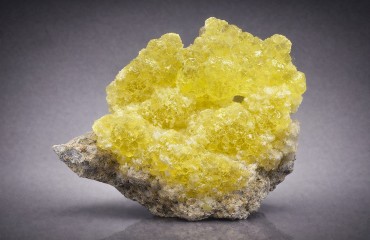
Brucite on Hydromagnesite - Image Credit: The Assay House, Public Domain Muslim Bagh in the north of the country is Pakistan’s best-known ophiolite-hosted mineral district. An ophiolite is a section of Earth's ancient oceanic crust and underlying upper mantle that has been tectonically uplifted and pushed over continental crust, in this case during the early stages of the closure of the Neo-Tethys Ocean, prior to the main collision of the Indian and Eurasian plates. South of the town, these ophiolitic rocks have been extensively quarried for their high-grade chromite deposits, and the settlement itself was historically developed in the late 19th century by the British to support this industry. Mining continues today and remains a significant contributor to Balochistan’s mineral economy. For mineral collectors, the district is notable not only for chromite but also for canary-yellow, botryoidal brucite and related serpentinization products from localities such as nearby Nisai. The brucite occurs in the mantle-section peridotite near magnesite deposits and is abundant in botryoidal habit and striking colour, which explain its popularity on the specimen market. The region is also notable for a number or rare and unusual rock types that include dunite, harzburgite, lherzolite, mylonite and wehrlite. While mining in Muslim Bagh has largely been industrial in focus, specimen-quality minerals are often recovered incidentally during extraction. The area’s complex geology and unusual rocks and minerals ensure Muslim Bagh’s distinctive niche in Pakistani mineralogy. |
|
Zard Mountain, Kharan District, Balochistan
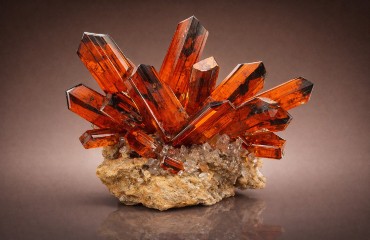
Brookite - Image Credit: The Assay House, Public Domain The Kharan District, Balochistan, in a much drier and more desert-like geological setting than the northern pegmatite districts. The main specimen occurrences lie about 40 kilometres northeast of Kharan town on the slopes of Zard Mountain. It is a relatively recent find that has rapidly become well known among collectors for its titanium minerals, including anatase, rutile and titanite. In addition, a named digging at Thurdook is claimed to be the source of spectacular crystals of red-brown, transparent brookite crystals, often associated with smoky quartz. However, the precise location is not known due to the secrecy of the miners working these finds. Geologically, the region consists largely of Paleocene to Eocene volcanic rocks, including andesite and basaltic andesite, associated with tectonic activity related to the formation of the Himalayan mountains. Overall, the primary mineralisation left by the accompanying hydrothermal activity is that of iron, consisting of pyrite, later partly metamorphosed to magnetite and maghemite, with associated minerals that include axinite-(Fe), chamosite and chromite. However, as well as iron, the mineralising fluids also contained titanium, leading to the formation of the already mentioned highly prized titanium minerals. Significantly, while iron is present, the mining of its ores has been minimal due to the area’s remoteness and difficult working conditions. Instead, small-scale specimen-focussed work has taken off recently, making both iron- and titanium-bearing specimens available for collectors. Ultimately, the value of Zard Mountain and the Kharan District lies in the quality and distinctiveness of its minerals and not any commercial exploitation of its metallic ores. |
|
Naran / Sapat Gali, Kaghan Valley, Mansehra District, Khyber Pakhtunkhwa
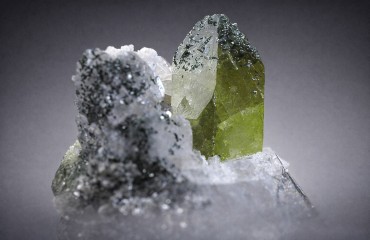
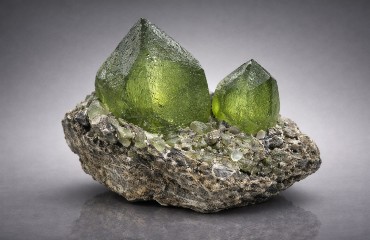
Forsterite var. Peridot - Image Credit: The Assay House, Public Domain The Kaghan Valley lies in northern Khyber Pakhtunkhwa, northeast of Mansehra, in a high mountain belt better known for alpine and metamorphic occurrences than for granitic pegmatites which are far more common throughout Pakistan. Geologically, the valley hosts ultramafic and metamorphic environments that favoured the formation of alpine minerals, including clinochlore, diopside, epidote, garnet group, katophorite, ludwigite, omphacite, rutile, spinel, staurolite and vonsenite. Because the cooling was slow, the conditions allowed the development of particularly large, colourful crystals of striking form and clarity. Many of these specimens are therefore remarkably gemmy and are eagerly sought by collectors. However, possibly the most prized are world-class, transparent bottle green crystals of forsterite and its variety peridot. The best specimens are found in small cavities in the mountains around Sapat Gali near the town of Naran, although others occur throughout the valley. The countryside around Naran itself is notable for striking specimens of corundum var. ruby, but these appear to be less central to the region’s fame than the peridot occurrences. Mining in the valley has been modest and locality-based rather than dominated by a single famous mine. For collectors, the district is best regarded as a notable northern Pakistani gemstone area with interest for peridot and associated metamorphic minerals, and a possible but less prominent corundum occurrence. |
|
Mingora Emerald Deposit, Swat District, Khyber Pakhtunkhwa
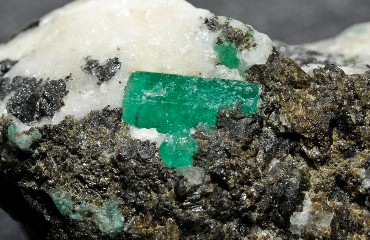
Beryl var. Emerald - Image Credit: Parent Géry, CC BY-SA 3.0 The Mingora deposit in Swat is one of Pakistan’s most renowned emerald gemstone and specimen localities. It is situated just northwest of the town of Mingora on the slopes of Mount Bandai and ranks among the country’s largest emerald-producing areas, with mining activity recorded for nearly two thousand years. The emeralds occur within sheared talc-carbonate and talc-chlorite-magnesite schists along fault-controlled shear zones, where crystals formed in pockets and cavities. Emeralds from Mingora entered the international market in significant quantities during the early 1980s and remain Pakistan’s most recognisable gem export, valued both for jewellery and as attractive matrix specimens. Mining today is largely small-scale, carried out through leased workings rather than large, mechanised operations, typically as open trenches following the mineralised shear zones along the mountainside. In addition to emerald, the locality has produced notable specimens of tremolite, talc, muscovite var. fuchsite, antigorite, enstatite and gersdorffite. Owing to its long history and consistent production, Mingora has rapidly grown to become the reference locality for Pakistani emeralds. |
|
Nangimali Ruby Deposit, Neelum District, Azad Jammu & Kashmir
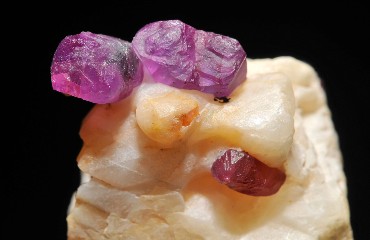
Corundum vra. Ruby - Image Credit: Parent Géry, CC BY-SA 3.0 Nangimali is in the Neelum Valley of Azad Jammu and Kashmir, near the village of Nangimali. It is one of Pakistan’s best-known ruby localities but was only discovered recently in the late 1970s. The deposit is hosted in ruby-bearing marble formed by the alteration of former carbonate-rich sedimentary rocks squeezed by the closure of the Neo-Tethys Ocean during the collision of the Eurasian and Indian tectonic plates. Associated minerals include phlogopite, anorthite, brucite, clinozoisite, titanite, tremolite, graphite and pyrite. That mineral assemblage is what makes Nangimali interesting to geologists, gemmologists and mineral collectors. Mining history has been difficult and intermittent, reflecting the rugged terrain and political sensitivity of the broader Kashmir region. Even so, Nangimali has become internationally important as a source of gem ruby crystals and specimens of ruby in marble matrix and ranks as one of Pakistan’s leading marble-ruby sources. |
|
Varcha & Khewra Salt Mines, Shahpur, Sargodha District, Punjab
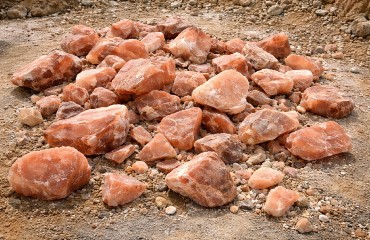
Himalayan Salt - Image Credit: The Assay House, Public Domain The Varcha (Warcha) and the Khewra Salt Mines are two of the most important sources of so-called Himalayan salt, both located within the Salt Range of Punjab, Pakistan, separated by about 200 kilometres. Despite its name, Himalayan salt does not originate in the high Himalayas, but from extensive evaporite deposits formed hundreds of millions of years ago and later uplifted to their present position. Geologically, these deposits belong to the Salt Range Formation, laid down around 600–800 million years ago when an ancient inland sea - part of the early Tethys Ocean - evaporated, leaving behind vast beds of crystalline halite and associated minerals. Much later, the collision between the Indian and Eurasian tectonic plates uplifted these deposits, placing them at the foothills of the Himalayas and giving rise to their modern association with the mountain range. The Varcha Salt Mine, near Shahpur in Punjab, is a major underground operation exploiting high-purity halite, typically around 98% pure, using the traditional room-and-pillar mining method. It is primarily an industrial mine producing salt for refining and iodisation, though collectors may find crystalline halite and occasional evaporite minerals such as blödite. Its significance is largely economic and geological, representing one of Pakistan’s key high-purity salt deposits. The Khewra Salt Mine, also known as the Mayo Salt Mine, is Pakistan’s largest and oldest salt mine and the second largest in the world. Discovered, according to tradition, by the army of Alexander the Great in 320 BC, it has been worked continuously in modern form since 1872. The mine extends over approximately 110 km² and contains vast reserves estimated at around 600 million tonnes. Today, it produces around 400,000 tonnes annually, accounting for a significant proportion of Pakistan’s total rock salt output. The mine also operates as a tourist attraction and the vast workings and caverns can be seen during guided tours. The salt from both mines ranges in colour from colourless and white to pink and red, the latter caused by trace amounts of iron oxides, and sold as Himalayan Salt. Together with other workings such as Kalabagh, these mines supply most of the Himalayan salt found on the global market. While primarily industrial in nature, they hold special geological importance as classic examples of ancient evaporite deposits uplifted by major tectonic processes. Ultimately, Himalayan salt is best understood as ancient sea salt, preserved and elevated through geological time, rather than a product formed directly within the Himalayan mountains. |

Pakistan stands as one of the world’s most compelling sources of mineral specimens, combining dramatic geology with a remarkable diversity of mineral-forming environments. From the high-altitude pegmatites of Gilgit-Baltistan to the marble-hosted ruby deposits of Kashmir and the ophiolite complexes of Balochistan, the country offers an exceptional range of minerals in both scientific and aesthetic terms. Many of these localities remain relatively young in collecting history, meaning new discoveries continue to emerge, often producing world-class specimens.
For collectors, Pakistan offers a unique combination of quality, variety and ongoing discovery. Fine aquamarine, topaz, tourmaline and fluorite, alongside rarer species such as brucite, brookite and titanite, make it a region of enduring interest. While care must be taken with locality data and identification, the rewards are considerable. Specimens from Pakistan often capture both the power of geological processes and the excitement of modern exploration, making them an essential and highly desirable addition to any serious mineral collection.
If you are interested in adding specimens from Pakistan to your collection, click HERE


