

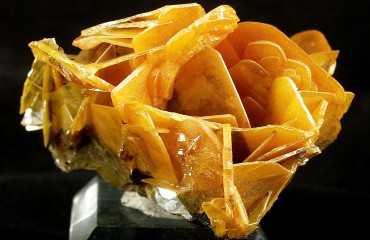
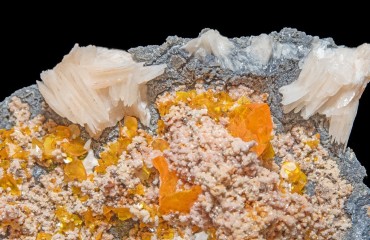
Red Cloud Mine, Arizona, USA; Glove Mine, Arizona, USA; Mibladen Mine, Aouli, Morocco Image Credits – Robert M. Lavinsky CC-BY-SA-3.0, Robert M. Lavinsky CC-BY-SA-3.0, Parent Géry CC-BY-SA-3.0
Wulfenite is one of the most visually striking minerals sought after by collectors, famous for its brilliant orange, red-orange, and honey-yellow crystals. Its vibrant colours, glassy lustre, and delicate crystal forms have made it a favourite among mineral enthusiasts for generations. Although relatively uncommon, fine wulfenite specimens are considered some of the most beautiful minerals ever discovered, often commanding high prices in the collector market.
Chemically, wulfenite is lead molybdate with the formula PbMoO₄. It forms as a secondary mineral in the oxidised zones of lead ore deposits, where groundwater and oxygen alter primary lead minerals over long periods of time. These conditions allow molybdenum-bearing fluids to react with lead-rich minerals, creating wulfenite crystals in cavities and fractures within the host rock. It is commonly associated with minerals such as cerussite, anglesite, vanadinite, mimetite, calcite, and limonite.
The crystal habit of wulfenite is one of its defining features. Most crystals are thin, tabular, and square or rectangular in shape, often appearing as delicate plates stacked together. Some specimens form thick blocky crystals, while others develop as extremely thin transparent sheets that seem almost too fragile to survive. Wulfenite has a Mohs hardness of only 2.5 to 3, making it relatively soft and brittle, so collectors must handle specimens with care.
Although orange and red-orange are the most famous colours, wulfenite can also occur in yellow, brown, grey, and occasionally colourless forms. The intensity of colour often depends on trace impurities and the geological conditions that are present during crystal growth. Highly lustrous crystals with deep orange or red colouring are especially prized.
Some of the world’s most famous wulfenite localities have produced museum-quality specimens admired internationally. The Red Cloud Mine in Arizona, USA, is perhaps the most legendary source. This locality is renowned for producing spectacular deep-red, transparent crystals with exceptional lustre. Many collectors consider Red Cloud specimens to be among the finest wulfenites ever found.
Another classic locality is the Los Lamentos district in Chihuahua, Mexico. Wulfenite crystals from this area are typically thicker and more robust than those from Arizona and often display rich orange or honey-yellow colours. Mexican specimens are highly collectible and frequently appear in major mineral collections around the world.
The famous Tsumeb Mine in Namibia also produced exceptional wulfenite specimens. Tsumeb is considered one of the greatest mineral localities ever discovered due to its extraordinary diversity of minerals. Wulfenite from Tsumeb is often associated with green mimetite, white cerussite, or colourful secondary minerals, creating striking aesthetic combinations that are highly valued by collectors.
In Morocco, the Mibladen mining district has become another important source of collectible wulfenite. Specimens from this area commonly feature bright orange crystals on contrasting matrix material, sometimes associated with vanadinite or barite. Morocco continues to produce attractive material for both beginner and advanced collectors.
In Europe, wulfenite has historical importance because it was first scientifically described from deposits in what is now Slovenia, formerly part of the Austrian Empire. The mineral was named in honour of the Austrian mineralogist Franz Xaver von Wulfen in 1845. Von Wulfen was an important early naturalist and mineral collector who studied the lead deposits of the Eastern Alps.
One interesting fact about wulfenite is that some specimens fluoresce under ultraviolet light, displaying glowing yellow or orange colours. Although fluorescence is not present in all specimens, it adds another level of fascination for collectors who enjoy viewing minerals under UV lighting.
Another fascinating aspect of wulfenite is its role as a minor ore of molybdenum. Molybdenum is an important industrial metal used to strengthen steel alloys and improve resistance to heat and corrosion. However, wulfenite is usually too rare and valuable as a collector’s mineral to be mined commercially for molybdenum extraction.
Wulfenite can also form unusual pseudomorphs, where another mineral replaces the original crystal while preserving its shape. These mineral replacements provide valuable information to geologists and mineralogists studying chemical alteration processes within ore deposits.
Because of its lead content, collectors should wash their hands after handling wulfenite specimens, especially before eating or drinking. While simply displaying specimens poses little risk, good mineral-handling practices are always recommended.
Today, wulfenite remains one of the most iconic and recognisable minerals in the world of collecting. Its vivid colours, delicate crystal forms, and famous localities have secured its place in museums and private collections alike. Whether displayed as a single crystal or as part of a complex mineral association, wulfenite captures the artistic beauty of the natural world and continues to fascinate collectors, geologists, and mineral enthusiasts across the globe.
If you are interested in mineral specimens of wulfenite for your collection, click HERE

