

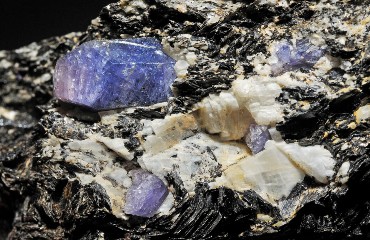
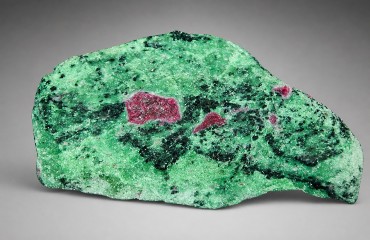
Winza, Mpapwa, Tanzania; Zazafotsy Quarry, Fianarantsoa Province, Madagascar; Mundarara Mine, Longido, Tanzania Image Credits – All Robert M. Lavinsky CC-BY-SA-3.0, Parent Géry CC-BY-SA-3.0, James St. John CC BY 2.0
Corundum is one of the most important and best-known gem minerals in the world. Chemically, it is aluminium oxide, with the formula Al₂O₃, and it is prized both as a mineral specimen and as the source of two of the most famous gemstones: ruby and sapphire. Pure corundum is colourless, but the rich colour of these varieties is created by the presence of trace elements. Chromium gives corundum its red colour, creating ruby, while iron and titanium commonly produce blue sapphire. Other trace elements can form yellow, pink, purple, green, or even colour-changing varieties.
One of the reasons corundum is so famous is its exceptional hardness. It ranks 9 on the Mohs scale, making it the second hardest naturally occurring mineral after diamond. This means it is not only beautiful but also extremely durable. That durability has made gem-quality corundum one of the most important materials in jewellery for centuries, while non-gem varieties have long been used as abrasives in industry.
Corundum forms in several geological environments. It is commonly found in metamorphic rocks such as marble, schist, and gneiss, and it can also occur in igneous rocks such as syenite and pegmatite. In some cases, corundum crystals weather out of their host rocks and become concentrated in alluvial deposits, where they may later be recovered as gem gravels. These secondary deposits have supplied many of the world’s finest rubies and sapphires.
The crystal form of corundum is usually barrel-shaped, tabular, or prismatic, often with hexagonal symmetry. Well-formed crystals can be striking, especially when they show rich colour and transparency. Even opaque or industrial-grade crystals can be attractive to mineral collectors because of their size, shape, and associations with other minerals.
Among the most famous corundum localities is Myanmar, historically known as Burma. The Mogok Stone Tract is legendary for producing some of the finest rubies ever discovered. These rubies are celebrated for their deep, glowing red colour, often described as “pigeon’s blood". Mogok has also produced fine sapphires and spinel, but its rubies remain among the most coveted gemstones in the world.
Sri Lanka is another classic source of corundum, especially sapphire. The island has produced gem gravels for centuries and is famous for yielding blue, pink, yellow, white, and padparadscha sapphires. Padparadscha, one of the rarest sapphire colours, is a delicate pink-orange shade and is especially prized by collectors and jewellers. Sri Lankan sapphires are often noted for their brilliance and lighter, brighter tones.
Kashmir is one of the most famous sapphire localities in gem history. The sapphires from this region are renowned for their velvety, intensely saturated blue colour. Fine Kashmir sapphires are rare and command extremely high prices. Although the historic deposits were never large and have long been largely exhausted, the name Kashmir remains one of the most prestigious in the gem trade.
Thailand and Cambodia have also been major sources of ruby and sapphire, especially from alluvial deposits. Australian corundum is likewise well known, particularly sapphire from New South Wales and Queensland. Australian sapphires are often dark blue, greenish-blue, or parti-coloured, and while they may differ in appearance from the classic stones of Kashmir or Sri Lanka, they are important both commercially and mineralogically.
In the United States, corundum has been found in several states, especially North Carolina and Montana. North Carolina was once an important source of ruby and sapphire, while Montana is known for sapphires from places such as Yogo Gulch. Yogo sapphires are particularly admired for their consistent blue colour and excellent clarity. Corundum also occurs in metamorphic localities in other parts of the world, including Madagascar, Tanzania, Afghanistan, Pakistan, and Vietnam.
For mineral collectors, corundum is appealing not just because of its gem varieties, but also because of its associations and crystal habits. Ruby in marble from Myanmar or Afghanistan can be very attractive, especially when bright red crystals contrast with white calcite. Sapphire crystals in metamorphic rock or alluvial pebbles can also make excellent specimens. Some corundum crystals display asterism, the star-like optical effect seen in star ruby and star sapphire, caused by tiny needle-like inclusions arranged in a precise internal pattern.
There are also a couple of especially interesting facts about corundum. The first is that both ruby and sapphire are exactly the same mineral species. The only real difference is colour, caused by trace elements. Red corundum is called ruby, while nearly every other colour is called sapphire. The second is that corundum’s hardness has made it useful far beyond jewellery. Before modern synthetic abrasives became widespread, corundum was widely crushed and used for grinding, polishing, and cutting.
In the end, corundum is a mineral that combines beauty, scientific interest, and practical value. Whether admired as a crystal specimen, a glowing ruby, or a fine blue sapphire, it holds a special place in both mineralogy and human history. Few minerals can match its combination of durability, variety, and worldwide fame.
If you are interested in mineral specimens of corundum for your collection, click HERE

