Building a mineral collection is not simply a matter of buying attractive specimens whenever they appear. The strongest collections are usually built with patience, knowledge, and a clear sense of direction. One of the most effective ways for a collector to improve both their collection and their judgement is to make good use of mineral dealers. The best dealers do far more than just sell minerals. They can help a collector learn, avoid mistakes, refine their taste, and build a collection with greater quality and purpose. Experienced dealers often emphasise the importance of condition, accurate labelling, provenance, rarity, and thoughtful buying rather than impulsive purchasing.
For newer collectors, mineral dealers can act as an important source of guidance. Beginners often focus mainly on colour, sparkle, or size, which is natural at the start. But over time, a collector learns that condition, crystal form, locality, aesthetics, rarity, and historical importance can matter just as much, and sometimes more. A knowledgeable dealer can explain why one specimen is common while another is genuinely unusual, even if the difference is not immediately obvious. That sort of practical knowledge is difficult to gain quickly without help.
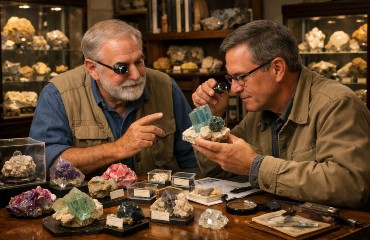
Collectors should also treat dealers as educators. Asking questions is one of the smartest habits a collector can develop. Why is one fluorite more expensive than another? Is a specimen repaired, cleaned, or unusually good for its locality? Is the damage minor or significant? Does it still have an old label, or a known provenance from an earlier collection? These are the kinds of details that shape serious collections. A good dealer can help train a collector’s eye so that each purchase becomes more informed than the last.
Another important way to use mineral dealers is to communicate your collecting goals. A collector who simply buys whatever looks appealing may end up with a random assortment rather than a coherent collection. Mineral dealers are often most useful when they know what you are looking for. That could mean thumbnails, classic localities, a favourite mineral species, old labels, cabinet pieces, or minerals from a certain country or mining district. Once a dealer understands your interests, they may remember you when suitable material appears. This can be especially valuable when older collections are dispersed, because many important specimens return to the market through established dealers.
Dealers can also help collectors improve by editing their collections over time. As taste develops, many early purchases no longer fit the collector’s standards. A trusted dealer can help identify which pieces are worth keeping, which might be upgraded, and which could be traded or sold. This process is part of building a better collection, not a failure. Most serious collectors refine their collections repeatedly as their knowledge grows.
The most successful collectors usually build relationships with a small number of dealers they trust. Those relationships are valuable because they are based on consistency, honesty, and shared understanding. Used wisely, mineral dealers are not just sellers of specimens. They are sources of knowledge, access, perspective, and long-term support in building a collection that becomes more focused, more personal, and more rewarding over time. Most importantly, many collector-dealer relationships turn into life-time friendships.