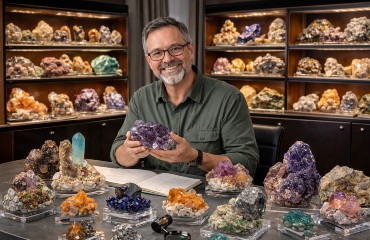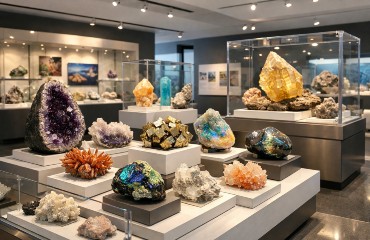
Museums play a crucial role in preserving, studying, and presenting mineral specimens to the public and scientific community. Behind every beautifully displayed crystal or rare mineral lies a carefully managed process of acquisition, documentation, conservation, and interpretation. Curating mineral collections is both a scientific discipline and an art form, requiring geological expertise, historical awareness, and an understanding of public engagement.
Acquisition of Mineral Specimens
The foundation of any museum mineral collection begins with acquisition. Specimens are obtained through a variety of channels, including field collecting, donations from private collectors, purchases from dealers, and exchanges with other institutions. Each specimen is evaluated based on several criteria: scientific significance, aesthetic quality, provenance, and relevance to the museum’s existing collection.
Provenance - the documented history of a specimen - is particularly important. Museums prioritise specimens with well-recorded localities and collection histories, as these provide valuable scientific data. For example, a mineral from a classic or now-closed locality can hold significant research and historical value beyond its visual appeal.
Documentation and Cataloguing
Once acquired, specimens undergo detailed documentation. This process ensures that each mineral is properly identified, recorded, and integrated into the museum’s database. Key information includes mineral species, locality, geological context, acquisition details, and any associated historical notes.
Modern museums use digital collection management systems to store and organise this data. High-resolution photography is often included, allowing curators and researchers to access visual records without handling the specimens directly. Proper cataloguing is essential not only for internal organisation but also for facilitating research and loans to other institutions.
Scientific Research and Classification
Mineral collections are not static displays; they are active research resources. Curators and scientists study specimens to understand mineral formation processes, chemical compositions, and geological environments. Advanced analytical techniques such as X-ray diffraction (XRD) and scanning electron microscopy (SEM) are commonly used to verify mineral identities and discover new insights.
Classification systems are continually refined as new minerals are discovered and existing classifications are updated. Museums must therefore periodically review and, if necessary, reclassify specimens to reflect current scientific understanding. This ongoing process ensures that collections remain relevant and accurate.
Conservation and Preservation
Preserving mineral specimens is a critical aspect of curation. While many minerals are stable, others can be highly sensitive to environmental conditions. Factors such as humidity, temperature, light exposure, and air quality can all affect a specimen’s integrity.
For instance, sulfide minerals like pyrite can deteriorate through oxidation, a process known as “pyrite decay.” To prevent this, museums carefully control storage environments and may use sealed display cases with desiccants or inert gases. Delicate specimens are handled minimally and often stored in archival-quality materials to prevent contamination or damage.
Regular condition assessments are conducted to monitor any changes. Conservation efforts aim to stabilise specimens while maintaining their original appearance and scientific value.
Designing Exhibitions
One of the most visible aspects of museum curation is exhibition design. Curators must balance scientific accuracy with visual appeal to create engaging displays for visitors. Minerals are often arranged by themes such as mineral class, geological environment, or geographic origin.
Lighting plays a key role in highlighting the beauty of specimens, enhancing colours and crystal forms without causing damage. Labels and interpretive panels provide context, explaining how minerals form, where they are found, and why they are significant.
Interactive elements, such as touchscreens or augmented reality features, are increasingly used to enhance visitor engagement. These tools allow museums to present complex geological concepts in an accessible and engaging way.
Educational and Public Engagement
Museums serve as educational institutions, using their mineral collections to inspire and inform the public. Educational programmes, guided tours, and workshops are designed to cater to a wide range of audiences, from school groups to advanced collectors.
Curators often collaborate with educators to develop content that aligns with curricula, helping students understand topics such as Earth processes, mineral identification, and resource use. Public lectures and special exhibitions further extend the museum’s reach, showcasing new discoveries or highlighting particular themes within the collection.
Digital outreach has also become increasingly important. Online databases, virtual tours, and social media platforms allow museums to share their collections with a global audience, making mineral specimens accessible beyond the physical gallery space.
Loans, Exchanges, and Collaboration
Museums frequently collaborate with other institutions through loans and exchanges. Specimens may be temporarily loaned for exhibitions or research, allowing collections to be shared and studied more widely. These collaborations foster scientific advancement and help build relationships between institutions.
Strict protocols govern the handling, transport, and display of loaned specimens to ensure their safety. Detailed agreements outline responsibilities and conditions, reflecting the high value—both scientific and monetary—of many mineral specimens.
Ethical Considerations and Collection Policies
Modern museum curation also involves ethical considerations. Museums must ensure that specimens are acquired legally and ethically, with respect for local laws and cultural heritage. This is particularly important for minerals collected from protected sites or regions with strict export regulations.
Collection policies guide acquisition decisions, ensuring that new specimens align with the museum’s mission and do not duplicate existing holdings unnecessarily. Ethical curation also involves transparency, with museums providing clear information about the origins and history of their specimens.
The Future of Mineral Curation
The future of mineral curation is being shaped by rapid technological advances and changing audience expectations. Digital collection databases are becoming more sophisticated, with some museums creating fully searchable online catalogues that allow collectors, researchers, and enthusiasts worldwide to explore specimens in detail. High-resolution 3D scanning is also emerging as a powerful tool, enabling virtual handling and study without risking damage to fragile pieces.
Artificial intelligence and machine learning are beginning to assist with mineral identification and classification, offering new ways to analyse large collections efficiently. These technologies may help uncover overlooked specimens or refine existing data, improving both scientific accuracy and accessibility.
Sustainability and ethical sourcing will play an increasingly important role. Museums are likely to place greater emphasis on transparency, ensuring that specimens are responsibly acquired and properly documented. At the same time, there is growing interest in preserving historically important collections from private hands, particularly as classic localities become exhausted.
Public engagement will also continue to evolve. Immersive exhibitions, virtual reality experiences, and interactive storytelling will make mineral displays more engaging for broader audiences, including younger visitors. Museums will need to balance traditional display methods with innovative technologies to remain relevant in a digital age.
Ultimately, the future of mineral curation lies in combining scientific rigour with accessibility. By embracing new tools and approaches while maintaining high standards of preservation and research, museums will continue to safeguard and share the world’s mineral heritage for generations to come.