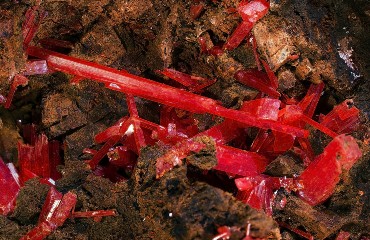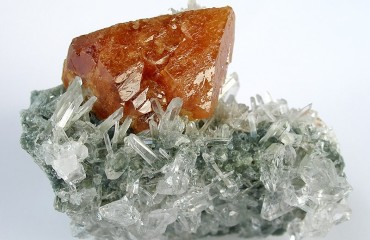


Scheelite, Group Structure, Powellite Image Credits – Robert M. Lavinsky CC-BY-SA-3.0, The Assay House, Robert M. Lavinsky CC-BY-SA-3.0
The tungstate and molybdate minerals form two closely related groups, whose structures are based on the tetrahedral anions [(XO₄)²⁻] where X are either the metals Tungsten (W) or Molybdenum (Mo), surrounded by oxygen atoms at each of the corners. Because both metals share similar ionic radii, valence states, and coordination, their respective minerals display almost identical crystal structures and chemical behaviour. Many species form solid-solution series between the two groups. They are typically secondary minerals, crystallising in the oxidation zones of hydrothermal veins, pegmatites, and skarns where the parent ore minerals have undergone alteration.
Composition and Structure
Both groups are built around complex oxyanions: the tungstate ion (WO₄)²⁻ and the molybdate ion (MoO₄)²⁻. These tetrahedral groups bond with large cations such as calcium, lead, iron, manganese, zinc, or copper to form distinctive and often brilliantly coloured minerals. Structurally, they belong to several crystal systems, most notably the scheelite type (tetragonal) and wolframite type (monoclinic). These structures are remarkably stable, a reason why tungstates and molybdates are valuable as indicator minerals in exploration geology.
The Tungstate Minerals
The most economically important tungstate minerals are scheelite (CaWO₄) and wolframite, a name applied to a continuous series between ferberite (FeWO₄) and hübnerite (MnWO₄). Together, they represent the principal ores of tungsten.
Scheelite is typically found as bright honey-yellow to orange-brown crystals with a high density (specific gravity about 6) and adamantine lustre. It is tetragonal and fluoresces an intense blue under short-wave ultraviolet light, a property long used for identifying ore-grade material. Major deposits include those of the Erzgebirge in Germany, the Mount Carbine district of Queensland, the famous deposits of China’s Jiangxi Province, and the Pine Creek area in California.
Wolframite, by contrast, forms dark brown to nearly black bladed crystals that exhibit perfect cleavage and a metallic lustre. It occurs in high-temperature quartz veins associated with granitic intrusions, often together with cassiterite, topaz, fluorite, and sulfide minerals. Classic wolframite localities include Panasqueira in Portugal, the Yaogangxian and Xihuashan mines in China, and numerous veins in Bolivia and the Erzgebirge. The iron-rich ferberite end member is darker and denser, while hübnerite tends to be reddish brown and often displays translucent edges.
Other less common tungstates include stolzite (PbWO₄), a lead tungstate forming brilliant yellow crystals isostructural with scheelite, and cuprotungstite (CuWO₄·2H₂O), a green secondary mineral formed by alteration of earlier tungstates. Tungstates may also appear in pegmatites and contact-metamorphic skarns where hot fluids react with limestone or calcareous shale to form calcium-tungstate assemblages.
The Molybdate Minerals
Chemically and structurally parallel to the tungstates, the molybdate group contains some of the most colourful secondary minerals known. The most common and economically significant is wulfenite (PbMoO₄), a lead molybdate famous for its brilliant orange to red tabular crystals. Wulfenite crystallises in the tetragonal system, with the same structure as scheelite. It forms in the oxidation zones of lead-bearing ore deposits where molybdenum released from primary molybdenite (MoS₂) combines with lead. Classic wulfenite localities include the Red Cloud Mine in Arizona, Los Lamentos in Mexico, Tsumeb in Namibia, and the Mežica mines of Slovenia. Some crystals are prized for their exceptional transparency and fiery colour, making wulfenite a collector favourite and, occasionally, a minor gemstone.
Other molybdates mirror the tungsten analogues. Powellite (CaMoO₄) is isostructural with scheelite and often forms a solid-solution series with it; many specimens contain both tungsten and molybdenum in varying proportions. Powellite crystals are typically pale yellow with strong fluorescence, occurring as alteration products of molybdenite and scheelite. Molybdite (MoO₃) is another secondary mineral, forming silky yellow fibrous crusts in the oxidation zones of molybdenum deposits. Rarer species include tungomolybdate and ilsemanite, representing hydrated or complex variations of the basic molybdate structure.
Formation and Occurrence
Both tungstates and molybdates are late-stage minerals in the paragenetic sequence of ore formation. Tungstates crystallise from hydrothermal fluids emanating from granitic magmas rich in volatiles such as fluorine and boron. These fluids infiltrate surrounding carbonate rocks, producing skarn deposits composed of scheelite, garnet, pyroxene, and vesuvianite. Molybdates, on the other hand, typically arise from the oxidation of primary molybdenite in near-surface environments where oxygenated groundwater promotes the formation of bright secondary minerals.
Identification and Significance
The dense weight of tungstates, their high refractive indices, and characteristic fluorescence make them readily recognisable. Molybdates are distinguished by their vivid colours and tetragonal forms. Both groups are soft (hardness 3–4.5) and brittle. Economically, tungsten is a strategic metal used in hard steels, lamp filaments, and high-temperature alloys, while molybdenum is vital for strengthening steels and as a lubricant additive. Collectors, however, value these minerals as much for their beauty as for their industrial roles.
Conclusion
The tungstate and molybdate groups exemplify how chemistry and crystal structure intertwine to produce strikingly similar yet distinct families of minerals. From the dark metallic blades of wolframite to the radiant orange plates of wulfenite, these minerals bridge the gap between industrial significance and aesthetic fascination. Their study reveals not only the intimate relationship between tungsten and molybdenum but also the diverse geological environments that yield such treasures of the mineral kingdom.
If you are interested in adding specimens of tungstate or molybdate minerals to your collection, click HERE.