
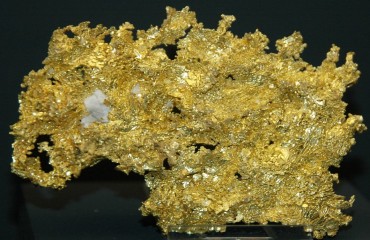
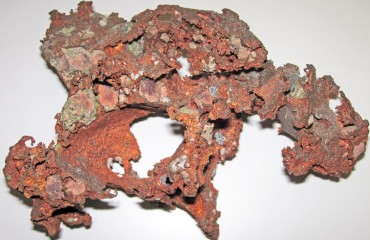
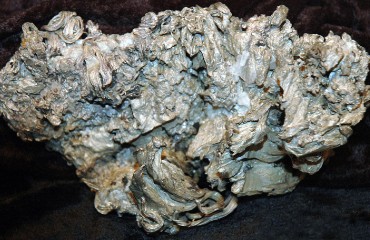
Native Gold, Native Copper and Native Silver: Image Credits – James St. John, CC BY 2.0
Most minerals are compounds where atoms of different elements are bound together: silicon to oxygen, sodium to chlorine, various metals to sulfur, or where multiple different atoms are held together in complex frameworks such as the silicates. The native elements are the rare exception. These are minerals composed of one chemical element in its uncombined and pure form, like naturally occurring gold, copper, sulfur or carbon.
Why are native elements rare?
Native elements are rare because, in most natural settings, elements “want” to react. Near the Earth’s surface there is usually water, carbon dioxide and plenty of oxygen, and under ordinary conditions these substances act upon uncombined elements – especially metals – to form compounds that are more chemically stable than the starting ingredients. Instead of remaining as pure gold, copper, sulfur, or carbon, the elements typically end up locked into oxides, sulfides, sulfates, carbonates, silicates, and other mineral families.
Why do native elements exist at all?
When a native element does occur, it usually does so because the local chemistry is unusually protective: there may be little or no water, low oxygen availability, strongly reducing conditions, or circumstances where formation happens so quickly that the element is deposited before it can react. In that sense, native elements are geological “exceptions” that often reveal something very specific about the environment in which they form and in which they survive – especially its redox state (how oxidising or reducing it is), along with temperature, fluid composition, and sometimes even biological influences that affect local chemistry.
In practice, native elements can endure under the following three circumstances:
First, some elements have naturally low reactivity: gold and the platinum-group metals are chemically reluctant to bond, so they can persist in elemental form even when reactive substances like oxygen or sulfur are present.
Second, native elements can be stabilised by reducing environments, where oxygen is scarce or oxidation is suppressed – conditions that can occur deep underground, in certain hydrothermal systems, in organic-rich sediments, or in some mantle-derived settings.
Third, native elements can form through rapid changes in a fluid’s temperature, pressure, or chemistry, causing an element to precipitate quickly before it can transform into a compound; in hydrothermal veins, small shifts in sulfur activity or redox conditions can be enough to “flip” which minerals are stable.
Major formation environments
1) Magmatic and ultramafic settings
Some native elements appear in high-temperature, deep-seated environments. Platinum-group minerals (often native platinum and related phases) are strongly associated with ultramafic rocks, layered intrusions, and placers derived from them. These elements are siderophile (iron-loving) and can concentrate in magmas and sulphide melts.
Native iron is uncommon in crustal rocks because it rusts easily, but it can occur in extremely reducing magmatic settings (for example, in some basalts or in unusual intrusions), and it’s famously abundant in meteorites (though meteorites aren’t “minerals” in the strict sense, they’re a major source of native iron metal in nature).
2) Hydrothermal veins and ore systems
Hydrothermal fluids – superheated water rich in dissolved ions – drive much ore formation. In these systems, changes in temperature, pressure, acidity, salinity, or sulfur content can trigger a metal to precipitate from solution. Native gold is the headliner here. It forms in quartz veins, shear-zone systems, and epithermal deposits, often associated with sulphides like pyrite, arsenopyrite, and tellurides. Native silver can form in similar settings, sometimes in association with acanthite (silver sulphide) and cobalt–nickel arsenides.
Native copper is a hallmark of certain basalts and red-bed environments. The classic image – bright copper masses and sheets – forms where copper-bearing fluids encounter reducing conditions (often involving organic matter or reduced iron), causing copper metal to drop out of solution.
3) Supergene and near-surface chemical zones
Near the surface, oxidation is intense, which sounds hostile to native metals. Yet paradoxically, supergene processes can liberate native metals. Weathering can dissolve or break down host minerals, leaving behind chemically resistant native gold grains. That’s why placer gold exists: it survives transport better than many compounds, concentrating in river gravels.
4) Volcanic fumaroles and evaporitic environments
Native sulfur is the iconic fumarolic mineral. Around volcanic vents, sulfur-rich gases cool and condense, depositing bright yellow sulfur in crusts and crystals. Low-temperature evaporitic or arid environments can also preserve native sulfur where sulphate reduction occurs and conditions prevent it from reoxidising.
5) Metamorphic and reducing niches
Some native semimetals, such as arsenic, antimony, and bismuth, occur in hydrothermal–metamorphic settings, often associated with sulfides and sulfosalts. These minerals are telling: they point to specific fluid chemistries and redox conditions, and they often occur in complex ore parageneses.
How the native elements are grouped
Mineralogists commonly classify native elements into three broad categories based on bonding and properties:
1) Native metals and intermetallics
These are true metallic substances with metallic bonding – they conduct electricity, are opaque, shiny and often malleable.
Gold (Au) is the archetype: dense, soft, and famously resistant to tarnish. In nature it often forms irregular masses, wires, leaves, and nuggets, commonly alloyed with silver to form electrum (a natural Au–Ag alloy). Because gold is dense and durable, it concentrates in river gravels as placer deposits.
Silver (Ag) is less inert than gold and can tarnish, but it still occurs native, often as wires, dendrites, and hackly masses. Native silver may form in hydrothermal veins where sulfur availability is limited or where conditions temporarily favour the metal over silver sulfides.
Copper (Cu) is a classic native element because copper can be stable under the right conditions. Native copper often forms wires and branching (“arborescent”) shapes. Compared with gold, copper is more reactive, so native occurrences can be sensitive to local chemistry.
Platinum-group elements (PGE) such as platinum (Pt), palladium (Pd), iridium (Ir) and others, can occur native or as alloys. They are among the most chemically resistant metals and are strongly associated with ultramafic rocks and certain placer environments.
Iron (Fe) is an interesting case. Native iron is rare in Earth’s oxygen-rich crust because iron oxidises readily; where it appears, it often reflects very reducing conditions, unusual geochemistry, or extraterrestrial origin (meteorites). Many iron meteorites are essentially native Fe–Ni alloys.
Mercury (Hg) can occur native as a liquid metal at room temperature, though it is uncommon as a mineral specimen because it’s volatile and usually associated with cinnabar (HgS) systems.
Some native-element minerals are best thought of as natural alloys rather than a single element. These may be treated within the native-elements group because they are metallic and formed directly from elemental components (e.g., electrum). In the 1850s, after finding crystalline combinations of silver and copper at the Keweenaw Peninsula of Michigan, miners called these half-breeds - a nickname that is still occasionally used by collectors to describe specimens with mixtures of native elements.
True mineral classification can be a little nuanced here, but for collectors and mineralogists the key idea holds: these are metallic native substances formed without needing a complex anion component like a sulfide or an oxide.
2) Native semi-metals (metalloids)
These have properties between metals and nonmetals and tend to be brittle, often with a metallic lustre but poorer electrical behaviour than true metals.
Arsenic (As) and antimony (Sb) can occur native, commonly in hydrothermal settings, especially where sulfur is limited or where conditions fluctuate. They are typically brittle and can show botryoidal or granular habits. Because these elements are toxic, they’re also a good reminder that mineral collecting sometimes requires careful handling and storage.
Bismuth (Bi) is a favourite for its high density and frequent iridescent tarnish. Native bismuth can occur in veins and pegmatitic environments, often alongside bismuth sulfides and tellurides, reflecting a system where slight chemical changes determine which bismuth phase forms.
Tellurium (Te) and selenium (Se) may occur native but are relatively rare; more commonly, they appear in compounds (tellurides, selenides) alloyed or combined chemically with gold and other metals.
3) Native nonmetals
These include elements that occur as non-metallic substances in nature, often with distinctive crystal chemistry.
Carbon (C) occurs native in two famous polymorphs:
Diamond forms under high pressure (typically deep mantle conditions) and is stable there but survives transport to the surface if brought up rapidly enough (for example, in volcanic pipes). Its strong covalent bonding yields extreme hardness and a high refractive index.
Graphite forms at lower pressures and is stable in many metamorphic environments, especially where carbon-rich material is present. Its layered structure makes it soft and lubricating.
Sulfur (S) commonly forms in volcanic and evaporitic environments. Bright yellow sulfur crystals and crusts can precipitate from volcanic gases (fumaroles) or form through oxidation of sulfide minerals and biological activity. Sulfur’s occurrence as a native element reflects sulfur’s ability to exist in multiple oxidation states and to cycle readily through geological and biological processes.
Why the native elements matter
Native elements sit at the intersection of chemistry, geology, and human history. Each occurrence is a chemical snapshot: it records what other elements or compounds were present in the local environment, the temperature, pressure, and fluid chemistry. Native gold points to geochemical pathways that concentrate and preserve a noble metal. Native copper can mark zones of reduction or secondary enrichment. Native sulfur and graphite bridge geology with atmospheric and biological cycles. Even rare native arsenic or tellurium can be clues to unusual fluid chemistry in ore systems. Native elements also dominate the story of human development and history: gold, silver, copper, and platinum-group elements are therefore not just collectible minerals – they’re foundational to economies, technologies, and the development of civilisations.
Conclusion
In short, native elements are mineral species at their most fundamental: the periodic table turned into natural objects – and at the same time some of the most visually iconic, historically important, and scientifically revealing minerals a collector or geologist can examine, admire and study.
If you are interested in adding specimens of native element minerals to your collection, click HERE.
