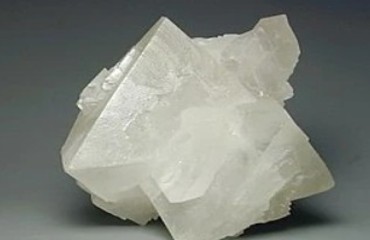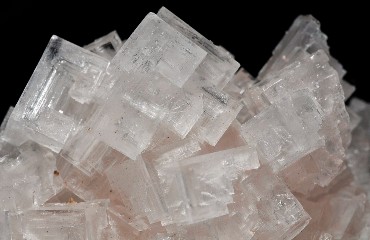
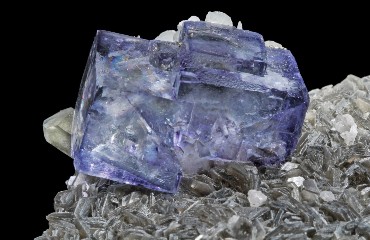
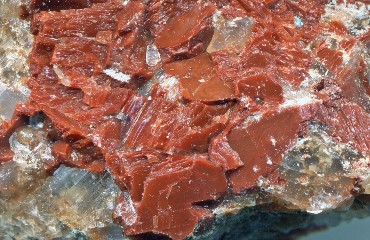
Halite, Fluorite and Sylvite Image Credits – Parent Géry, CC BY-SA 3.0, Parent Géry, CC BY-SA 3.0, James St. John CC BY 2.0
The halide group of minerals forms a distinctive family characterised by the presence of the halogen elements – fluorine, chlorine, bromine, or iodine – combined with metals such as sodium, calcium, magnesium, potassium, or silver. Though they represent a relatively small proportion of the mineral kingdom, halides are both scientifically important and visually appealing. Their simple chemical compositions and perfect cubic or octahedral crystal forms make them familiar to every collector, while their modes of formation reveal much about the processes of evaporation, volcanic activity, and hydrothermal alteration.
Halide minerals are typically defined by their general chemical formula, MX, in which M represents a metal cation and X is one of the halogen anions (F⁻, Cl⁻, Br⁻, I⁻). The resulting ionic bonds give these minerals distinctive physical properties – softness, relatively low hardness (often between 2 and 4 on the Mohs scale), and easy cleavage along one or more directions. They commonly form in evaporitic or volcanic environments where saline waters concentrate through evaporation or where gases rich in halogens react with metals at high temperatures.
The Most Common Halides
The best-known member of the group is halite, or rock salt, sodium chloride (NaCl). It crystallises in the cubic system, forming colourless to vividly tinted cubes, often transparent enough to read through. Halite forms by evaporation of saline waters in arid climates – classic examples being the Great Salt Flats of Utah, the domes along the Gulf Coast, and the thick deposits of Stassfurt, Germany, which have been mined for centuries. In nature, halite is highly soluble, so fine crystals rarely survive for long in humid climates. Impurities can impart attractive colours: iron oxides produce orange or red hues, organic matter yields blues or purples, and inclusions of fluid bubbles can give a milky appearance. Because of its perfect cubic cleavage and crystal form, halite is one of the easiest minerals to identify.
Closely related is sylvite, potassium chloride (KCl). Sylvite resembles halite in form but is usually lighter in colour and forms smaller crystals. It is an important source of potash for fertiliser, and it occurs with halite in evaporite sequences. Pure sylvite crystals are rare in collections, as they are even more soluble than halite and readily absorb moisture from the air.
Fluorite, calcium fluoride (CaF₂), is perhaps the most colourful and best-known halide to mineral collectors. Unlike halite, fluorite is hard enough to take a bright polish and commonly forms perfect cubes, octahedra, or complex combinations. Its colour range – from colourless to purple, blue, green, yellow, and pink – is unmatched among non-metallic minerals. Fluorite occurs in a wide variety of environments: hydrothermal veins with galena and sphalerite, cavities in limestones, pegmatites, and contact-metamorphic deposits. Fluorite’s perfect octahedral cleavage and ability to fluoresce under ultraviolet light give it special appeal. Fine examples come from Weardale, England; Elmwood, Tennessee; southern Illinois; and the classic mines of China and Mexico.
Other halides are less common but equally interesting. Cryolite (Na₃AlF₆), once mined at Ivittuut, Greenland, was the principal source of aluminium before modern electrolytic methods were developed. Transparent, colourless cryolite crystals are rare, and massive specimens resembling frozen grease are more typical. Villiaumite (NaF) forms vivid carmine-red octahedra in nepheline syenites and is so soluble and toxic that it must be kept dry and handled with care. Carnallite, a hydrated magnesium-potassium chloride, occurs as a deliquescent mineral in potash deposits and is used as an ore of magnesium. Atacamite, boleite, and cumengeite represent secondary copper halides found in arid, oxidised zones of copper deposits; boleite and cumengeite, from the Amelia Mine in Baja California, are famous for their deep blue colour and striking cubic and pseudo-cubic crystals.
Formation and Occurrence
Halide minerals commonly form by evaporation of saline waters in closed basins or marine lagoons, where increasing concentration causes successive precipitation of carbonates, sulfates, and finally halides as the last stage. This process created immense Permian salt beds in Europe and North America. In volcanic regions, halides can also precipitate from hot gases escaping fumaroles; for instance, sublimed halite, sylvite, and fluorite occur around vents at Vesuvius and Etna. Hydrothermal fluids rich in halogens can deposit fluorite or rare complex halides in veins and cavities. Because most halides are soluble, well-preserved crystals are often found only in arid climates or protected cavities deep underground.
Properties and Uses
Halides are typically soft, low-density, and easily cleaved. Many dissolve rapidly in water and are sensitive to humidity, so collectors must store them in sealed containers or desiccated cabinets. Despite their fragility, several halides are economically important. Halite is indispensable for food and chemical industries, sylvite and carnallite provide essential potash fertilisers, fluorite is used in metallurgy and to make hydrofluoric acid, and cryolite once revolutionised aluminium production. In addition, their transparency and wide colour range make halides favourites for collectors and educators alike.
Conclusion
The halide group, though small, offers a remarkable variety of colours, habits, and geological stories. From the purple brilliance of fluorite to the delicate cubes of halite and the blue geometries of boleite, halide minerals bridge the worlds of chemistry, geology, and art. They remind us that even the simplest chemical compounds – mere combinations of metals and halogens – can yield some of nature’s most captivating crystals.
If you are interested in adding specimens of halide minerals to your collection, click HERE.
If you are specifically looking for fluorite specimens, please click HERE.