
In an age of online databases and other internet resources, it’s easy to forget that many minerals can still be identified using the same simple tests collectors relied on a century ago. These at-home techniques require only a few inexpensive tools and a bit of patience – perfect for beginners and seasoned enthusiasts alike.
Start with hardness, one of the most reliable traits. Using the Mohs scale, try scratching your specimen with a fingernail (hardness 2½), a copper coin (3), a knife blade (5½), and a piece of glass (6). The point where it starts to resist scratching gives you a good hardness estimate.
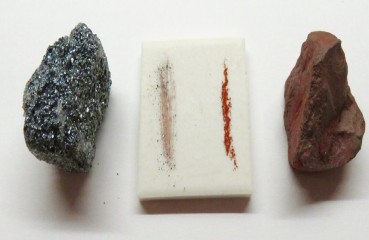
Next, check the streak – the colour of a mineral’s powdered form. Drag the specimen across a piece of unglazed porcelain (a “streak plate”). Hematite, for example, always leaves a reddish-brown streak, even when its surface looks metallic grey.
The crystal habit is often a useful clue. For instance, fluorite, quartz, baryte and many other minerals form very distinct and often unique crystal shapes.
Acid solubility is another classic test. A small drop of diluted hydrochloric acid (or even household vinegar for safety) will fizz on some carbonates like calcite, confirming their chemical composition and likely identity.
Observing cleavage and fracture can also help. Some minerals split cleanly along flat planes (cleavage), while others break irregularly (fracture).
A few other clues can be surprisingly helpful. Specific gravity – how heavy a specimen feels for its size – can easily distinguish barite from quartz. Lustre (metallic, glassy, dull, or silky) and transparency also guide identification.
Also, consider the environment of origin. Knowing whether your specimen came from a pegmatite, limestone, or basalt can narrow the possibilities quickly.
Finally, be aware that colour is probably the least reliable method of identifying minerals. Colour is often caused by inclusions rather than the mineral itself, which means that it is very easy to make a mistake just by looking at colour alone.
By combining these simple observations, collectors can solve most identification puzzles without expensive equipment. So the next time you wonder whether that dark, metallic crystal is hematite or goethite, go back to basics - the answers are right at your fingertips.