
Sweden is one of Europe’s underrated mineral counties, yet it abounds with mineralogical wealth that rivals many of the continent’s more famous locations. At the root of its rich mineral diversity lies the Fennoscandian Shield - ancient Precambrian crust dominated by granites and gneisses, with belts of volcanic and sedimentary rocks that were later folded, metamorphosed and mineralised. The best-known ore province is Bergslagen in south-central Sweden, where 1.9-billion-year-old volcanic–carbonate successions host classic skarn iron deposits and polymetallic sulfides, underpinning a mining tradition that reaches back to the Middle Ages and helped shape Sweden’s industrial rise. In the far north, the Kiruna–Gällivare region contains world-class iron oxide–apatite ores dominated by magnetite and apatite, still worked on a vast scale today. Northern Sweden also includes the Skellefteå field, a globally important belt of volcanic-hosted sulfide deposits rich in zinc, copper, lead, silver and gold, while rare-element pegmatites and alkaline complexes add famous mineralogically significant localities such as Utö, Ytterby and Alnö. Together these sites tell a comprehensive story - ancient geology, centuries of mining innovation, and a mineral palette ranging from magnetite, chalcopyrite and sphalerite to highly unusual rare-earth minerals and classic type-locality species.
For a Map of Mineral Locations in Sweden click HERE
|
The Bergslagen Mining Province
Ore Smelter at Västmanland - Image Credit: Jonas Löwgren, CC BY 2.0 The Bergslagen is a mining province in south-central Sweden that runs for about 200 kilometres from Kristinehamn in the southwest to Sandviken in the northeast. It ranks among the world’s oldest mining and most studied mining regions, renowned for its rich deposits of iron ore, base metal sulfides, and precious metals, including gold and silver. Mining here dates to the Iron Age, featuring hundreds of metallic mineral deposits. Some, like Garpenberg and Zinkgruvan remain active today and over the centuries have helped power Sweden’s industrial rise. Geologically, Bergslagen is essentially a block of ancient Paleoproterozoic crust dominated by 1.9-billion-year-old felsic volcanic and volcaniclastic rocks (tuffs, rhyolitic units and related intrusions) interlayered with sediments that include limestones and dolostones. These carbonate layers are the main reason why Bergslagen hosts so many diverse mineral deposits (skarn-magnetite, VMS and stratiform Zn-Pb-Ag sulphides). That’s because during later metamorphism and deformation, hydrothermal fluids and intrusions reacted with these carbonates to form ‘calc-silicate’ assemblages (skarns), while depositing and concentrating iron and other base-metals. The result is the area’s almost unprecedented mineral richness, consisting of vast iron and other-base metal reserves, as well as at least 620 individual mineral species, among them 161 type location minerals.
For a specific map of Mineral Locations in Bergslagen click HERE |
|
Bergslagen Iron Deposits – Riddarhyttan (incl. Bastnäs), Persberg (incl. Harstigen), Dannemora and Norberg (incl. Malmkärra & Östanmossa)
Cerite-(Ce) from Riddarhyttan - Image Credit: Didier Descouens, CC BY-SA 3.0 Bergslagen is especially well-known for its numerous and economically important iron deposits. Among the most notable are Riddarhyttan, Persberg, Dannemora and Norberg. Riddarhyttan in the province of Västmanland is the oldest confirmed iron-mining site in Sweden where carbon dating of smelting remains has indicated that iron working began somewhere between 700 and 400 BC, lasting intermittently until 1979. The deposit was probably first discovered due to the iron-stained soil in the region, especially in the area called Röda Jorden (red earth). Geologically, the iron ore lies within the classic 'calc-silicate' skarn mineral assemblage, consisting mainly of magnetite associated with skarn-type minerals like pyroxenes and amphiboles. In addition to iron, a small region within the wider Riddarhyttan field contains a notable and almost unique cerium mineralisation. The element was first discovered here in 1803 by Jöns Jakob Berzelius and Wilhelm Hisinger in the form of its oxide, ceria. Subsequently, the deposit was worked as the Bastnäs Mines, producing 4,500 tons of cerium ore (mainly cerite-(CeCa) and ferriallanite-(Ce)) between 1875 and 1888. Other cerium-bearing minerals include britholite-(Ce), dollaseite-(Ce), synchysite-(Ce) and parisite-(Ce), as well as the mines being the type location for five additional cerium minerals like bastnäsite-(Ce) (named for the location), percleveite-(Ce) and ferriperbøeite-(Ce). The element lanthanum was also first discovered in minerals from Bastnäs (by Carl Gustav Mosander in 1839), including the type location species håleniusite-(La). Finally, Bastnäs is the type locality for the complex cobalt sulfide linnaeite. Persberg in Värmland is another typical skarn iron deposit which was one of the first to be studied in detail – thereby linking Persberg to the first use of the term ‘skarn’. In addition to iron mining, Persberg is also notable for a manganese mineralisation which was worked by the Harstigen Mine. Although a small operation between 1847 and 1889, producing only about 356 tonnes of iron ore and 153 tonnes of manganese ore, the mine is renowned as the type location for 9 rare manganese minerals, namely, barysilite, brandtite, caryopilite, flinkite, ganophyllite, harstigite, pyrophanite, sarkinite and trimerite. Dannemora in Uppland province is another skarn-type magnetite field, over 3km in length and around 400 to 800 metres in width, historically prized for low-phosphorus iron and again noted for manganese-rich components and minor base-metal/silver by-products, feeding the Lövstabruk iron works. Since the lodes are shallow, most of the iron ore was worked by around 50 open-cast mines, the largest of which, Storrymningen, is 200 m long and 100 m deep. Norberg in Västmanland County is the fourth, and arguably the largest, of the iron skarn deposits in the Bergslagen mining province. Ore extraction began here more than 700 years ago and grew rapidly to become one of the most important iron mining areas in Sweden, ceasing only in the late 20th century. The geology consists of old volcanic rocks that surround folded layers of altered carbonate rock hosting the mineralised zones, mainly iron (sometimes with manganese) oxides, with smaller amounts of sulphide minerals. As with various other Bergslagen locations, Norberg is also noted for a suite of rare element minerals including those of cerium, yttrium, gadolinium, neodymium and lanthanum. Among the 30 or so minerals of these elements, several type location species have been identified, many from the Malmkärra Mine: åsgruvanite-(Ce), fluorbritholite-(Nd), ulfanderssonite-(Ce) and västmanlandite-(Ce). Four further type location minerals have also been reported: fluoborite from Tallgruvan; and norbergite (named after the ore field), arrheniusite-(Ce) and dollaseite-(Ce) from the Östanmossa mine. |
|
Bergslagen Copper, Cobalt, Tungsten and Silver Deposits – Håkansboda, Kopparberg, Yxsjöberg, Garpenberg, Sjögruvan & Nordmark
Glaucodot - Image Credit: Robert M. Lavinsky, CC BY-SA 3.0 As well as its rich iron deposits, the Bergslagen region is similarly famous for a significant number of other metallic deposits, also closely associated with the underlying highly modified carbonate rocks and skarns.
Kopparberg lies in Ljusnarsberg, Örebro County, within the Bergslagen mining district, and developed around copper working that began after the ore field was discovered in the 1620s. Initially, the ores were mined north of the town of Kopparberg that grew rapidly with the expansion of mining. The deposits are typical Bergslagen carbonate-volcanic systems, where sulphide ores occur with skarn developed between dolomitic carbonate rocks (locally ophicalcite) and altered metavolcanics, a setting that also yields distinctive calc-silicate minerals. Early copper output peaked in 1649 before slowly declining, but by the early 19th it had resumed, becoming a major supply of the world's copper, and a considerable contributor to the Swedish economy. Eventually, copper production from here ceased in late 19th century. Nevertheless, the nearby Kaveltorp Mines, just south of the town, (discovered 1849; production from 1857) took over as the leading polymetallic workings for Cu-Pb-Zn-Ag, continuing until the 1970s, with individually named mines including Haraldsgruvan (the oldest in the area), Katarinagruvan and Auroragruvan among many others. Notable minerals include chalcopyrite, pyrite, arsenopyrite, sphalerite, galena and calcite. However, the most notable minerals from Kaveltorp are its striking specimens of the magnesium silicate, chondrodite, and the type location complex sulfosalt valleriite, specifically from the Aurora Mine.
Yxsjöberg, located near the northern border of Örebro County, is another classic Swedish skarn deposit in the Bergslagen mining district. However, atypically, the ores here are mainly those of tungsten, where tungsten-bearing fluids reacted with carbonate rocks and adjacent igneous rocks, creating calc-silicate skarn and concentrating the metal mainly as scheelite (locally also molybdoscheelite) with associated Ca-rich skarn minerals. The deposit was discovered in 1728 and was a minor copper producer until the demand for tungsten rose sharply in WW1. Afterwards, the mine’s fortunes fluctuated widely depending on the price of the metal, supplemented by fluorite, eventually closing in 1989. Notable minerals include scheelite (often with purple fluorite and quartz), plus skarn assemblages such as garnet, ilvaite, and sulphides like pyrrhotite/pyrite and sphalerite recorded on the dumps. In addition to tungsten the ore field was also noted for minor molybdenum, occurring mostly as molybdenite.
Sjögruvan is a small but mineralogically interesting Fe–Mn occurrence at Grythyttan in Hällefors Municipality (Örebro County), within the Bergslagen mining district. The ores occur in dolomitic carbonate rock, and the deposit is best known for iron and manganese oxides rather than sulphide metals. Mining was brief but well documented - during 1886 to 1889 the workings produced about 303 tonnes of manganese ore and 85 tonnes of iron ore, and the mine was only around 16 m deep when it was abandoned, largely due to flooding caused by the nearby lake. The iron ore is reported as mainly hematite, while the manganese ore is dominated by hausmannite, braunite, and rhodonite, with dolomite common in the host rock and dump material. Sjögruvan is the type locality for several interesting minerals including arseniopleite, manganberzeliite, melanostibite and örebroite.
|
|
Åskagen Quarry, Persberg, Filipstad, Värmland
Åskagenite-(Nd) - Image Credit: The Assay House, Public Domain The Åskagen Quarry, near Filipstad, Värmland, lies within the same Bergslagen mineralisation as the metal bearing deposits described above, but is presented separately because it is famous for its granite pegmatite and unusual REE–Y mineralogy rather than metal content seen elsewhere in the region. Historically, the lake-side site was worked mainly as a quartz quarry between 1882 and 1916, and while it left only a modest surface footprint it has created an outsized mineralogical legacy. That is because the pegmatite, quartz and feldspar host a suite of rare yttrium/rare-earth silicates and carbonates, including thalénite-(Y), tengerite-(Y), keiviite-(Y), gadolinite-(Y) and allanite-group minerals, with several species recorded as type locality minerals - most famously åskagenite-(Nd) (and also allanite-(Nd) and allanite-(Y) in type-locality listings). Today, the mineralogical site is essentially the small quarry itself, valued by collectors for micromount-scale REE minerals rather than large specimens. |
|
Långban Ore District, Filipstad, Värmland
Native Lead - Image Credit: Ra'ike, CC BY-SA 3.0 Although Långban, in the Filipstad area of Värmland once again lies within Sweden’s Bergslagen province, it deserves individual attention as one of the world’s richest mineral districts and a landmark locality for collectors and mineralogists alike. Geologically it is a dolomite/marble-hosted iron–manganese deposit that has been strongly metamorphosed and repeatedly intruded by hydrothermal fluids, producing an unusually complex skarn–carbonate assemblage and an exceptional variety of accessory phases. Mining here probably began in the 15th century, focussing mainly on iron and manganese ores, with later extraction shifting to dolomite after the 1950s as metal mining declined. The area’s widespread workings are collectively referred to as the Långban Mine within the wider Långban Ore District, with multiple pits and dumps that have yielded the locality’s variety of nearly 340 individual mineral species, the enormous diversity being Långban’s standout feature. Notable minerals include hausmannite, rhodonite, braunite and ludwigite, but Långban’s real fame is its type-locality record, a listing that exceeds 80 valid mineral species. Among these are långbanite and långbanshyttanite, both named for the location itself. While specimens of Långban’s minerals continue to circulate from old collections, collecting across much of the area is not possible today due to its protected status. |
|
Falun (Falu Gruva), Dalarna
Falun Mine Museum - Image Credit: Pudelek, CC BY-SA 4.0 Falun is another major Bergslagen deposit worth highlighting, not least because it ranks among Scandinavia’s most historically significant mining landscapes. Geologically, the deposit is a highly metamorphosed, sulfide-rich system dominated by an Fe-Zn-Pb-Cu-(Au-Ag) mineralisation, consisting of massive to semi-massive ores and remobilised zones hosted in 1.9-billion-year-old Paleoproterozoic volcanic–sedimentary rocks that were later deformed and altered, with pyrite, chalcopyrite, sphalerite and galena forming the core ore suite. The different rock types in the area include leptites, mica schist, and quartzite along with marble, skarn, quartz porphyry intrusions and amphibolites. Mining is documented at least from the 13th century, peaked in the 17th century, and continued until closure in 1992, after which the mine became a major heritage and museum site and now part of a UNESCO World Heritage list. The principal working is the Falun Mine itself (including the famous Stora Stöten (‘Great Pit’), with surrounding satellite workings in the district. Notable collector minerals include bright chalcopyrite and pyrite, as well as sphalerite and galena, and a distinctive suite of bismuth-bearing sulfosalts/selenides. The overall mineral listing includes 61 valid minerals from the mine, including 7 type locality species: albite, botryogen, fluocerite-(Ce), gahnite, nordströmite, weibullite and wittite. |
|
Utö Mines, Utö, Haninge, Stockholm
Magnetite-Holmquistite-Epidote - Image Credit: James St. John, CC BY 2.0 Utö (Utö island) lies in the Stockholm archipelago and was Sweden’s oldest continuously mined district, worked for iron ore since in the 12th century and finally closing in 1878 (with minor silver mining in the 17th century). Geologically, the area consists of several Proterozoic pegmatite dykes that cut the basement rocks in northern Utö, especially around the historic iron mines. These were studied chemically by the Swedish chemist Johan August Arfvedson, who identified the presence of a new alkali metallic element in 1817, naming it "lithium" (from Greek lithos, "stone"). The discovery came from a new mineral called petalite, for which Utö is also the type location. In addition, because of the lithium content, these dykes were the first to be classified as lithium pegmatites, a type of coarse-grained, intrusive igneous rock, enriched in lithium-silicate minerals and sometimes along with tantalum, niobium, and cesium. Apart from petalite, Utö is also the type location for holmquistite, manganotantalite and spodumene, together with common pegmatite minerals such as quartz, feldspar, lepidolite, tourmaline and beryl. |
|
Ytterby, Resarö, Stockholm
Gadolinite-(Y) - Image Credit: The Assay House, Public Domain Ytterby is a small village on Resarö in the Stockholm archipelago, and its quarry is one of geology’s and mineralogy’s most globally important historic sites. The deposit is a coarse granite pegmatite dyke that was worked first for quartz from the 1600s, then increasingly for feldspar used for glass and porcelain manufacture, with production continuing into the early 20th century before closure. Throughout its working life miners in the quarry regularly met unusual minerals which became the subject of intense curiosity and study. Analysing a specimen in 1794, the Finnish chemist Johan Gadolin found what he correctly surmised to be a new chemical element, naming it yttrium after the location. Eight years later, another sample studied by the Swedish chemist Anders Gustaf Ekeberg yielded the element tantalum. Terbium, erbium and ytterbium followed in the mid-19th century, all continuing the naming tradition began by Gadolin. By the end of the century, Ytterby had become the world’s richest single source of rare elements adding gadolinium, holmium, thulium, scandium, lutetium and tantalum to the list. Where all these elements came from originally is unknown except that they must have once been present in the earth’s mantle. What is known is that during the cooling of the magmatic intrusion to form the pegmatite these rare elements did not fit into the crystal structures of common minerals and were concentrated into a "residual melt". The Ytterby deposit is classified specifically as an NYF-family pegmatite (enriched in Niobium, Yttrium, and Fluorine), which specifically favours the concentration of rare earth elements, particularly yttrium and heavy lanthanides. These rare elements crystallised into specific, dense, dark minerals. The most significant of these was gadolinite (historically ‘ytterbite’), the source of many of the new elements, along with others like fergusonite-(Y), lokkaite-(Y), formanite-(Y) and kimuraite-(Y). In addition, Ytterby is the type location for yttrotantalite-(Y) and tangerite-(Y), as well as the aforementioned gadolinite-(Y). |
|
Smålands Taberg, Månsarp, Jönköping
Smålands Taberg Mountain c.1910 - Image Credit: Digitalmuseum.org, Public Domain Smålands Taberg mountain rises just south of Jönköping in Småland (about 12 km south of Lake Vättern) and is famous for its unusual Fe–Ti–V oxide ore hosted in a 1.2-billion-year-old ultramafic to mafic intrusion. Unlike Bergslagen sites, Taberg is a magmatic ‘oxide accumulation’ deposit, where ore layers are dominated by titanomagnetite (intergrowths of magnetite with ilmenite/spinel), together with abundant olivine and minor plagioclase, as well as small amounts of sulfides like pyrrhotite and chalcopyrite. Mining has a long, intermittent history. The first privileges were issued in the early 1600s under Gustav II Adolf. At the time, for unknown reasons, the iron produced from local ores proved unusually hard and was therefore of great use militarily. This led to the mine’s reopening during WWII for identical reasons. The cause of the hardness was discovered in 1830 by the chemist Nils Gabriel Sefström who found that Smålands iron ores contain the element vanadium dispersed through the oxides, small amounts of which enter the iron during smelting, thereby unintentionally creating a vanadium-alloyed iron that is noticeably harder and tougher than iron lacking vanadium. Not only did this explain the metal’s resistance to shock, corrosion, and high temperatures, but was also the world’s first confirmed discovery of the new element. As well as metallic ores, the Smålands deposit also presents a number of other notable minerals of igneous origin which include olivine, garnets, chromite, mica group, forsterite, epidote and serpentine-group alteration products. |
|
Malmberget, Gällivare, Norrbotten
Stilbite and Fluorite - Image Credit: Robert M. Lavinsky, CC BY-SA 3.0 Malmberget (‘the Ore Mountain’) is a major iron-ore field at Gällivare in Norrbotten, northern Sweden, worked today by several large, deep underground operations. Geologically it is an iron oxide–phosphate (IOA) system, consisting of magnetite- and hematite-rich ore bodies with significant amounts of apatite, hosted within Paleoproterozoic volcanic rocks and strongly altered by later metamorphism. Mining is recorded from 1741, with large-scale growth tied to the arrival of rail transport in the late 19th century, and the modern mine comprises several named mines including Koskullskulle, Vitåfors, Välkomman, Kapten, Tingvallskulle, Fredrika and Kungen. For collectors, the standout minerals are magnetite and hematite with apatite, with common associates such as amphiboles, pyroxenes (e.g., hedenbergite/diopside), titanite, vermiculite, mica group, stellerite, fluorite, calcite, epidote, stilbite, diopside, feldspars and minor sulphides like pyrite and molybdenite. |
|
Gladhammar mines, Västervik, Kalmar
Gladite - Image Credit: The Assay House, Public Domain Gladhammar, near Västervik in Kalmar County (southeast Sweden), is a historic cobalt–copper mining area whose workings are clustered on the slopes above local lakes, and it remains one of Sweden’s oldest and best-known cobalt localities. Work at the site may have started in the 12th century but was initially for iron. The first reliable record officially dates the site to 1525, followed by a transition to copper mining in the 1560s. Cobalt extraction began in 1777, but the mines eventually closed in 1892. During it’s last century of operation about around 4,260 tonnes of cobalt ore (about 6% grade) were extracted, making Gladhammar Sweden’s largest historical cobalt producer. The workings formed three main NW–SE groups: Ryssgruve Field, Holländare Field and Solbergs Field, spread across roughly 1 kilometre. The Holländare Field was the most important, on the slopes of Käringryggen hill above Lake Tjursbosjön. Geologically, the deposit consists of cobalt-rich sulphide ores hosted in Paleoproterozoic rocks in distinct zones of iron, copper, cobalt and very occasionally with native gold. Recent prospecting has focussed on the possibility of rare earth elements, but this work is incomplete. For collectors, the locality stands out for common sulphides like chalcopyrite, pyrite, arsenopyrite) and several cobalt minerals but is especially notable as the type locality for the complex Bi–Pb–Cu sulfosalts gladite, hammarite and lindströmite. Today, onsite collecting is limited due to the removal of the dumps by 2011 to reduce leakage of highly toxic As, Co, Cu and Pb runoffs into the lake, leaving only very limited material for modern scientific study. |
|
Skrikerum Mine, Valdemarsvik, Östergötland
Crookesite - Image Credit: David Hospital, CC BY-SA 4.0 Skrikerum (Skrikerumsgruvan) is a small but mineralogically famous Cu–Ag–Pb–Se mine in Valdemarsvik Municipality, Östergötland, set in a hilly forest landscape that is now a protected nature reserve. Geologically it is best known for its unusual selenide-rich mineralisation - a hydrothermal copper deposit where selenium became concentrated into distinctive Cu–Ag selenides alongside more typical copper sulfides and carbonates. The mining history is unusually well documented. Copper was worked from 1779 to 1784, then copper and selenium from 1826 to 1832, and later a short phase for selenium only between 1898 and 1899. The locality became scientifically famous when Berzelius first described the element selenium from here in 1817–1818. The principal working is the Skrikerum Mine itself, but its “leading output” today is mineralogical. It is the type locality for berzelianite, eucairite, crookesite, and selenojalpaite, and is also noted for umangite, chalcomenite, klockmannite, sabatierite, stromeyerite and some native silver in calcite-rich material. |
|
Tunaberg, Nyköping, Södermanland
Cobaltite - Image Credit: Ra'ike , CC BY-SA 3.0 Tunaberg is a Bergslagen-type ore area about 14 kilometres from Nyköping in Södermanland, where the mineralisation sits in skarn developed from carbonate horizons upon earlier Palaeoproterozoic crustal rocks, giving a mixed ‘iron–skarn–sulfide’ ore with additional Co–Cu sulfides centrally with local Zn–Pb–Ag enrichment at the margins. Mining for iron began in Medieval times from around the early 1400s, when King Erik of Pomerania granted mining privileges, before turning to other metal ores as their particular mineralised zones and lenses were encountered. Individual mines and ore fields recorded include Hultebo, Mormorsgruvan, Österbergsgruvan and Dammgruvan among others. Notable minerals reflect the skarn and sulfide association, especially fine crystals of cobaltite, chalcopyrite, pyrrhotite, sphalerite and galena with quartz, as well as skarn silicates such as diopside–hedenbergite, tremolite and garnet. The Mormorsgruvan mine is noted as the type locality occurrence for hedenbergite. The Strömshult mine is notable for a type of rock called ‘eulysite’ first described from here by A. Erdmann in 1848, which consists of pyroxene, garnet, olivine, amphiboles and some magnetite, known to have experienced higher grade metamorphism than similar rocks from other mines in the area. |
|
Norra Kärr, Gränna, Jönköping
Mosandrite-(Ce) - Image Credit: Jyrki Autio, CC0 1.0 Norra Kärr, located near Gränna on the east side of Lake Vättern, is one of the world’s oldest agpaitic complexes, whose formation is dated to about 1.5-billion-years-ago. An agpaitic rock is a low aluminium/high sodium or potassium silicate igneous rock typically containing unusual rare and obscure minerals. The Morra Kärr complex is no different, being rich in zirconium, rare REE-rich minerals like eudialyte and catapleiite, as well as being the type locality for the rock types grännaite, lakarpite, kaxtorpite, and pulaskite. Geologically, the formation consists of an elongated intrusion (1200 x 400 m) emplaced into Precambrian granite gneisses (Svecofennian) which are known collectively as the Växjö granite. Norra Kärr has been known to mineralogists since the early 1900s, but it has no long historic mining tradition. Instead, it has been intensively studied, including recently as a possible source of strategically important REE elements. For collectors, it is a rich source of rare and unusual minerals including arfvedsonite, jinshajiangite, låvenite, lorenzenite, rosenbuschite, and thalcusite, as well as more common species like aegirine, garnet group, epidote, fluorite, microcline, orthoclase, nepheline, quartz, willemite and others. Although it was never mined commercially, Norra Kärr also contains occasional metal-bearing ore minerals including chalcopyrite, galena, ilmenite, pyrite, native silver, native copper, native bismuth and thorite, a possible source of uranium and thorium. |
|
Sala, Sala Town, Västmanland
Queen Christina shaft - Image Credit: Riggwelter, CC GNU Sala is Sweden’s historic silver district, centred on the Sala Silver Mine in Sala Town, Västmanland, on the northern flank of the Bergslagen province. The ore sits in white dolomitic marble that becomes green and skarn-like close to the mineralisation, where tremolite, serpentine, diopside and chlorite accompany the ore sulphides. The main metals are Ag–Pb–Zn, where lead occurs chiefly as galena and zinc as sphalerite, while the silver is largely ‘invisible’ in specimens because it is hosted in complex Sb-bearing antimonides and sulfosalts dispersed through the sulfides, with native silver only found rarely. Mining is documented from the 15th century (with royal charters by the early 1500s), ran continuously until 1908, and saw brief later activity nearby at the Bronäs Mine in the mid-20th century. Collectors value the locality for silver-rich galena and its distinctive Ag–Sb–Hg mineral suite, which include acanthite, freieslebenite, miargyrite, pyrargyrite, eugenite, moschellandsbergite, paraschachnerite, schachnerite and luanheite, alongside attractive carbonate–skarn specimens of marble, granodorite and schist from the historic dumps. In addition, the location is known for three type locality minerals, diopside var. salite, geocronite and native antimony. |
|
Hålsjöberg, Torsby, Värmland
Kyanite - Image Credit: The Assay House, Public Domain Hålsjöberg is a small deposit near Torsby in northern Värmland notable for its striking blue kyanite and worked for aluminium-rich industrial minerals rather than as a metal mine. Geologically it is a kyanite–quartzite body with associated high-alumina and phosphate assemblage. The high aluminium content arose from the chemical leaching of granitoid rocks across a transition zone into the quartz-kyanite area followed by later metamorphism which introduced phosphate. Quarrying began in the early 1900s, and the deposit was worked for some years until closure in the mid-20th century. New prospecting began in 1984 but did not deliver the expected results. Nevertheless, it left behind the remains of Hålsjöberg Quarry and extensive dumps that are the main source of present day specimens. Notable minerals include abundant kyanite and quartz, with rutile and a diverse aluminium suite which includes over 20 different species, including the type locality mineral svanbergite, originally discovered here in 1851. In addition, the location is also known for its phosphate minerals, many of which also contain aluminium. Examples include augelite, berlinite, burangaite, crandallite, ferrowyllieite, gatumbaite, goyazite, lazulite, scorzalite, trolleite and wyllieite. The kyanite was occasionally of gem quality and was marketed as ‘Caribbean Blue’. |
|
Alnö Complex, Sundsvall, Västernorrland
Ijolite - Image Credit: The Assay House, Public Domain The Alnö Complex lies on Alnön Island just outside Sundsvall on Sweden’s central Baltic coast and is one of Europe’s few alkaline–carbonatite ring intrusions, the others being mainly in northern Russia around the Kola Peninsula. It features concentric bodies of alkaline silicate rocks (ijolite, nepheline-syenite, and pyroxenite) and various carbonatite and silicate-carbonatite dykes (sövites, silico-sövites and alvikite respectively) that crop out in a semi-circular pattern, surrounded by a metasomatic fenite halo where fluids altered the country gneisses. Alnöite, a mafic alkaline silicate rock that belongs to the kimberlite family and is melilite-rich, has been named after the island. Since Alnö lacks notable metallic ores, the region was never extensively mined except for some baryte and apatite, mainly during WW2. The apatite was extracted and concentrated by flotation, but the activity proved uneconomic once the war ended. The principal workings are numerous small quarries and exposures rather than a single large mine, with multiple named localities listed across northern Alnön and nearby rocky islands. Notable minerals include calcite/dolomite carbonatite, apatite, titanium-bearing magnetite, perovskite and pyrochlore-group phases, fayalite group, feldspar group, garnet group, and about 30 other rare silicates like tazheranite, fersmite, kaersutite, katophorite, pargasite and kimzeyite. |
|
Nasafjäll Mine, Arjeplog, Norrbotten
Old mining pit on Mount Nasafjäll - Image Credit: Skogsfrun, CC BY-SA 4.0 Nasafjäll (Nasa Silver Mine) sits high on Nasa Mountain at the Swedish–Norwegian border in Arjeplog, Norrbotten, close to the Arctic Circle and around 1,000 m elevation, making it one of Sweden’s most dramatic historic mine sites. Geologically, it is a hydrothermal Pb–Zn–Ag vein deposit, with sulfide ore in quartz veins cutting graphite-rich schists. The silver itself was never found in its metallic native state but rather as the argentiferous ore of lead, galena, where silver replaces some of the lead atoms within the crystal structure. Mining began with great ambition in 1635 until 1659 when the mine was destroyed by attacking Norwegian troops. The second period of operation lasted between 1770 and 1810, with smelting of the ores at Adolfström. Despite the high grade of silver in the galena, neither period was particularly successful due to the remoteness of the site and the harsh weather conditions. Typically supplies arrived and the ore was taken out using sleds pulled by reindeer. The main working is the Nasafjäll mine itself (with related infrastructure along the historic reindeer “Nasa trail”). Notable minerals include galena (often silver-rich), sphalerite, arsenopyrite, chalcopyrite, pyrite, ilmenite, pyrrhotite and secondary lead minerals such as anglesite, as well as classic Pb–Sb sulfosalts like boulangerite and jamesonite from dump material. |
|
Boliden, Skellefteå, Västerbotten
Tellurobismutite - Image Credit: Thomas Binder, CC BY-SA 4.0 Boliden lies within the mineral-rich Skellefteå ore field of Västerbotten in northern Sweden, one of the world’s great Paleoproterozoic volcanic-hosted massive sulfide (VMS/VHMS) deposits. Formed around 1.9-billion-years-ago as a submarine volcanic arc, its volcanoclastic rocks and associated sediments host extensive Zn–Cu–Pb ores, famously accompanied by rich Au–Ag occurrences. The name Boliden refers both to the settlement and to the historically important Boliden ore discovery in 1924 that launched the area’s fame, triggering a century of highly profitable mining and leading to the foundation of the region’s main population centre. During the next century over 30 mines worked here, including the original Boliden mine which closed in 1967. Today, underground ore extraction continues at Kristineberg, Renström and Kankberg mines, all of which produce complex sulfide ores of zinc, copper and lead. However, Kankberg, and formerly Boliden, are better known for their gold, which once made Boliden the largest and richest gold mine in Europe. After its gold reserves were exhausted, mining relocated to Kankberg, which is particularly notable for its distinctive gold–tellurium mineralisation and associated telluride minerals, including petzite, calaverite and sylvanite (and tellurobismuthite) alongside other metal sulfides that commonly include chalcopyrite, sphalerite and galena. The tellurium mined in Kankberg is used, among other things, for solar cell production. |
|
Varuträsk, Skellefteå, Västerbotten
Lepidolite - Image Credit: Hannes Grobe, CC BY-SA 4.0 Varuträsk is a famous rare-element pegmatite locality in Västerbotten, northern Sweden, in the Skellefteå region near the lake Varuträsket. Geologically it is a highly fractionated LCT (lithium–caesium–tantalum) pegmatite, commonly described as strongly zoned (border, wall and intermediate zones around a quartz core) and considered one of Sweden’s best-developed examples of this pegmatite type. It was discovered in 1932 (often credited to Harald Holmgren) and was worked on a small scale, with lithium and caesium mining reported mainly during the 1930s and 1940s. Today it is better known as a site of mineralogical and geological significance than an active mine. The key working was the Varuträsk pegmatite quarry, sometimes promoted locally as the ‘Wilderness Mine’ (Vildmarksgruvan). Notable minerals include petalite and spodumene-(Li), pollucite-(Cs), tantalite-(Mn,Ta), colourful tourmaline varieties, and a rich phosphate suite including varulite (named after the location), whose type locality is Varuträsk. Three other type locality minerals from the site are oxystibiomicrolite, alluaudite and stibarsen. Today, the site consists of several highly overgrown dumps. |
|
Ultevis, Jokkmokk, Norrbotten
Braunite - Image Credit: The Assay House, Public Domain Ultevis is a cluster of mineral occurrences about 100 kilometres west of Jokkmokk in Norrbotten, northern Sweden, spread along a roughly 20-kilometre zone between the Stora and Lilla Luleälven rivers. Several of the sites lie inside the Ultevis Fjällurskog nature reserve. Geologically the best-known deposits are low-grade metamorphic Mn–Fe–Ba–As mineralisations hosted in, and adjacent to, Svecofennian volcanic rocks and marble horizons near a transition from volcanic to sedimentary bodies dated to approximately 1.8-billion-years-ago. At a later date these deposits were enriched hydrothermally by tungsten, molybdenum and uranium, which led to significant interest in the area. However, the uranium was never mined commercially, and the deposits are mainly mineral/geological interest sites rather than producers of any note. Despite this, the prospecting and trials have left numerous small pits across the area which have yielded a surprisingly rich suite of mineral specimens, including several manganese oxides and silicates such as ferrihollandite, manganite, piemonite, braunite, romanechite, spessartine and bixbyite-(Mn). Associated minerals include, scheelite, powellite, svabite, topaz and related skarn–carbonate assemblages. Uranium specimens are very rare, but when found, they typically consist of uraninite, kasolite, parauranophane, uranophane and wölsendorfite. |
|
Kiruna, Norrbotten
Kiruna Mine - Image Credit: Jan Norman, CC BY 2.5 Kiruna is Sweden’s modern iron district, located in Norrbotten (Lapland) above the Arctic Circle, where LKAB works one of the world’s largest underground iron mines. The ores are classic iron oxide–apatite (Kiruna-type/IOA) bodies, consisting of steep, sheet-like masses of magnetite (with local hematite, goethite and ilemnite) containing abundant apatite, emplaced into Paleoproterozoic volcanic rocks around 1.88–1.87 billion years ago and later metamorphosed and deformed. Mining began on an industrial scale in 1898, first as open-pit extraction before moving underground, and the district includes several named ore bodies, notably Kiirunavaara and Luossavaara, with additional deposits such as Tuollavaara and Per Geijer in the wider field. Kiirunavaara is one of the largest underground mines in the world. The orebody is a vein of apatite-bearing magnetite ore 4 km long, 80 m wide stretching to an estimated depth of 2 km. Present day mining has reached a depth of 1045 meters. Historically, Kiruna’s iron deposits were known since at least the late 17th century, but the remoteness of the site meant that no mining took place until the arrival of rail transport in the late 19th century, making the region the cornerstone of Swedish iron supply. For collectors, the notable minerals are magnetite, apatite, and associated gangue such as actinolite–tremolite, calcite, zoisite and diopside, with minor sulphides (e.g., pyrite/chalcopyrite) and their secondary species recorded locally. Iron phosphates are also common, including cacoxenite, frondelite, kidwellite, mitridatite, paravauxite, phosphosiderite, rockbridgeite, strengite and tinticite. Because of ground instability caused by mining activity the city of Kiruna is gradually being relocated to a site approximately 5 kilometres to the east from its present-day location. |
|
Zinkgruvan (Åmmeberg), Askersund, Örebro
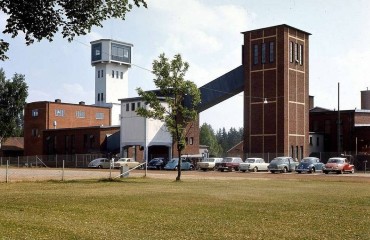
Zinkgruvan Mine Museum - Image Credit: Digitalmuseum.org, Public Domain Zinkgruvan has been operating since the 1860s as a cornerstone Swedish zinc mining and a textbook example of banded, stratiform sulfide mineralisation later overprinted by metamorphism and deformation. The dominant ore minerals are sphalerite and galena, with pyrite/pyrrhotite and minor chalcopyrite plus arsenopyrite in places, where subsequent structural reworking has remobilised galena (and especially silver) into extensive veins and fractures. The entire mineralisation extends for 5 kilometres and to a depth of 1,400 meters, with some of the zinc lenses being up to 40 meters thick of almost entirely solid sphalerite. While not knowing this at the time, the original mining company took a bold gamble on the area’s potential, launching a uniquely ambitious plan for the time. They didn’t just begin mining ore but funded the creation of an entire new town, including homes, hospitals, schools and a port to support the operation. The risk paid off spectacularly and the operation they established not only survived, but is still producing various metals, and at a higher level than ever. Today, the site consists of several shafts and two ore concentrating facilities, one for zinc and one for both lead and copper. The mine itself uses a high degree of automation utilising a combination of longitudinal and transverse long-hole mining methods. Overall, Zinkgruvan represents one of the best examples of Scandinavian base-metal mining evolution from discovery to investment and industrialisation, to modern production, and a promising future. For collectors specimens are few due to industrial methods, but historic specimens can be rewarding - sharp galena, resinous sphalerite, and occasional silver-bearing pieces or unusual textures that show how metamorphism has reshaped the ore. Among rarer minerals are cobaltite, cubanite, laumonite, maucherite, and native bismuth, silver and gold, as well as pentlandite, safflorite, witherite and scheelite. Zinkgruvan is also the type locality for the complex barium-manganese-iron silicate zinkgruvanite, named after the location. |



Sweden rewards collectors because its localities sit on some of Europe’s oldest, best-exposed geology, and that heritage shows up directly in the specimens. Few countries offer such a balanced mix: medieval ore districts like Bergslagen with classic skarn and sulphide suites, world-scale magnetite–apatite iron deposits in the far north, the gold-rich Skellefteå field, and landmark science localities such as Utö, Ytterby and Långban that produced type minerals and even helped define elements. Collecting Swedish material is also inherently “story rich”: labels often connect to centuries of mining history, famous mines, and well-studied geology that makes research and provenance especially meaningful. Buildin a Sweden suite ends up with more than attractive pieces - collectors gain a compact tour of European mining, mineral diversity, and scientific discovery, all anchored by dependable locality information that stands up over time.
If you are interested in adding specimens from Sweden to your collection, click HERE