


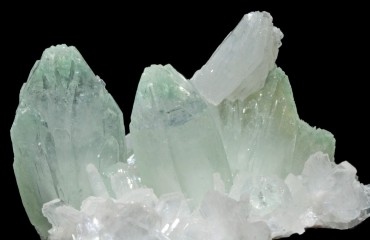
Cavansite on Stilbite, Wagholi Quarry, Apophyllite Image Credits - CC Géry PARENT CC BY-SA 3.0, Hideyuki KAMON, Géry PARENT CC BY-SA 3.0
The Pune mining area, also spelled as Poona, located in the western Indian state of Maharashtra, is one of the world’s most celebrated sources of zeolite minerals. Rather than being a metallic mining district, Pune’s fame rests on the discovery of spectacular crystal-lined cavities within the basalt flows of the Deccan Traps. These ancient volcanic rocks, laid down some 60 to 65 million years ago, form vast plateaus across western India. Over millions of years, fluids circulating through the basalt have created mineral-filled voids filled with dazzling crystals that would later captivate mineral collectors around the globe.
Mining around Pune began primarily for building stone, not minerals. But in the mid-twentieth century, quarry workers began uncovering pockets lined with glistening crystals of apophyllite, stilbite, heulandite and other notable zeolite minerals. Word spread quickly through the world of mineral collecting, and Pune soon became synonymous with Indian zeolites. Unlike traditional ore deposits, the region’s value lies in its mineralogical beauty and diversity.
Among Pune’s most notable quarry sites is the Wagholi district on the city’s outskirts, perhaps the most famous zeolite locality in India. The name 'Wagholi' is derived from the temple of Wagheshwar, which is located at the entrance to this mining complex, 20 km northeast of Pune. 'Wagh' in the local Marathi language means 'tiger'. The entire Wagholi complex comprises around 40 quarries of varying size.
These quarries have yielded countless superb crystals and clusters of apophyllite – transparent, sharply formed prisms often with mint-green colour and striking combinations of stilbite, laumontite, and heulandite on basalt. The dark colour of the matrix rock often provides a striking background to these brightly coloured minerals.
Nearby, the small quarries of Hadapsar have also produced excellent examples of apophyllite, along with delicate sprays of stilbite. The Deccan basalt exposures extending toward Lonavala have yielded gyrolite, mesolite, heulandite, and prehnite – minerals whose colour and perfection rival those from any other location in the world.
However, the most striking minerals from the Pune area are the vivid blue rosettes of cavansite and pentagonite that sparkle against the matrix, together with peach-pink stilbite fans, glassy apophyllite crystals, and silky white scolecite sprays. Together they form one of the most impressive suites of zeolite minerals known to mineralogy.
Today, many Pune quarries are closed or restricted due to urban expansion and safety concerns, but their legacy endures. Specimens from this region remain essential to museums and collectors worldwide, representing a unique chapter in the mineralogical story of India’s remarkable Deccan Traps.
If you are interested in mineral specimens from Pune and India for your collection, click HERE