
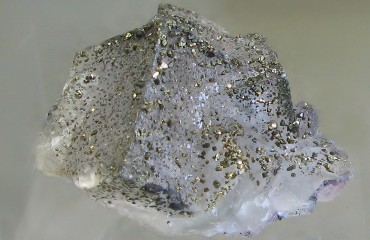
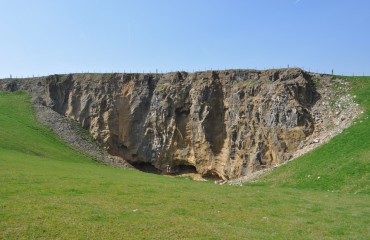
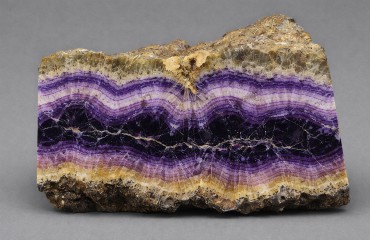
Pyrite on Fluorite, Dirtlow Rake, Blue John Fluorite Image Credits - CC Ra'ike CC BY-SA 3.0, Ashley Dace CC BY-SA 2.0, The Assay House
The Derbyshire mining area, set in the heart of England’s Peak District, holds one of the longest mining histories in Britain. Mining here dates back over two thousand years to Roman times, when the region’s abundant lead deposits were worked to meet the empire’s vast demand. By the medieval period, Derbyshire had become one of Europe’s most productive lead-mining centres, operating under the unique 'Derbyshire Barmote Court' system – an ancient mining law that gave miners rights to claim and work veins of ore and which still exists ceremonially today.
The geology of Derbyshire is key to its mineral wealth. The county sits within the White Peak area of the Peak District National Park, where thick beds of Carboniferous limestone formed over 330 million years ago in a warm tropical sea. As time went on, hot mineral-rich fluids upwelled into cracks within these rocks, leaving behind valuable metallic ores and crystals as they cooled. The channels that guided the hydrothermal flows provided the ideal environment for the formation of galena, fluorite, baryte, and other valuable minerals, which have made Derbyshire famous among miners and collectors alike.
Lead was initially the main focus of the Derbyshire mining industry and was used for roofing, plumbing, and later in paints and ammunition. The primary ore, galena (PbS), was found in rich veins cutting through the local limestone, often alongside the zinc ore sphalerite (ZnS) and the copper ore chalcopyrite (CuFeS₂). Fluorite, baryte, calcite, and quartz were common associates. Deep mines were few, the majority of the minerals being taken from shallow pits, quarries or 'rakes', long trenches in shallow veins along the surface. Eventually, as lead ores began to run out, miners turned their attention to other minerals, usually deeper within the veins, especially baryte and fluorite.
Significantly, the Derbyshire fluorite differs from other British locations in many interesting ways. For instance, it rarely forms large crystals, and these tend to be pale, colourless or yellow. Where colour exists, the specimens tend to be blue-purple or pink-violet. Often, the colour only runs along the edges, leaving the interior clear. Some fluorite crystals contain tiny inclusions, including marcasite, and are sometimes covered by thin crusts of calcite or baryte. And finally, Derbyshire fluorite is not normally fluorescent.
The area around Castleton is famous for a particular type of fluorite called 'Blue John'. It is a rare and semi-precious form of the mineral, distinguished by unique and beautiful bands of deep purple-blue, white, and yellowish colours. The name is thought to come from the French term 'bleu et jaune', meaning 'blue and yellow', and it was once prized for use in ornaments and jewellery. The colour banding is thought to come from organic inclusions. The fluorite here sometimes also exists as jet-black cubes, but they, like Blue John, are increasingly scarce, so the extraction of any fresh material is severely restricted.
In addition to these well-known minerals, Derbyshire is also noted for producing fine specimens of pyromorphite, cerussite, anglesite, smithsonite, and witherite. Pyromorphite and anglesite, both lead secondary minerals, were formed in the oxidised zones of the old lead mines and are highly sought after by collectors for their bright colours and crystal forms. Witherite and barytocalcite, once also mined commercially, occur in striking white and honey-coloured crystal clusters at sites such as Bradwell. Arbor Low in Middleton Common is famous for a unique variety of baryte called 'Oakstone', a stalactitic formation consisting of alternating bands of dark and pale brown mineral. These were often cut into slices and polished for use as decorations.
Some of the most notable mines in the Derbyshire orefield include the Odin Mine near Castleton – one of the oldest recorded lead mines in England, believed to date back to the 13th century or earlier. The Magpie Mine near Ashford is another historic site, its ruins still visible today; it was active well into the 20th century and is now preserved by the Peak District Mines Historical Society. Other famous workings included the Cromford and Wirksworth mines, both major producers in the 18th and 19th centuries which supported thriving local communities. One of the largest and richest rakes was 'Dirtlow Rake', a major hydrothermal fissure-vein complex, extending for over 6 km. Unfortunately, because most Derbyshire mines were shallow, the traces of many former workings have disappeared and been lost to time.
By the late 19th century, the once-booming local mining industry faced decline due to falling demand and international competition. Many miners left the area altogether. Today, the landscape is dotted with sporadic reminders of this rich heritage – empty rakes, crumbling stone walls, and capped shafts that tell the story of generations of miners.
An interesting fact is that Derbyshire’s lead miners were among the first in Britain to use gunpowder for blasting in the 17th century, revolutionising underground mining. Today, the region’s legacy endures through the Peak District Mining Museum at Matlock Bath and preserved sites like Magpie Mine, celebrating Derbyshire’s enduring contribution to Britain’s industrial and mineralogical history.
If you are interested in mineral specimens from Derbyshire and the United Kingdom for your collection, click HERE