


Liroconite, Botallack Mine, Chalcopyrite var. Blister Copper Image Credits - CC Marie-Lan Tay Pamart CC BY 4.0, Robert Pitman CC BY-ND 2.0, Didier Descouens CC BY-SA 3.0
Cornwall, on England’s rugged southwest peninsula, has a mining story that stretches back thousands of years. It dates back to the Bronze Age, when early inhabitants extracted tin from river gravels and shallow workings. By Roman times, Cornwall was already well known across Europe for its tin, which, alloyed with copper, produced bronze – the essential metal of early civilisation. Some argue that tin was the primary reason for the Roman invasions of Britain in AD 43 and again in AD 54-55. The region later became one of the world’s most important mining districts, pioneering technologies and sending its miners and engineers to every continent.
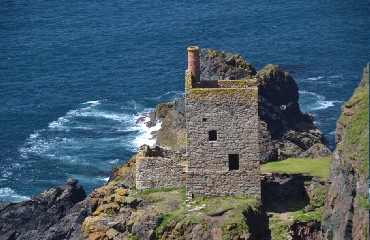
Cornish mining flourished from the 18th to the mid-19th centuries. Steam technology, perfected by local inventors, such as Richard Trevithick, revolutionised deep mining by draining water from shafts and therefore allowing access hundreds of metres underground. Tin and copper were the primary metals, though later the area also yielded notable amounts of lead, iron, zinc, and arsenic. At its height, Cornwall was dotted with thousands of engine houses and chimneys, their ruins still forming an iconic part of the landscape today. However, when global metal prices collapsed in the late 1800s, many mines closed, prompting a wave of emigration. Cornish miners carried their knowledge and skills to Australia, South Africa, Mexico, and the Americas.
Cornwall’s mineral wealth originates from an upwelling of molten granite that intruded through surrounding Devonian and Carboniferous slates about 300 million years ago. As it cooled, the granite released hydrothermal fluids rich in tin, copper, and other metals, which circulated through cracks in the rocks and formed mineralised lodes. These veins produced the distinctive assemblage of cassiterite (tin oxide) and chalcopyrite (copper iron sulfide), often accompanied by quartz, fluorite, baryte, tourmaline, and topaz.
Significantly, the mineralisation had a distinct temperature gradient, where copper was deposited in the upper, cooler zones while tin was laid down in the deeper, hotter areas. This dictated the type of mining undertaken, where most mines initially began working the shallow copper ores until these ran out, before turning to tin lower down. Other mineralisation phases introduced arsenic, lead, tungsten, iron, antimony, zinc, uranium, silver and even some gold.
Among the most famous operations were Dolcoath Mine near Camborne – once the deepest and richest copper, and later tin, mine in the world – and South Crofty and Geevor. Numerous mines along Cornwall's coast, including Botallack and Levant, possessed extensive workings that extended far out below the sea. The St Agnes, St Just, and Redruth-Camborne districts were particularly productive, and the Levant and East Pool mines became known for their pioneering machinery, including the Levant man engine, an innovative way of transporting miners up and down. Many of these sites are now part of the UNESCO Cornwall and West Devon Mining Landscape World Heritage Site, preserving engine houses, dressing floors, and other artefacts as reminders of the area's industrial past.
Although Cornwall is best known for its primary ore minerals, such as cassiterite, chalcopyrite, and arsenopyrite, it stands out for its vast suite of secondary minerals, which currently stands at over 540 valid species. Many of these are brightly coloured copper minerals that form in the weathered areas of copper veins, often as arsenates, and include popular collector favourites like clinoclase, liroconite, cornubite, cornwallite, bayldonite, and chalcophyllite. The classic locations for these specimens lie around the St Day area and include the mines Wheal Gorland and Wheal Unity.
Other notable locations include the Penberthy Croft mine, which also features a number of rare copper minerals, but also those unusually containing lead, nickel, cobalt and vanadium. Their minerals include annabergite, alloclasite, beudantite and mottramite. The Herodsfoot mine is a world classic for the sulfide minerals tetrahedrite and especially for bournonite, which occurs as large, spherical, intergrown crystals known as 'cogwheel' ore, reflecting their shape.
Cornwall is also known for its small, but notable, uranium mineralisation. Three locations are especially well known: South Terras Mine near St Stephen-in-Brannel, Wheal Edward near St Just and the Basset Mines near Carne Brea. Only South Terras was worked commercially for uranium and later for radium. Specimens from these locations include brightly coloured autunite, bassetite, zeunerite, torbernite, saleeite and zippeite.
Cornwall’s mining culture left a global legacy: the Cornish “beam engine” became the template for pumping technology worldwide, and Cornish pasties were designed as convenient, hand-held meals for underground workers. Today, with renewed interest in sustainable domestic resources, exploration for lithium in the region’s geothermal brines may mark the beginning of a new chapter in Cornish mining – linking its proud heritage to the green technologies of the future.
If you are interested in mineral specimens from Cornwall and England for your collection, click HERE