
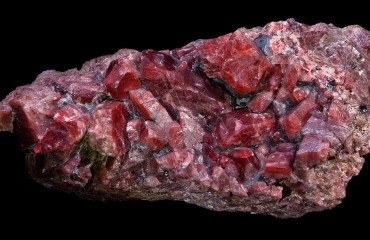


Rhodonite, Block 10 Broken Hill District, Cerussite Image Credits - CC Didier Descouens CC BY-SA 4.0, Public Domain, Géry Parent CC BY-SA 4.0
The Broken Hill mining area in far western New South Wales is one of Australia's most celebrated and productive mining districts. Its story began in 1844, when the explorer Charles Sturt first saw and named the Barrier Range and, at the time, referred to a 'Broken Hill' in his journal.
However, mining only began in 1883, after a boundary rider named Charles Rasp discovered silver ore outcrops on a remote sheep station. What he found turned out to be one of the richest ore deposits on Earth – a massive lode of silver, lead, and zinc that would transform the Australian outback and the country's economy. Rasp and his partners formed the Broken Hill Proprietary Company (BHP), which grew into one of the world’s largest mining corporations and laid the foundation for Australia’s modern mining industry.
The orebody at Broken Hill extended for almost eight kilometres, forming a series of highly mineralised zones that were worked for over a century. The area was divided up into more than 40 blocks, many of which were named by the miners that worked them. Major mines along the line of lode included the North Mine, South Mine, Central Mine, Block 14, and the Zinc Corporation Mine, later consolidated into the Broken Hill South and Broken Hill North companies. These mines produced millions of tonnes of ore, supplying a significant portion of the world’s lead and zinc throughout the 20th century.
Geologically, the Broken Hill deposit is a metamorphosed sediment-hosted orebody, notable for its complex structure and rich variety of ore and secondary minerals. The area has yielded magnificent specimens of galena, sphalerite, anglesite, cerussite, and smithsonite, along with rarer species caused by weathering, such as bustamite and pyroxmangite – minerals prized by collectors worldwide for their vivid colour and crystal form. To date, the location has yielded over 340 valid minerals and served as a type location for twenty-six species, including kintoreite, plimerite, costibite and raspite. However, Broken Hill is probably most famous for its striking crystalline cerussite and for some of the finest specimens of rhodonite ever found on the planet.
Beyond its mineral wealth, Broken Hill has a rich cultural and industrial heritage. The city that grew around the mines, often called 'Silver City', became a symbol of Australian perseverance, survival and innovation in harsh desert conditions. Today, the mines have largely ceased production, but the town endures as a National Heritage-listed site, with the Albert Kersten Mining and Minerals Museum and the Line of Lode Miners Memorial preserving the memory of miners killed at work during the decades of mining.
Broken Hill remains both a cornerstone of Australia’s mining history and a world-renowned mineralogical treasure, representing a rare combination of geology, history, and human achievement.
If you are interested in mineral specimens from Broken Hill and Australia for your collection, click HERE