
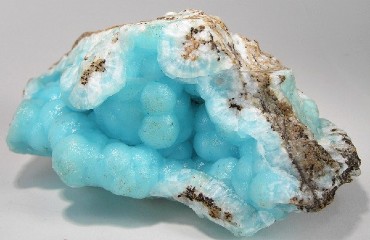
Image Credit – Robert M. Lavinsky, CC-BY-SA-3.0
Hemimorphite is one of the most attractive and collectible secondary zinc minerals, prized for its delicate crystal forms and, in some cases, its striking blue colour. Found in the oxidised zones of zinc deposits, hemimorphite forms under specific geochemical conditions, often alongside minerals such as smithsonite, cerussite, and calcite. While it occurs globally, only a handful of localities have produced specimens of exceptional quality, colour, or historical significance.
The following list highlights some of the world’s most important and famous sources, each known for producing distinctive and desirable material.
1. Mapimí (Ojuela Mine), Durango, Mexico - The Ojuela Mine at Mapimí is widely regarded as the premier locality for hemimorphite. It is famous for producing colourless, transparent bladed crystals, often grouped into striking fans. These pieces are among the most visually striking of all zinc minerals. The complex oxidation zone of this historic mine created ideal conditions for hemimorphite formation, often in association with smithsonite and calcite, making it a benchmark locality for collectors.
2. Wenshan Mine, Yunnan, China - Wenshan has become one of the most important modern sources of hemimorphite. Its specimens are known for vivid, electric-blue botryoidal forms. Often displaying exceptional freshness and lustre, Wenshan pieces have quickly gained popularity in the collector market. The locality’s rise reflects the broader emergence of China as a major supplier of high-quality mineral specimens.
3. Kelly Mine, New Mexico, USA - The Kelly Mine is a classic American locality, particularly known for its association between hemimorphite and smithsonite. Specimens are typically white to pale green, forming botryoidal crusts or small crystals. Although they are less vibrant in colour, they are valued for their historical importance and mineralogical associations. This locality has contributed significantly to the understanding of carbonate-hosted zinc deposits.
4. Tsumeb Mine, Namibia - Tsumeb is one of the most famous mineral localities in the world, producing a vast array of species. Its hemimorphite typically occurs as colourless to pale blue needle-like crystals, often well-formed and associated with rare minerals. The mine’s complex geochemistry makes its specimens particularly interesting to collectors and researchers alike.
5. Touissit, Morocco - Touissit is known for attractive hemimorphite associated with galena and other lead-zinc minerals. The specimens often display lustrous surfaces and interesting mineral combinations. Moroccan material is widely collected due to its aesthetic appeal and accessibility.
6. Broken Hill, New South Wales, Australia - Broken Hill is a world-famous mining district, and its hemimorphite occurs in oxidised zinc deposits. Typically white and forming small clusters of elongated crystals, the material is valued for its historical and geological significance rather than its colour intensity.
7. Laurium District, Greece - Laurium is an ancient mining region with a history stretching back thousands of years. Hemimorphite occurs as pale coatings and crystalline aggregates, varying in vibrancy from colourless to pale green. Specimens are prized as much for their historical context as for their mineralogical interest.
8. Berg Aukas, Namibia - Berg Aukas is known for its rich zinc mineralisation and high-quality secondary minerals. Hemimorphite from here often forms botryoidal masses with subtle blue tones, making it an important African locality.
9. Kabwe, Zambia - Kabwe is a major zinc-lead deposit where hemimorphite occurs in oxidised zones. While generally white and less visually striking, specimens are important for understanding large-scale mineral formation processes. Many specimens consist of highly lustrous, rounded, botryoidal masses often covering cerussite.
10. Gorno, Lombardy, Italy – Gorno is a classic Italian locality producing colourless botryoidal and crystalline hemimorphite, the latter often arranged into radiating fan-like aggregates. Its specimens are valued for their historical mining context and association with alpine mineralisation.
11. Skorpion Mine, Namibia - A modern zinc operation, Skorpion has produced pale blue to white, highly crystalline hemimorphite specimens. It demonstrates that high-quality secondary minerals continue to form in active mining environments.
12. Leadville District, Colorado, USA - Leadville is a historic mining district where hemimorphite occurs in oxidised ores, typically as gemmy white crystals. Specimens are valued for their provenance and role in American mining history.
13. Franklin, New Jersey, USA - Franklin is one of the most famous mineral localities in the United States. Hemimorphite occurs among a diverse assemblage of minerals, making it collectible despite its modest appearance.
14. Santa Eulalia District, Chihuahua, Mexico - Santa Eulalia has produced some of the world's most outstanding hemimorphite specimens, often in association with other classic minerals. The locality is known for its diversity and consistent specimen quality. These commonly occur as large, well-terminated prismatic crystals, often grouped into striking fan-like aggregares.
15. Joplin District, Missouri, USA - The Joplin district is a historic zinc mining area producing many forms of hemimorphite. Among the most common are striking radial sprays of gemmy crystal blades. Others include botryoidal masses and also hollow pseudomorph casts after calcite. Often the mineral is coloured yellow by internal inclusions of greeockite. Joplin's importance lies in its contribution to early American mining and mineralogical research.
16. Stefanie Mine, Bad Bleiberg, Villach-Land District, Carinthia, Austria – The mine is notable for the occurrence of particularly large prismatic crystals of hemimorphite, some reaching up to 2.5 cm in length, usually white but sometimes stained red or yellow by iron coatings and inclusions.
17. Wenshan, Yunnan, China - A zinc mine known for producing aragonite and, less frequently, hemimorphite in predominantly blue and white hues, with rarer green varieties. It is particularly renowned for its world-class deep blue hemimorphite specimens, which display a delicate, fine surface growth reminiscent of okenite.
18. Kipushi Mine, Kipushi, Kipushi Territory, Haut-Katanga, DR Congo - Specimens typically occur as white to pale blue botryoidal masses or crystalline coatings formed in the oxidised zone of this exceptionally rich orebody. While not usually as vividly coloured as Mexican or Chinese material, Kipushi hemimorphite is valued for its association with a diverse suite of secondary minerals.
19. Silvermines District, Tipperary County, Munster, Ireland - The Silvermines District is Ireland’s most important historic zinc mining area and a well-known source of hemimorphite. Specimens are generally white to pale blue, forming botryoidal crusts or fine crystalline aggregates within oxidised ore zones. Although rarely dramatic in colour, they are particularly sought after by collectors of British Isles material, and the district holds considerable importance in the study of carbonate-hosted zinc deposits.
20. Roughton Gill, Caldbeck, Allerdale, Cumbria, England, UK - Roughton Gill, in the Caldbeck Fells, is one of the best-known British localities for hemimorphite. It produces delicate white to pale blue crystalline coatings and botryoidal formations, often associated with other secondary minerals from the Cumbrian orefield. Specimens are typically small but aesthetically pleasing, with fine crystallisation. The locality is highly regarded among UK collectors due to its classic status and historical mining context, making it an important source of British hemimorphite.