
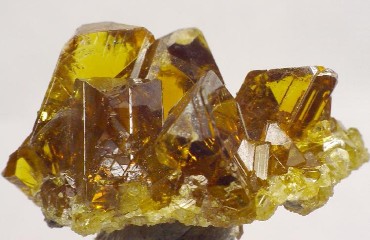
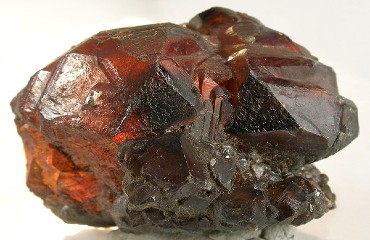
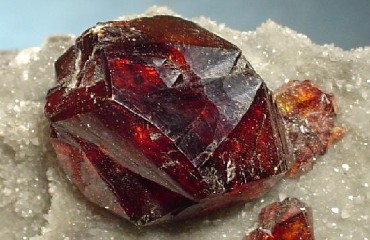
Hyatt Mine, Talcville, NY, USA; Las Manforas Mine, Spain; Kangjiawan Pb-Zn-Ag-Au deposit, China Image Credits - All Robert M. Lavinsky CC-BY-SA-3.0
Sphalerite, a zinc sulfide mineral (ZnS), is the world’s most important ore of zinc and one of the most widespread sulfide minerals. Its name derives from the Greek word "sphaleros", meaning "deceptive", reflecting its frequent confusion with galena despite containing no lead. It forms in a wide range of geological environments, most commonly in hydrothermal veins, sedimentary exhalative deposits, and skarns. In many settings, sphalerite is typically found alongside galena, pyrite, chalcopyrite, and calcite, forming an important part of many polymetallic ore systems.
Crystallising in the isometric system, sphalerite commonly develops tetrahedral, dodecahedral, or complex multi-faced crystals. Its lustre ranges from resinous to adamantine, giving high-quality specimens an almost glassy brilliance. One of its most striking features is its wide colour range, which includes black, deep brown, honey-yellow, orange, red, and occasionally green. This variation is largely controlled by iron content: iron-rich sphalerite, often referred to as "marmatite", is dark and opaque, while low-iron varieties can be transparent and highly lustrous.
Transparent sphalerite is especially prized by collectors and gem cutters due to its exceptional optical properties. It has a greater dispersion than diamond, meaning it can display intense flashes of spectral colour when cut and polished. However, with a relatively low hardness of 3.5–4 on the Mohs scale and perfect cleavage in multiple directions, it is fragile and requires careful handling, limiting its practical use in jewellery.
Sphalerite is found in significant quantities across the globe, with many classic and modern localities producing exceptional specimens. In the United States, the Tri-State district (Missouri, Kansas, and Oklahoma) was historically one of the largest zinc-producing regions, while the Elmwood Mine in Tennessee is famous for its large, lustrous crystals associated with calcite and fluorite. The Viburnum Trend in Missouri remains a major source of zinc ore.
In Europe, the historic mines of Freiberg in Germany have produced fine crystallised specimens for centuries, while Trepča in Kosovo and the Madan district of Bulgaria are renowned for sharp, well-formed crystals. Spain’s Picos de Europa, particularly the Aliva area, yields beautiful gemmy orange and red sphalerite specimens highly sought after by collectors. Elsewhere, notable occurrences include Huanzala in Peru, Naica in Mexico, Dal’negorsk in Russia, and the famous Broken Hill deposit in Australia, one of the world’s richest polymetallic ore bodies.
Sphalerite also has a few intriguing physical characteristics. When scratched or struck, it can emit a distinctive sulfurous smell, a reminder of its chemical composition. Some specimens exhibit triboluminescence, producing tiny flashes of light when fractured or rubbed, adding to its reputation as a mineral of hidden fire.
Combining major industrial importance with remarkable aesthetic appeal, sphalerite occupies a unique position in the mineral world. Whether as the principal source of zinc or as a collector’s gemstone displaying extraordinary brilliance, it remains a mineral that truly lives up to its reputation as one of nature’s most deceptively beautiful creations.
If you are interested in mineral specimens of sphalerite for your collection, click HERE

