

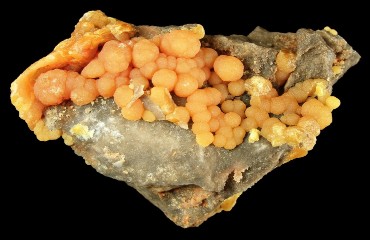
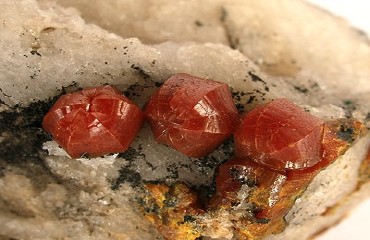
Ojuela Mine, Durango, Mexico; Haus Baden Mine, Baden-Württemberg, Germany; var. CAMPYLLITE – Caldbeck Fells, Cumbria, England, UK Image Credits – All Robert M. Lavinsky CC-BY-SA-3.0
Mimetite is a striking lead arsenate chloride mineral best known for its bright yellow, orange, or honey-coloured crystals and rounded, lustrous aggregates. A member of the apatite group, it has the chemical formula Pb₅(AsO₄)₃Cl and forms in the oxidised zones of lead ore deposits, where arsenic-rich fluids interact with lead-bearing minerals. Although it is not among the most common collector minerals, mimetite has long been admired for its vibrant colour, varied crystal habits, and its association with some of the world’s great lead deposits.
For mineral collectors, mimetite is especially appealing because it can appear in several quite different forms. Some specimens consist of tiny sparkling hexagonal crystals, while others form smooth botryoidal coatings, barrel-shaped crystals, or tightly packed globular aggregates. Its colour ranges from pale lemon-yellow to deep orange-brown, and some specimens can show a rich, almost golden glow under good lighting. This combination of colour and form gives mimetite a visual warmth that makes it instantly attractive in a display cabinet.
Mimetite belongs to a mineral series with pyromorphite and vanadinite. In simple terms, these minerals share a similar crystal structure but differ in chemistry. In mimetite, arsenate is dominant; in pyromorphite, phosphate takes that place; and in vanadinite, vanadate is dominant. Because of this close relationship, specimens can sometimes show intermediate compositions, making identification more complicated than appearance alone might suggest. This is one reason why collectors and mineralogists value well-documented mimetite specimens from classic localities.
One of the most famous mimetite localities is Tsumeb, Namibia. The Tsumeb Mine is legendary for producing an extraordinary variety of rare and beautiful minerals, and mimetite from there is no exception. Tsumeb specimens can show bright yellow to orange crystals, often with excellent lustre and sharp form. Because Tsumeb minerals are so highly regarded, mimetite from this locality is especially sought after by serious collectors.
Another major source is the Ojuela Mine, Mapimí, Durango, Mexico. This locality has produced some of the finest mimetite specimens in the world, including vivid yellow botryoidal aggregates and sparkling druses of crystals. Ojuela is renowned for its richly mineralised oxidised zones, and mimetite is one of the standout species from the mine. Many collectors consider Mexican mimetite to be among the most aesthetically pleasing because of its intense colour and sculptural habits.
France has also produced notable mimetite, especially from the classic lead deposits of the Languedoc region. In older European mining districts, mimetite often occurs alongside cerussite, wulfenite, and other secondary lead minerals. These localities may not always produce the largest or brightest specimens, but they are important historically and mineralogically, and older European pieces often carry strong provenance.
In the United Kingdom, mimetite is known from several lead mining areas, including parts of Cornwall and the Caldbeck Fells in Cumbria. The latter is best known for a rare variety known as 'campyllite', distinguished by its strongly curved, barrel-shaped crystals, a habit that gives it an elegant and unusual appearance compared with more typical prismatic forms. Although chemically it is still mimetite, the distinctive habit and historic British localities have made campyllite one of the most sought-after named varieties within the species.
Other notable occurrences include sites in Spain, Germany, Morocco, Australia, and the United States. In Arizona, for example, mimetite has been found in lead-rich oxidised deposits and sometimes appears as small but colourful collector specimens. Australian deposits, particularly those associated with old lead workings, have also yielded fine examples. The mineral’s broad geographic spread makes it interesting not only as a display mineral but also as a species that reflects similar geological processes in many different mining regions.
A couple of facts make mimetite especially fascinating. First, its name comes from the Greek word 'mimetes', meaning 'imitator', because it closely resembles pyromorphite in both appearance and crystal habit. Early mineralogists found the two easy to confuse, and the name reflects that deceptive similarity. Second, despite its attractive colour and often jewel-like appearance, mimetite contains both lead and arsenic, which means it should be handled sensibly. It is perfectly suitable for display in a mineral collection, but like many lead and arsenic minerals, it should not be ground or handled carelessly, especially without washing hands before eating.
In the end, mimetite is a mineral that combines beauty, chemistry, and collecting interest in equal measure. Its warm colours, wide range of habits, and occurrence at famous localities such as Tsumeb and Ojuela make it a favourite among collectors of secondary minerals. Whether found as tiny sparkling crystals or bold botryoidal masses, mimetite is one of those minerals that proves that even in the weathered upper parts of an ore deposit, nature can create something remarkable.
If you are interested in mineral specimens of mimetite for your collection, click HERE