
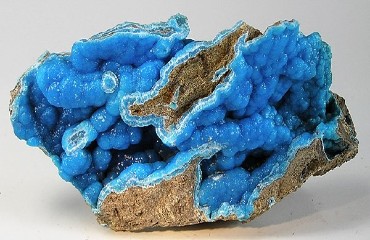
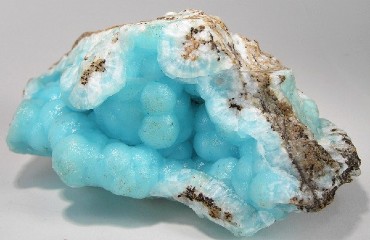
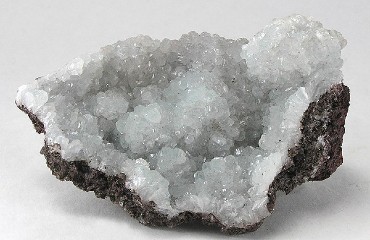
Wenshan Mine, Yunnan Province, China; Magistral, Durango, Mexico; Mvouti (M'Fouati), Republic of Congo (Brazzaville) Image Credits – All Robert M. Lavinsky CC-BY-SA-3.0
Hemimorphite is a visually striking zinc silicate mineral with the chemical formula Zn₄Si₂O₇(OH)₂·H₂O, prized by collectors for its delicate crystal forms and vibrant blue-to-green colouration. Its name refers to one of its most distinctive characteristics – hemimorphism – where the two ends of a crystal develop and terminate differently. Derived from the Greek "hemi" (“half”) and "morph" (“shape”), the term reflects this asymmetry. Although this trait is very common among Hemimorphite crystals, its visibility is often obscured by one end of a crystal being attached to the matrix. Where both ends of the mineral are visible, one end is usually prismatic, while the other is tabular or rounded.
This unusual growth habit arises because, although hemimorphite crystallises in the orthorhombic system, its crystal structure lacks a centre of symmetry. As a result, each end of the crystal has a different atomic arrangement, leading to its own particular growth and development.
Hemimorphite typically forms in the oxidised zones of zinc deposits, where it develops as a secondary mineral through the alteration of primary zinc sulfides such as sphalerite. It commonly occurs as botryoidal (grape-like) masses, fibrous aggregates, and, occasionally, as slender prismatic crystals. Its lustre ranges from vitreous to silky, and its colour varies from white to pale green, with the most sought-after specimens displaying an intense sky-blue hue. With a hardness of 4.5 to 5 on the Mohs scale, hemimorphite is relatively soft, making it better suited to display than everyday jewellery, though it is sometimes cut into cabochons.
Before 1803, hemimorphite and smithsonite were grouped together under the name "calamine". This changed when the British mineralogist James Smithson demonstrated that they are distinct mineral species. Smithsonite was subsequently named in his honour, while hemimorphite was named for its unusual crystal habit.
Hemimorphite occurs in many classic mineral localities worldwide. Among the most famous is the Ojuela Mine, known for exceptional transparent crystals and well-formed clusters. In Europe, notable sources include Sardinia in Italy and the historic Vieille Montagne deposits in Belgium. The Tsumeb Mine is another legendary locality, producing high-quality specimens often associated with other colourful minerals. More recently, the Wenshan Mine has become renowned for its vivid blue botryoidal hemimorphite, significantly increasing the mineral’s popularity among collectors. Additional occurrences are known from Greece, the United States, and parts of Central Europe.
Two additional properties further enhance hemimorphite’s mineralogical interest. Some specimens are piezoelectric, meaning they generate an electrical charge when subjected to mechanical pressure. They can also exhibit pyroelectricity, producing a temporary electrical charge when heated or cooled. Both effects arise from the already mentioned asymmetric structure of the mineral, which allows electrical charges to build up and flow through the crystal unevenly under stress or temperature change.
Today, hemimorphite remains a favourite among collectors for its combination of rarity, unusual crystallography, and eye-catching colour. Whether as delicate crystals from Mexico or luminous blue botryoidal masses from China, it stands out as one of the most distinctive minerals formed in oxidised zinc deposits.
If you are interested in mineral specimens of hemimorphite for your collection, click HERE