
Spain’s mineral heritage is both rich and remarkably diverse. The Iberian Peninsula is a patchwork of ancient Variscan mountain cores, wide Mesozoic limestone basins, and young Tertiary and Quaternary volcanic fields. These varied geological settings created ideal conditions for countless mineral-forming processes – from granite intrusions and hydrothermal veins to marine sedimentation, zeolite- and agate-filled cavities, and volcanic fumaroles. Together, they made Spain one of Europe’s important sources of mineral specimens and metallic ores.
Humans began exploiting these resources as soon as they settled in the region, and mining in Spain spans at least four thousand years. Pre-Roman peoples worked copper and lead, the Romans developed major silver and mercury deposits, and later periods saw the discovery of iron, tin, zinc, and nickel. Quarries also produced marble, gypsum, baryte, fluorite, limestone, and many types of clay and stone. Some of Spain’s most famous mineral localities have been worked since antiquity, and the specimens they produced still rank among the world’s finest.
Although most of these mines have long since closed, their legacy is preserved in museums and private collections around the world. The mirror-bright pyrite cubes of Navajún, deep purple fluorite from Asturias, and vivid red cinnabar from Almadén are more than geological curiosities – they are enduring reminders of how Spain’s natural history and human history have been intertwined for millennia.
For a Map of Mineral Locations in Spain click HERE
|
Linares–La Carolina District, Jaén, Andalusia
Winding tower of San Vicente Pit - Image Credit: Romero García, Javier, CC BY-SA 3.0 The Linares–La Carolina district in the Sierra Morena is one of Europe’s most historic lead mining regions. Activity here began in ancient times, with the Iberians and Romans exploiting rich veins of galena. The district reached its peak in the 19th century, when British companies modernised operations and transformed Linares into one of the world’s leading producers of lead ore. Geologically, the deposits consist of hydrothermal veins cutting Cambrian–Ordovician slates and granitic rocks. These veins hosted high-grade galena along with barite, cerussite and anglesite. The district is especially renowned for its superb galena crystals – sharp, metallic cubes often set on sparkling calcite. Mines such as La Cruz, Arrayanes and Matacabras produced specimens that remain classics in European collections. Although large-scale mining ended in the late 20th century, the Linares–La Carolina district remains a landmark of Spanish mineralogy. A network of shafts, pumping engines and railways once covered the area, many of which still stand today as a legacy of the area’s former industrial past. |
|
Almadén, Ciudad Real, Castile–La Mancha
Cinnabar - Image Credit: Bergminer, CC BY-SA 4.0 Almadén is the world’s most famous mercury deposit and one of the oldest continually worked mining districts on Earth. Mining began in pre-Roman times and expanded under Roman rule, when cinnabar was prized both as a pigment and as a source of mercury. For nearly two millennia, Almadén supplied a substantial share of global mercury, reaching its industrial peak between the 16th and 20th centuries. Its historic furnaces, shafts and prison-labour system form a unique record of Spain’s mining past, now recognised as a UNESCO World Heritage Site. Geologically, the deposit lies within the Almadén syncline of the Hercynian Belt. Cinnabar occurs in Silurian quartzites, slates and volcanic rocks, formed through submarine volcanic processes that produced both horizontal layers and later vertical veins. The district is renowned for brilliant red cinnabar crystals, often on dolomite or quartz, along with rare occurrences of native mercury. These striking specimens remain highly valued by collectors. Although mining ceased in 2003, Almadén stands as a landmark of geological, economic and mineralogical history. |
|
Cartagena–La Unión District, Murcia
Baryte - Image Credit: Bergminer, CC BY-SA 4.0 The Cartagena–La Unión district, set within the coastal mountains of southeastern Spain, is one of the country’s most historic and productive polymetallic mining areas. Silver and lead extraction began around La Unión in ancient times, reaching considerable size under Roman rule, when Cartagena was founded nearby to serve as a strategic Mediterranean port for exporting these metals. Mining declined sharply afterwards due to limited ancient technologies but revived in the 19th century when new mining methods became available. As deep mines replaced the former opencast workings, iron and zinc were now also mined. Eventually, all activity ceased in the early 1990s, but not before severe environmental damage to these coastal mountains. Geologically, the area is characterised by hydrothermal Pb–Zn–Ag veins emplaced by volcanic activity during the Late Miocene into earlier Triassic limestones. The mineralised veins often display open spaces where crystals developed freely, producing aesthetic specimens popular with collectors. The district is best known for its transparent, sharply defined anglesite and cerussite crystals, along with barite, galena, and attractive copper alteration products. The San Valentín mine and several others nearby are especially noted for yielding high-quality, colourful specimens of goethite, hemimorphite, mimetite, azurite, malachite, smithsonite, pyromorphite, and devilline, as well as several crystalline varieties of quartz, including amethyst, chalcedony, and sceptres. |
|
Hiendelaencina, Guadalajara, Castile-La Mancha
Freieslebenite - Image Credit: Miguel Calvo, CC BY-SA 4.0 Hiendelaencina is one of Spain’s most celebrated historic silver districts, renowned for its exceptional native silver and various silver sulfosalt specimens. The deposit was discovered in 1844, triggering a rapid mining boom that transformed the backward rural area into a thriving industrial centre almost overnight. Within two years almost 600 small mines had sprung up, including at the nearby villages of Congostrina, La Bodera, Robledo de Corpes, Alcorlo, and in places as far away as Atienza. The peak of production was in the latter years of the 19th century, making these some of Spain’ most productive silver workings, drawing investment, engineers, and miners from across Europe. However, the success was short-lived because of the deposits’ limited depth, so that by the early 20th century virtually all the mines had closed. The silver ores occurred in quartz veins hosted within metamorphic schists. These hydrothermal veins provided ideal open spaces for the growth of delicate and intricate crystal forms. As a result, Hiendelaencina is well known for its spectacular native silver wires, filaments, and arborescent clusters, many of which rank among the finest European examples of the metal. The veins also produced notable specimens of acanthite and chlorargyrite, as well as a remarkable suite of silver sulfosalts, including proustite, pyrargyrite, miargyrite, and stephanite. Today, the area is prized not only for its historic silver fever but also for the silver specimens that have become classics in museums and private collections worldwide. |
|
Ojén & Los Reales (Sierra Bermeja), Málaga, Andalusia
Clinochlore - Image Credit: Miguel Calvo, CC BY-SA 4.0 The Sierra Bermeja massif, rising above the Costa del Sol near Ojén and Los Reales, is one of Europe’s rare exposures of upper-mantle rock uplifted by Alpine mountain building during the collision of the European and African tectonic plates. Unlike classic mining districts, Sierra Bermeja is valued less for ore production but more for its unique geology, serving as a natural laboratory for studying ultramafic processes. Although small chromite workings operated intermittently from the 18th to 20th centuries, the area’s main significance lies in the minerals formed through the alteration of mantle peridotite into harzburgite and lherzolite. These rocks underwent further extensive serpentinisation, creating distinctive assemblages of olivine, enstatite, chromite, and secondary antigorite and magnetite. Thus, while the region never became a major mining centre, its metamorphic mineral specimens – particularly sharp chromite crystals, spinel, quartz, garnets, and striking green serpentine – are highly valued for their aesthetics and geological significance. Today, Sierra Bermeja is better known as a protected natural area, where dramatic landscapes and exceptional geology combine to create one of Andalusia’s most distinctive mineral localities. |
|
El Horcajo, Ciudad Real, Castile–La Mancha
Pyromorphite - Image Credit: Miguel Calvo, CC BY-SA 4.0 El Horcajo is one of Spain’s most celebrated classic localities, renowned for producing some of the finest pyromorphite specimens ever found. The mine, active mainly from the late 19th to early 20th century, was worked for lead and silver to a depth of 600 metres but quickly gained fame among collectors for the vivid green crystals that emerged from its much shallower oxidation zones. Although silver production was never large by industrial standards, its pyromorphite specimens became benchmarks for the species. Geologically, El Horcajo consists of hydrothermal lead veins cutting Carboniferous slates. The weathering of galena in these open fractures creates ideal conditions for secondary lead minerals to form. The result was exceptionally well-developed pyromorphite – bright apple-green barrels, elongated prisms, and hoppered crystals, often perched on galena, cerussite, or iron oxides. Their intense colour, sharp form, and aesthetic arrangement place them among the finest historical pyromorphites worldwide. Though long inactive, El Horcajo remains a name of distinction in mineral collecting, and well-preserved specimens are treasured pieces in museums and private collections. Most recently, very aesthetic spherical aggregates of cacoxenite have been found on the dumps nearby, but these are thought to originate from the new high-speed railway tunnel that has intersected the mine underground. |
|
La Collada, Siero, Asturias
Fluorite - Image Credit: Juan F. Buelga, CC BY 3.0 La Collada, part of the rich fluorite belt of Asturias, is one of northern Spain’s most admired mineral localities. Although mined mainly for industrial fluorite during the 20th century, it quickly gained a strong reputation among collectors for the colour and quality of its crystals. The deposits occur in hydrothermal veins cutting Carboniferous limestones and shales, where large cavities allowed fluorite to grow freely. These produced vivid purple, blue and lilac cubes, often transparent, sharply formed, and showing colour zoning, phantoms and associations with calcite and occasional quartz. The mining zone runs roughly north–south for about 2.5 km, with the southern workings known for more complex crystal habits, including dodecahedral forms. In the early 21st century, the nearby La Viesca Mine briefly became famous for exceptional fluorite discoveries. The “Geoda de Las Monjas” pocket, found in 2010, yielded perfectly transparent lilac or colourless cubes with striking internal zoning – now considered among the finest fluorites ever found in Spain. Though mining has ceased, La Collada remains highly regarded, and its distinctive fluorites continue to be prized in collections worldwide. |
|
Berbes & Caravia Districts, Asturias
Fluorite and Baryte - Image Credit: Didier Descouens, CC BY-SA 4.0 The Berbes–Caravia district stretches for about 5 km along the Asturias coast of northern Spain, with Caravia in the west and Berbes in the east. Mining here began in the late 19th century and expanded throughout the 20th century, supplying high-grade fluorite for metallurgical and chemical industries. Over time, however, the area became even better known for its superb mineral specimens, making it Spain’s most famous fluorite-producing region and one of Europe’s classic mineral localities. The deposits consist of low-temperature hydrothermal veins cutting Jurassic limestones. These veins developed large open cavities where fluorite crystals grew undisturbed. Berbes–Caravia is especially celebrated for its transparent violet, blue, and colour-zoned fluorite cubes – often perfectly sharp and highly lustrous. Many specimens display striking internal phantoms or strong fluorescence under UV light. Classic associations include snow-white barite blades, often on a matrix of quartz. Deep mines such as Eduardo, Obdulio and Aurora in Caravia, and opencast quarries around Berbes produced exceptional pieces that remain central to major museum and private collections worldwide. Although most workings are now closed, local small-scale field collection continues so that Berbes–Caravia’s fluorite retains its position at the forefront of Spanish mineralogy. |
|
Navajún, La Rioja
Pyrite - Image Credit: James St. John, CC BY 2.0 Navajún, located in the Cameros Basin of La Rioja, is one of the world’s most iconic mineral localities, celebrated for producing the finest cubic pyrite crystals ever discovered. The Victoria Mine, worked intermittently since the mid-20th century for iron, was never a major industrial operation, yet it quickly became famous among collectors for the extraordinary perfection of its pyrite. Geologically, the deposit occurs in soft Cretaceous marls that once formed part of a shallow marine–lagoonal environment. Diagenetic processes allowed iron and sulfur to combine under low-temperature conditions, producing pyrite crystals that grew undisturbed within the sediment. The result is astonishingly sharp, mirror-bright cubes – some exceeding 10 cm – often preserved intact in their original clay-rich matrix. Occasional cuboctahedra and pyritohedra also occur, but the flawless right-angled cubes remain the locality’s hallmark. Specimens from Navajún are sought after worldwide for their geometry, lustre and striking visual impact. Regular collecting seasons at the mine, combined with careful extraction methods, have ensured a steady supply of museum-grade pieces. Today, Navajún stands as the definitive global reference locality for cubic pyrite and remains one of Spain’s most celebrated mineral sites. |
|
Bellmunt del Priorat, Tarragona, Catalonia
Marcasite - Image Credit: The Assay House, Public Domain Bellmunt del Priorat is one of Catalonia’s most historic lead-zinc mining districts, with workings that trace back to medieval times and expanded significantly during the 19th and early 20th centuries. At its peak, the area supported a thriving mining community centred around the Mina Eugènia complex, now preserved as part of the regional Mining Museum. Though industrial extraction declined after the mid-20th century, Bellmunt remains well known for the variety and quality of minerals found in its veins. Geologically, the district contains hydrothermal Pb–Zn–Ag veins cutting through Cambrian limestones and slates. These veins produced sharp, metallic galena crystals, lustrous sphalerite, and striking marcasite aggregates, often accompanied by white barite and classic calcite scalenohedra. While not as internationally famous as some Spanish localities, Bellmunt’s specimens are highly regarded for their clean crystal forms, strong lustre and well-documented provenance. Today, Bellmunt del Priorat is valued as both a mineral locality and a heritage site, preserving the mining landscapes and traditions of southern Catalonia. |
|
La Granada de Ríotinto (Rio-Tinto), Huelva, Andalusia
Corta Atalaya Pit Rio Tinto - Image Credit: Vtornet, CC BY-SA 3.0 Riotinto, or the ‘Red River’, lies in the heart of the Iberian Pyrite Belt and ranks as one of the world’s oldest and most significant mining districts. Copper extraction began here at least 5,000 years ago, with major activity under the Tartessians, Phoenicians, and Romans, who exploited the vast sulfide bodies for copper, silver, and gold. After being abandoned, industrial-scale mining resumed in the 18th and 19th centuries, transforming the region into one of Europe’s largest open-pit mining complexes, including the Cerro Colorado and Atalaya mines. The modern landscape – marked by vast terraced pits, some partly filled with vividly coloured acidic waters – reflects centuries of intense extraction. Geologically, Riotinto is part of a massive volcanogenic massive sulfide (VMS) province formed during Paleozoic seafloor hydrothermal activity. The ores consist mainly of pyrite, chalcopyrite, sphalerite, and bornite, with supergene zones producing approximately 160 different colourful secondary minerals such as azurite, malachite, cuprite, and strikingly iridescent goethite. While primarily a metal-producing district, the deposits have also yielded numerous collectible specimens, particularly well-crystallised pyrite and copper minerals from its oxidation zones. Today, Riotinto continues as a mining region but is also a major industrial heritage site, illustrating the long relationship between human history and one of Earth’s most remarkable ore systems. |
|
Tharsis, Alonzo, Huelva, Andalusia
Goethite - Image Credit: Robert M. Lavinsky, CC BY-SA 3.0 Tharsis is part of the same Iberian Pyrite Belt as Rio Tinto but located further east. Both are part of one of the world’s premier volcanogenic massive sulfide provinces. Mining here dates back to antiquity, but the district reached major industrial importance in the 19th century when British companies developed five large open pits and railway links to export copper-rich pyrite. These pits were the Filón Norte and Sierra Bullones in the north, Filón Centro in the middle, and Filón Sur and Esperanza in the south. Geologically, the deposits consist of enormous lenses of massive iron ore, some 130 m thick, with significant chalcopyrite, sphalerite, and marcasite, formed by Paleozoic seafloor hydrothermal activity. Tharsis is especially noted for producing sharply defined golden pyrite crystals – cubes, pyritohedra, and complex combinations – that differ in habit and colour from the famous sedimentary pyrites of Navajún. Oxidation zones occasionally yield attractive malachite, azurite, and iron-oxide minerals. Although large-scale mining has declined, Tharsis remains a classic locality within the Pyrite Belt, valued for its mineral specimens and its important role in Spain’s industrial mining history. |
|
Cabo de Gata, Níjar, Almería, Andalusia
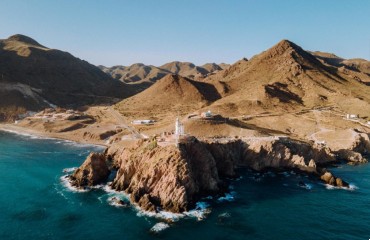
Cabo de Gata - Image Credit: Joan Costa, Public Domain Cabo de Gata, located on Spain’s southeastern Mediterranean coast, is one of the country’s most distinctive volcanic mineral localities. Unlike many historic mining districts, Cabo de Gata is valued not for commercial production but for the diversity of rare silicate minerals formed within its Miocene volcanic rocks. Geologically, Cabo de Gata is dominated by andesitic and dacitic lava flows, tuffs, and domes belonging to the Neogene volcanic arc of southern Spain. Gas-rich cavities in these lavas host a wide range of unusual zeolites and carbonates, including augite, clinoptilolite, erionite, faujasite, ferrierite, morednite, paulingite, phillipsite, and sepiolite. The location is also notable for many types of quartz, including opal, agate, chalcedony and amethyst, as well as the very rare lead uranite kasolite. Nearby Rodalquilar adds historical interest as a former gold deposit associated with hydrothermal alteration, noted for its native gold and the gold tellurides calaverite and krennerite. Although small in scale, Cabo de Gata remains an important locality for understanding low-temperature volcanic mineral formation. Its well-preserved cavities and visually attractive specimens continue to draw field collectors from across Europe. |
|
Mina Las Cruces, Gerena, Seville, Andalusia
Las Cruces copper mine - Image Credit: Pablo Ruíz Velasco, CC BY 2.0 Mina Las Cruces, located just northwest of Seville, is one of Spain’s most important modern mineral localities and a notable producer of quality copper ore minerals, including bornite, chalcopyrite and chalcocite. Started in the early 2000s as a big open-pit mine in the eastern Iberian Pyrite Belt, the mine quickly gained a reputation among collectors for the outstanding quality of its copper ores and specimens from the oxidation zone. Geologically, Las Cruces sits above deeply weathered massive iron and copper sulfides, where long-term oxidation and groundwater circulation created a thick supergene enrichment zone. Although it is primarily an industrial mine, fine specimens of djulerite, luzonite, digenite, and covellite have fortunately been recovered. These specimens, collected mainly during the early years of the mine’s development, are now considered modern Spanish classics. Nowadays, while active ore mining continues, the opportunity for specimen recovery has diminished, making early Las Cruces pieces increasingly sought after by Spanish and European collectors. |
|
Camporrobles, Utiel-Requena, Valencia
Aragonite - Image Credit: The Assay House, Public Domain Camporrobles is a small municipality on the Utiel-Requena plateau in inland Valencia, close to the border with Cuenca, at around 900 m elevation. Triassic and other carbonate rocks host notable aragonite occurrences, including purple clusters from Camporrobles and the Terzaga ravines, with associated calcite, quartz, goethite, gypsum, hematite and siderite at nearby localities such as La Mina. These minerals, and especially the sharp, purple aragonite clusters, are popular with collectors and reflect the area’s sedimentary and tectonic history. |




Spain’s mineral localities offer an exceptional window into the geological complexity and long mining history of the Iberian Peninsula. From ancient silver workings and Roman mercury furnaces to modern copper operations and volcanic landscapes, each region reveals a unique blend of mineral-forming processes and cultural heritage. Classic districts such as Linares, Almadén, Berbes–Caravia and Navajún have produced specimens recognised worldwide for their colour, quality and crystallisation, while areas like Sierra Bermeja and Cabo de Gata showcase Spain’s remarkable natural diversity.
Though most mines are now closed, the country’s mineral legacy lives on through collections, museums and continued geological research. These specimens remain ambassadors of Spain’s natural richness, reflecting a land where tectonics, volcanism, sedimentation and human activity have converged for millennia. Together, they form a mineralogical heritage among the finest in Europe, continuing to inspire collectors, scientists and enthusiasts alike.
If you are interested in adding specimens from Spain to your collection, click HERE


