
Much of Brazil’s history has been shaped by the extraction of its vast natural resources, including its mineral wealth. Claimed for Portugal in 1500 by Pedro Álvares Cabral, the earliest focus was on the red dye obtained from a coastal tree called Brazilwood, giving the country its name. Inland exploration began soon afterwards and led to the discovery of emeralds and gold in what is now the province of Minas Gerais, or ‘General Mines’ in Portuguese. The find sparked a frenzied gold rush, driving settlement into the interior, improving mining techniques, and opening new mining districts. Diamonds were found shortly after, also in Minas Gerais, briefly making Brazil a world-leading diamond producer. Since then, the country has continued to benefit from its mineral wealth, yet vast areas remain underexplored, especially in remote northern regions.
Brazil’s geology, like much of South America’s, is built on ancient Precambrian crust. This foundation consists of several large, stable cratons, later covered by younger sedimentary rocks and cut by major magmatic intrusions. Central Brazil is underpinned by the Amazonian Craton, which forms the basin under the Amazon River. To the south lies the Paraná Craton, extending into Uruguay and Argentina. Meanwhile, to the east lies the São Francisco Craton, which roughly corresponds to the region that is Minas Gerais. Here, ancient rocks are covered by Proterozoic sedimentary and volcanic sequences. Later, during events that assembled the supercontinent Gondwana, mountain belts formed around the edges of the area. This tectonic activity folded and fractured existing rocks, introduced granitic intrusions, and caused hydrothermal circulation – processes that led to the region’s extensive mineralisation, including valuable ore deposits and the vast pegmatite fields that have made Minas Gerais the mainstay of Brazil’s mineral production.
However, Minas Gerais is not the only source of Brazil’s mineral wealth, and several other regions have also made major contributions. These include Pará in the north, Bahia in the northeast, Mato Grosso in the central-west and Rio Grande do Sul in the south. As a result, Brazil is regarded as one of the most mineralogically abundant places on the planet. Apart from commercial ores that drive the county’s economy, many outstanding specimens have found their way into museums and private collections. Among these are spectacular beryl varieties (emerald and aquamarine), multicoloured tourmalines (including copper-bearing ‘Paraíba’-type), diamonds, imperial topaz, and quartz in many forms – especially amethyst – along with an extraordinary range of other pegmatite and metamorphic minerals.
For a Map of Mineral Locations in Brazil click HERE
|
Eastern Brazilian Pegmatite Province (EBPP), Minas Gerais
Tourmaline var. Elbaite - Image Credit: Robert M. Lavinsky, CC-BY-SA-3.0 The Eastern Brazilian Pegmatite Province (EBPP) is an approximately 820-kilometre belt of pegmatite outcrops along the eastern margin of Minas Gerais. It begins near Itambé in the state of Bahia and runs south through Minas Gerais to its terminus near Rio das Flores in the state of Rio de Janeiro. Along its length, dozens of exposures have produced world-class specimens of tourmaline, beryl (especially emerald and aquamarine), quartz, spodumene, topaz and many other minerals. Most EBPP pegmatites were created around 650–500 million years ago during the Brasiliano orogeny, a time when the collisions that helped assemble Gondwana created mountain ranges and produced granitic magma. At great depths, these melts cooled extremely slowly, so minerals crystallised in stages as the temperature dropped and elements were progressively removed from the remaining melt. Early minerals incorporated the abundant major components – silicon and aluminium, plus sodium and potassium – while lithium, beryllium, boron and fluorine stayed in the melt longer and later formed their own minerals. This stepwise chemical separation is called fractionation. It produces pegmatites with distinct internal zones, each characterised by a particular mineral suite and element chemistry. Such strongly differentiated bodies are termed highly evolved granitic pegmatites (HEGPs). Zoning can be economically useful because mining can target the zones where specific minerals are concentrated, reducing the need to excavate large volumes of unwanted material. Commercial mining in the EBPP expanded massively during World War II, driven by US military-industrial demand for mica, beryl and quartz. Today the focus is moving to lithium, and the province is believed to hold one of the world’s largest untapped lithium reserves. The same slow cooling process also resulted in exceptionally large, well-formed crystals, particularly tourmaline and aquamarine, which make EBPP specimens highly prized by collectors, often commanding premium prices worldwide and supplying fine gem rough for high-end jewellery. |
|
Tourmaline and Aquamarine Pegmatites
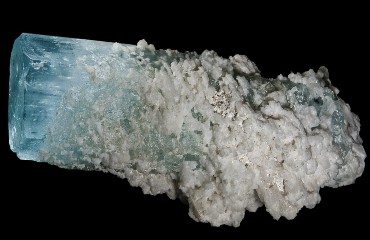
Aquamarine and Albite - Image Credit: Didier Descouens, CC BY 4.0 A striking feature of the Eastern Brazilian Pegmatite Province is that, along its roughly 820-kilometre length, it appears to divide into two broad belts of outcrops that fall on either side of Highway 116. Pegmatites east of the highway are typically best known for tourmaline, while those to the west are dominated by the aquamarine variety of beryl. It is likely that this divide was caused by the relative availability of beryllium – where concentration was high, it led to the formation of beryl-type minerals, including aquamarine and heliodor. Where beryllium was scarce, higher amounts of other elements, like lithium, sodium, and aluminium, led to the preferential formation of tourmalines, especially elbaite and rubellite. The Minas Gerais tourmaline pegmatites fall into five main districts: The Minas Gerais aquamarine pegmatites fall into four main districts: The following four locations lie outside Minas Gerais in neighbouring states: |
|
Coronel Murta / Araçuaí / Itinga / Virgem da Lapa / Rubelita / Salinas, Minas Gerais
Rubellite - Image Credit: Robert M. Lavinsky, CC-BY-SA-3.0 A large number of separate pegmatite exposures are situated in the north of the EBPP in each of these six neighbouring municipalities. Together, they form a region approximately 60 km long by 20 km wide along the Jequitinhonha and Araçuaí Rivers, which join just downstream of the town of Araçuaí. There is evidence to show that pegmatite gems were traded from here by indigenous people during the early days of Portuguese colonisation. Their origin was eventually discovered in the late 17th century by the explorer Fernão Dias Paes Leme, who came here seeking emeralds. Instead, he found spectacular tourmaline crystals that quickly became the signature gemstones of the region and continue to be highly sought after by collectors today. A striking feature of the terrain is the many smoothly rounded granite domes, or inselbergs, that are characteristic of this pegmatite region. The tourmalines occur in pegmatites near these exposures and in placer deposits along the river valleys where they have been eroded out. Mining has been taking place since the early 1800s, when conditions were so primitive that it took five weeks for the stones to reach the coast. Today, the area continues to be famous for the green, blue-green, and blue tourmalines that are among the finest of their kind in all of Brazil. Some superb red tourmaline is also obtained from time to time, for example, from the Rubelita mines, leading to this variety of tourmaline being known as rubellite. Otherwise, the region’s pegmatites are particularly rich in lithium, which has also led to a range of spectacular lithium-bearing mineral specimens, including lepidolite, spodumene, petalite, and amblygonite. Feldspars, beryls (aquamarine, emerald, goshenite, heliodor and morganite), quartz (agate, rose, citrine, sceptre and smoky) and micas are also widely distributed in varying amounts throughout the area. |
|
São José da Safira (Cruzeiro, São José and Pederneira Mines), Minas Gerais
Tourmaline from Cruzeiro Mine - Image Credit: The Assay House, Public Domain The small town and municipality of São José da Safira is located about halfway down the length of the EBPP, about 60 kilometres northwest of the city of Governador Valadares. The Safira pegmatites are known for excellent gem-quality green and multicoloured tourmalines. These are obtained through shallow workings, but four underground mines also operate in the area. The Pederneira mine is furthest north and is mined entirely for mineral specimens. These occur in pockets featuring striking rubellite/elbaite tourmaline, quartz, feldspars, lepidolite, and other associated pegmatite species. The Chiá mine also produces tourmaline, but it is better known for highly crystalline, transparent euclase and for superb specimens of severely distorted crystals of dark brown smoky quartz. The São José mine also produces quartz crystals, but these are often irradiated to produce what in the gem industry is known as ‘green gold’ and ‘lemon gold’ quartz. The most important mine, however, is the Cruzeiro mine, which is arguably one of the most important gem and specimen mines in the world. Discovered in 1915, it initially served as a mica producer for the American military during World War 2. Afterwards, interest in the location declined, but in the 1950s mining resumed for tourmaline and other mineral specimens. The mineralogy at the site is complex, with at least five distinct pegmatite types in rocks that consist of schists, metagabbros, serpentinites and talc. Since the pegmatites are highly weathered and decomposed, nearly all tourmaline specimens are recovered as crystals or clusters without matrix. The colours range from red to yellow and green, and many crystals have multiple colour zones. The result is without doubt a mine that has produced some of the most spectacular tourmaline specimens ever found on the planet. |
|
Conselheiro Pena / Resplendor / Galilea / Sao Geraldo do Baixio / Divino das Laranjeiras, Minas Gerais
Apatite - Image Credit: Robert M. Lavinsky, CC-BY-SA-3.0 Conselheiro Pena, formerly called Lajão, is a small town near the middle of the Eastern Brazilian Pegmatite Province (EBPP), southeast of Governador Valadares. The surrounding countryside is dotted with small mines and quarries that yield attractive pegmatite specimens, notably spodumene, elbaite tourmaline, and several varieties of quartz. Many workings also produce beryl var. aquamarine, making the district almost unique for combining both tourmaline and beryl mineralisation in the same pegmatite field. What most distinguishes Conselheiro Pena, however, are its unusually phosphorus-rich pegmatites. The parental melt evidently contained abundant phosphorus, so as it cooled it crystallised primary phosphate minerals – especially triphylite-lithiophilite and montebrasite – along with plentiful apatite. With time, weathering and later reactions with other pegmatite minerals partly to completely altered these early phosphates, generating an extraordinary suite of secondary phosphates. To date, more than 70 phosphorus-bearing species have been identified in the district, including many rare minerals and at least one type-locality species, correianevesite. These deposits are prized by collectors, and they have also become a key source of study for understanding how Li–Al pegmatite minerals (such as tourmaline) and Be-bearing phases (beryl) coexist with phosphates and how post-crystallisation alteration can create exceptional mineral diversity. |
|
Ouro Preto (Morro Velho and Passagem Mines), Minas Gerais
Morro Velho Mine - Image Credit: The Assay House, Public Domain Ouro Preto lay at the centre of Brazil's first major gold rush in the 1690s, after explorers found deposits in nearby districts such as Tripuí, Mariana, and Antônio Dias. Prospectors and settlers soon poured in, and the emerging town of Vila Rica, or ‘Rich Village’, became one of colonial Brazil’s key economic centres, even serving as the capital of Minas Gerais. In 1823 it was renamed Ouro Preto, or ‘Black Gold’, reflecting the local gold often being coated by dark iron oxides. Gold production depended heavily on enslaved African labour, and at its peak, the entire population of the city reached about 80,000, making it the largest settlement in South America at the time. Much of the metal was shipped to Portugal, though some was stolen or lavishly used to adorn local churches. By the late 1800s output waned, the region declined, and in 1897 the state capital moved to Belo Horizonte. Geologically, gold is associated with ancient hydrothermal systems (about 2.6 billion years old), in which hot mineralised fluids moved through faults and fractures in banded iron formations and metabasalts. Early mining focused on river placers, but once these were exhausted, operations moved underground. The Morro Velho Mine stands out for its scale and longevity. It opened in 1834, reportedly producing more than 300 tonnes of gold before closing in 2003. When it reached a depth of 2,454 meters, it became South America's deepest mine. Between Ouro Preto and Mariana, the historic Passagem Mine, open between 1719 and 1985, now operates as a tourist site, where visitors descend about 120 metres to see old workings. Today, gold specimens from Ouro Preto are very rare and mostly resurface from old collections. However, mining elsewhere in Brazil, such as in Alta Floresta, Cumaru, Itaituba and Rio Tapajós, continues to provide new specimens for collectors. A recent gold rush in the 1980s at Serra Pelada in the Amazon jungle has also yielded specimens from the largest open-pit gold claim in the world, resulting in an enormous hand-dug crater 300 metres across and 100 metres deep. |
|
Capão do Lana Mine, Minas Gerais
Imperial Topaz - Image Credit: Didier Descouens, CC BY 4.0 The Ouro Preto region in Minas Gerais is also Brazil’s most famous source of topaz. There are three notable deposits, two approximately 15 kilometres west of the city at Capão do Lana and Trino, and one approximately 10 kilometres to the northeast at Antônio Pereira. The Trino mine is best known for its lavender-rose-coloured crystals, which are gemmy and occasionally twinned. However, the most prized specimens are the orange-gold to sherry-coloured crystals of ‘Imperial Topaz’ that come from Capão do Lana and Antônio Pereira. Both sites have been working since the 1800s and continue to produce about 12 to 20 kilogrammes of gem rough per year, destined mainly for jewellery but also sought after by mineral collectors. Geologically, the topaz occurs in strongly altered host rocks, resulting from hydrothermal processes that mobilise and precipitate fluorine-rich phases under changing temperature–fluid conditions. Apart from providing quality gemstones, the district is important for understanding how alteration intensity and fluid pathways control wider topaz occurrence, preservation, and formation of crystal habit. Iron oxides often commonly appear in association since the wider region is one of Brazil’s leading sources of iron ore. |
|
Quadrilátero Ferrífero & Itabira Districts, Minas Gerais
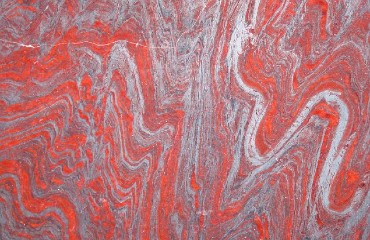
Jaspillite/Itabirite - Image Credit: James St. John, CC BY 2.0 The Quadrilátero Ferrífero, or ‘Iron Quadrangle’, is a mineral-rich region of central Minas Gerais, about 50 kilometres southeast of Belo Horizonte, covering roughly 7,000 km². The Itabira district lies around 90 kilometres to the northeast, and the two areas are closely linked. They were early focal points of the Brazilian gold rush in the late 1600s – Ouro Preto sits in the far southeast corner of the Quadrilátero – and the boom drew thousands of migrants and the forced arrival of vast numbers of enslaved Africans. Today, however, the region is far better known for enormous iron ore deposits (and significant manganese) that supply Brazil and global markets. Geologically, these ores occur along the margin of the São Francisco craton and originated as marine sediments about 2.5 billion years ago. Deformation and metamorphism later folded and transformed them into extensive banded iron formations, consisting of thin layers of hematite and magnetite alternating with quartz that has been altered under pressure into a mix of microcrystalline quartz and jasper. This type of ore-rock is commonly known by geologists as jaspillite, on account of the jasper content, but in Brazil it is widely referred to as itabirite, after the location where such deposits are widely found. This material typically produces a very high-grade iron ore, because sulfur and phosphate impurities were removed by the metamorphic processes. Mining is dominated by massive open pits, making collectible specimens uncommon, though crystalline material is occasionally recovered by miners. Notable minerals include specular hematite, magnetite, goethite and quartz, valued for sharp crystal forms and strong lustre. The district has also yielded several type-locality species, including arsenopalladinite, atheneite, isomertieite, jacutingaite and palladseite. Some pegmatites occur as well, and the Piteiras Mine at Itabira produced about two kilograms of emerald rough between 2000 and 2008. |
|
Casa de Pedra mine, Congonhas do Campo, Minas Gerais
Hematite Rose - Image Credit: The Assay House, Public Domain Casa de Pedra is one of several giant iron-ore open-pit mines in the vicinity of Congonhas, in Brazil’s Quadrilátero Ferrífero of central Minas Gerais (roughly 80 km south of Belo Horizonte). Although early records are incomplete, many of these mines were already operating by the early 20th century, and since 1947, they have grown into one of Brazil’s largest iron producers. Geologically, Casa de Pedra exploits the same high-grade banded jaspillite/itabirite iron ores as the other iron mines in the Quadrilátero Ferrífero district. What sets Casa de Pedra apart from the area's other mines, however, is the occasional presence of two types of crystalline haematite instead of the more common banded amorphous masses. The first type consists of large, pseudo-cubic, highly lustrous metallic crystals, some of which reach 15 centimetres across. The second type consists of spectacular, flattened crystals that form spherical clusters known as ‘iron roses’. The best specimens were mined in the early 1950s and are some of the best world occurrences known. However, the mine continues to produce further superb specimens, together with a handful of other locations, including Miguel Bournier and Cachoeira do Campo. |
|
Diamantina & Jequitinhonha River diamond fields, Minas Gerais
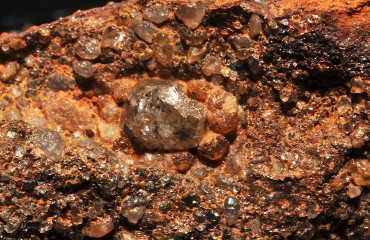
Diamond in Conglomerate - Image Credit: Géry PARENT, CC BY-SA 3.0 The Diamantina–Jequitinhonha diamond region lies in the Espinhaço highlands of northern Minas Gerais and is centred on the historic town of Diamantina. The settlement was originally called Arraial do Tejuco, but it was renamed Diamantina after it became the centre of Brazilian diamond mining in the 18th and 19th centuries. The gems were first discovered here in 1729 by prospectors searching riverbeds for gold and emeralds. Instead, they noticed pale, glassy pebbles in the gravel – stones that proved to be diamonds – and Brazil went on to dominate global diamond supply for more than a century. Importantly, there is no single mine but a scattered diamond field. The diamonds occur in river gravels along the Jequitinhonha and its tributaries and in diamond-bearing sedimentary rocks in the surrounding uplands. A few named workings include the Areinha claims (Rio Novo mine); the Jobô mine at Quartéis do Indaiá; the Duro claim at São João da Chapada; the Extração district; and deposits near Datas. Otherwise, the most common method of mining involved building temporary dams to divert a river, digging the exposed bed for gem-bearing gravels, returning the river to its original course, and then repeating the process further along. It is assumed that the region’s diamonds were eroded from some primary source, but the original structure, like a kimberlite or lamproite pipe, has never been found. The collectible mineral is, of course, diamond, most often prized when the crystals retain sharp natural edges and when specimens are accompanied by accurate locality documentation. |
|
Teófilo Otoni and Governador Valadares, Minas Gerais
Beryl var, Aquamarine - Image Credit: The Assay House, Public Domain Although these two local municipalities have few deposits of their own, they serve as the main market for aquamarine specimens mined from the surrounding pegmatite regions of Minas Gerais, as well as those from the neighbouring states of Bahia and Espirito Santo. The heyday of aquamarine mining took place in the 19th and 20th centuries, and especially during World War 2 when the mineral was sought for its beryllium content needed by the American military and then in the 1950s for the American nuclear programme. Nowadays, most aquamarines are mined as mineral specimens, mainly from alluvial deposits, but also from occasional subsurface mines. The key areas where aquamarine occurs are pegmatites that were enriched by beryllium due to fractionation processes in the cooling melts. In Minas Gerais aquamarine occurs in four key pegmatite areas. Of these, the Carai (Marambaia) are the most famous, producing superb, large, blocky, perfectly transparent, azure-blue crystals. To the north is Medina, to the southwest is Santa Maria de Itabira, and to the south is Conselheiro Pena, which completes the four and is also a unique shared locality with tourmaline. Neighbouring states extend the aquamarine mineralisation: such pegmatites are also documented in Espírito Santo (e.g., Colatina and Mimoso do Sul) and Bahia (e.g., Itambé and Teixeira de Freitas), showing that the broader eastern Brazilian pegmatite belts don’t stop at state borders. All are highly collectible locations and prized by mineral collectors, although locality labelling is not always clear, accurate or complete. |
|
Ametista do Sul, Rio Grande do Sul
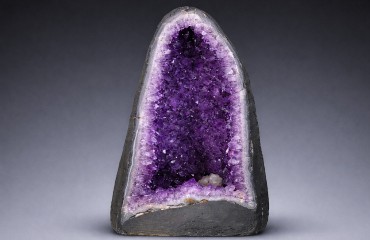
Amethyst Geode - Image Credit: The Assay House, Public Domain Ametista do Sul is a small municipality in northwestern Rio Grande do Sul, in southern Brazil, famous for the amethyst mines that start at the edge of town. Originally called São Gabriel, it was renamed Ametista do Sul in the 1980s as amethyst mining became central to the local identity and economy. A string of workings, including Salles, Célio, Testa, Trock, Narciso, Mioto, Zanon, Simonetti and Bortoluzzi, extends for roughly 20 kilometres, with production feeding into nearby Soledade, where much of the buying and selling takes place. Soledade itself was also once a source of amethyst, as were other neighbouring areas, but these have declined in favour of Ametista do Sul. Geologically, the amethyst occurs as geodes within the Serra Geral Formation basalts. The accepted model of their formation describes a two-stage process. It begins when gases create cavities within the molten basalt as it cools and solidifies. Subsequently, low-temperature circulating fluids fill them with silica, crystallising into quartz and amethyst crystals. Mining is straightforward but labour-intensive. Tunnels are simply driven horizontally into basalt layers, and geodes are extracted as they’re encountered. The specimens are typically cavernous ‘cathedral’ geodes lined with sharp, purple quartz points, often with banded quartz at the rim and sometimes with associated late calcite. These purple-white combinations are particularly attractive and highly prized by collectors, although many are bought by the general public as ornamental pieces. |
|
Batalha mine, São José da Batalha, Salgadinho, Paraíba
Paraiba Tourmaline - Image Credit: The Assay House, Public Domain Mina da Batalha lies near the village of São José da Batalha in Paraíba, northeast Brazil. It is a relatively small pegmatite locality that became world-famous for a single extraordinary find. In the early 1980s, most often dated to 1982, miners discovered an intensely blue-green tourmaline that proved to be copper-bearing elbaite, now celebrated as ‘Paraíba tourmaline’. Its electric colour arises from traces of copper, a rare ingredient in tourmaline, and the mine remains the key location for understanding ‘Paraíba-type’ mineralisation. Geologically, the deposit consists of granitic pegmatites that occur as parallel, tabular (sheet-like) bodies. These formed from late-stage granitic melts enriched in fluids and volatiles, allowing large crystals to grow in pockets and fractures. The unusual presence of copper suggests very specific late crystallisation conditions, likely involving metal availability and fluid chemistry not typical of most other granites. Today, the region continues to produce world-class specimens of ‘Paraiba tourmaline’, massively prized by collectors, as well as specimens of quartz, feldspar-type minerals and lepidolite and muscovite micas. |
|
Carnaíba, Marota & Socotó (Campo Formoso) emerald districts, Pindobaçu, Bahia
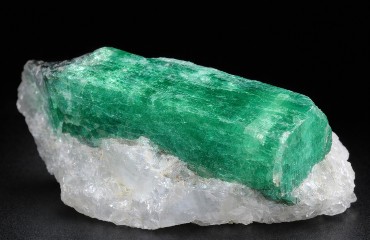
Carnaiba Emerald - Image Credit: The Assay House, Public Domain After settling Brazil’s coast in the early 1500s, the Portuguese began exploring the interior, initially driven not by gold but by emeralds worn by Indigenous peoples. The earliest recorded expedition set out in 1538, travelling up the Doce and Jequitinhonha rivers into what is now Minas Gerais. Many others followed; official records list at least 12 attempts between 1550 and 1682. Most expeditions returned mostly empty-handed, defeated by hostile encounters, dense forest, and diseases such as malaria. Yet they brought back valuable geographic knowledge that helped open routes for inland settlement, and, in the process, they stumbled upon other riches – most notably gold around Ouro Preto and a range of gemstones, including beryl, topaz, and tourmaline. Ironically, emerald deposits do exist in Minas Gerais at places like Serro and Diamantina, sites visited by some of these early parties, but who failed to find them – and ultimately, these deposits proved relatively small. Consequently, Brazil did not emerge as a significant emerald producer until the 20th century, after new fields were discovered in the neighbouring state of Bahia from 1912 onwards. Early localities such as Brumado, Fazenda dos Pombos, Açude Sossego, and Salininha yielded only sporadically and tended to produce stones of moderate quality. A major breakthrough, however, came in 1965 in rural Pindobaçu, about 30 kilometres south of Campo Formoso, at a deposit that became famous as Carnaíba. Carnaíba’s emeralds occur in a north–south belt of quartzite surrounded by older gneiss, where a granite intrusion generated pegmatite bodies. The gems are concentrated in a mica-rich rock dominated by biotite and phlogopite, close to the pegmatites, with associated minerals such as quartz, apatite, and molybdenite. Crystals can reach a few centimetres, showing a strong vitreous lustre, occasional transparency, and a highly prized deep green hue. In recent years production has dropped sharply as workings have deepened to around 150 metres, bringing persistent flooding problems. Two other Campo Formoso deposits are notable. Marota, nearby, is often mined by shallow pits, producing fewer stones that may be larger but are generally paler. Socotó, discovered in 1979 about 40 kilometres from Carnaíba, yields distinctive emeralds that can be vanadium-bearing, giving a lighter, sometimes bluish-green colour prized by high-end jewellers and collectors. |
|
Santa Terezinha de Goiás (Campos Verdes) emerald district, Goiás
Santa Terezinha Emerald - Image Credit: The Assay House, Public Domain Santa Terezinha de Goiás, better known in the gem trade as the Campos Verdes district, is another significant source of emeralds in Brazil. It lies in central Brazil’s Goiás State, about 20 km north of the town of Santa Terezinha de Goiás. Emeralds were known here since the 1920s, but the main discovery took place in 1981 when a bulldozer accidentally uncovered the deposit while clearing land for a new road. It rapidly became one of Brazil’s most productive emerald rushes, worked largely by independent miners, locally called garimpeiros. Geologically, the emeralds occur in a talc-schist layer intersected by pegmatite, and mining has historically focused on two main areas known as Trecho Velho and Trecho Novo, using trenches, pits and tunnels rather than large modern open pits or deep mines. Studies interpret the mineralisation as structurally and chemically controlled within schistose, carbonate- and phlogopite-rich zones. Most stones are small (commonly under a carat when cut), and many have characteristic inclusions, including pyrite and chromite, that help identify the source. |
|
Poços de Caldas Alkaline Complex, São Paulo / Minas Gerais
Sodalite - Image Credit: James St. John, CC BY 2.0 The Poços de Caldas Alkaline Complex sits on the border of southern Minas Gerais and northeastern São Paulo, centred on the city of Poços de Caldas. It is a huge, roughly circular geological feature, about 800 km², often described as resembling a collapsed volcanic caldera. Interest in the complex has long been driven by the presence of unusual chemical elements, especially zirconium, in the form of the oxide baddeleyite, which are the biggest known reserves in the world. Other elements and their minerals include uranium, thorium, niobium, neodymium, strontium, tantalum, thallium, cerium and cadmium. Apart from the baddeleyite, the other resources extracted include the ores of uranium, thorium, and aluminium, as bauxite. Geologically, Poços de Caldas is an alkaline igneous complex, with rocks formed from magmas with uncommon chemistry compared with normal granites or basalts. That chemistry tends to concentrate “high-field-strength” elements such as zirconium, thereby producing mineral suites that are distinctive and scientifically useful for studying alkaline magmatism and late-stage alteration. The wealth of the various elements present, plus extensive weathering of the deposits and ores, has given rise to at least 175 reported minerals, making this one of the most diverse and rich mineralogical sites in Brazil. Rare zirconium minerals are of particular interest to systematic collectors, including the type location species bortolanite, named after the Bortolan quarry in the extreme north of the complex. |
|
Jacupiranga mine, Cajati, São Paulo
Quintinite - Image Credit: Robert M. Lavinsky, CC-BY-SA-3.0 The Jacupiranga Mine (often referred to as Morro da Mina) lies near Cajati in the Ribeira Valley of southern São Paulo State. It is best known as a major commercial phosphate producer, with large-scale mining since 1970, and it represents one of Brazil’s most important worked examples of a carbonatite–alkaline complex. Geologically, Jacupiranga is associated with carbonatite rocks – unusual, carbonate-rich magmas derived from the mantle. Carbonatites commonly concentrate incompatible elements and can host large apatite resources as well as iron oxide mineralisation. In the case of Jacupiranga, the elements include cerium, niobium, strontium, tantalum, uranium and zirconium. For instance, niobium minerals include the three type locality species melcherite, menezesite and pauloabibite. Zirconium minerals include zirconolite and zirkelite. For mineral collectors and researchers, the interest lies in these rare minerals, as well as the distinctive association suite consisting of carbonate minerals (calcite and dolomite) and magnetite, together with a wider list of accessory and alteration minerals recorded across the complex. The apatite from Jacupiranga is mostly massive and black, and it is not especially attractive. However, other locations in Brazil are famous for their highly crystalline, brightly coloured apatite specimens, especially from Pederneira, Conselheiro Pena, Rio Grande do Norte, Morro Velho and Fazenda das Panelas. Many of these crystals occur in the same Minas Gerais pegmatite outcrops as the more famous tourmalines, but in smaller amounts. The colours range from deep blue to green, yellow and pink. Brazil is among the few global locations where apatite is sufficiently gemmy for use in jewellery and lapidary. |
|
Pedro II precious opal district (incl. Boi Morto mine), Piauí
Precious Opal - Image Credit: The Assay House, Public Domain The Pedro II precious opal district lies in northern Piauí, in northeastern Brazil, centred on the town of Pedro II. It is Brazil’s best-known source of gem opal, with the discovery of precious opal in the area commonly attributed in reports to J. R. Sauer in 1960. Mining has been mostly small-scale and intermittent, spread across a number of named workings. Among these, the Boi Morto mine is the best known because it yielded a small amount of black opal from a vein in 1974, followed by later artisanal activity. Geologically, the district is known for opal occurring in vein-style deposits, indicating that silica-rich fluids moved through fractures and precipitated opal as they cooled or changed chemistry. The field produces both precious opal (with play-of-colour) and common opal/potch, reflecting differences in the microscopic structure that creates or suppresses colour effects. |
|
Córrego Frio & Telírio, Linópolis, Laranjeiras, Minas Gerais
Brazilianite - Image Credit: Didier Descouens, CC BY 4.0 Córrego Frio and Telírio (also known as the Telírio claim or Lavra do Telírio) are small pegmatite outcrops at Linópolis, in the municipality of Divino das Laranjeiras, forming part of the broader Aimorés pegmatite district within the EBPP. Córrego Frio came to fame in 1942, when a new gemmy mineral was found, and by 1945 it had been identified and named as brazilianite, in honour of Brazil, making Córrego Frio the mineral’s type locality. Other type-minerals from this location are scorzalite and souzalite. All three are phosphates and are the result of a secondary phosphate enrichment of this pegmatite, which is granitic in origin and enclosed within highly altered biotite–garnet schist. The nearby pegmatite in Telírio is similar in structure but contains an even greater range of rare phosphate minerals, including zanazziite, rockbridgeite, frondelite, montebrasite, moraesite, strengite and beryllonite. These formed in small cavities, locally called ‘ximboquinhas’, within the rock that were able to concentrate phosphate minerals. Another feature of Telírio is the fact that slightly different conditions here allowed the formation of even better, world-class specimens of brazilianite, occurring as large, gemmy, blocky, bright yellow crystals. Apart from brazilianite, the location is also renowned for rare phosphate amblygonite, found as outstanding cream-coloured, twinned fishtail crystals. |
|
Carajás iron complex, Parauapebas, Pará
Mina serra N1 - Image Credit: IsabeleC, CC BY-SA 4.0 Carajás is a vast mining province in southeastern Pará, in the Amazon region of northern Brazil, centred on the Serra dos Carajás ranges. Mining began after the famous 1967 discovery that opened up what became one of the world’s leading iron districts. Geologically, Carajás is dominated by Archean banded iron formations similar to those of Quadrilátero Ferrífero, consisting of layered jaspilites/itabirites, later modified by hydrothermal processes and intense tropical weathering. A key example is the S11D (Serra Sul) deposit, where studies describe “soft” high-grade ore formed through alteration and supergene/lateritic transformation of the original iron formation. The best-known commercial products are iron minerals – hematite and goethite – with other metals, including gold, copper and nickel, also recorded across the province. Mineral specimens are rare due to large-scale commercial extraction, but the location is highly significant as one of the largest iron ore deposits in the world. |
|
Pela Ema, Minaçu & Catalão I and II, Catalão, Goiás
Catalão I - Image Credit: Leider, CC BY-SA 1.0 The state of Goiás, in central Brazil, has become one of the country’s most strategic states for rare earth elements (REEs) thanks to two very different types of deposit. In the very north of the state, near Minaçu, the Pela Ema (Serra Verde) deposit entered commercial production in 2024. Unlike regular hard-rock mines, Pela Ema is an ionic adsorption clay deposit, where the deep weathering of granite has created a clay-rich saprolite, where REE ions are loosely adsorbed onto clay surfaces, including valuable magnet REEs such as neodymium, praseodymium, dysprosium and terbium. Distinct mineral species include monazite, thorite and xenotime. In southeastern Goiás, the Catalão I and II complexes represent classic alkaline–carbonatite deposits. Catalão I is a 6-kilometre-wide carbonatite plug mined mainly for niobium and phosphate, with minor REE represented by monazite, goyazite, ceriopyrochlore, bastnäsite, svanbergite, cerianite and burbankite. For mineral collectors, Catalão can yield carbonatite-type minerals such as apatite, magnetite and REE minerals like monazite, while Pela Ema is important scientifically and economically but rarely produces showy crystals. |
|
Morro do Urucum iron & manganese deposit, Corumbá, Mato Grosso do Sul
Morro Urucum - Image Credit: Andrew Mercer, CC BY-SA 4.0 The Urucum district (Serra do Urucum/Serra da Santa Cruz) lies near Corumbá, on Brazil’s border with Bolivia in the state of Mato Grosso do Sul. Iron and manganese were reported here in the late 19th century, and the deposits were formally investigated in 1941, leading to the discovery of a mountain composed almost entirely of hematite and manganese oxides. These exposures continue over the border into Bolivia, forming the world’s largest deposit of iron ore. Several enormous open-pit mines work here, including the Figueirinha, Lais and Santa Cruz mines. These deposits, similar to those in the Quadrilátero Ferrífero, are made up of layers of haematite and a type of silica known as jasper, which creates a striped rock called jaspilite, locally known as itabirite. However, what sets these particular deposits apart is the presence of large lenses of manganese oxides and hydroxides (typically cryptomelane, but also a mixture of hausmannite and pyrolusite) in between the layers of iron ore and silica. This manganese is thought to have been concentrated into these structures by ancient microbial activity. For collectors, Urucum’s most distinctive specimens are the banded hematite-jasper jaspilite slabs, lustrous hematite-rich specimens, and laminated “graphic” manganese-oxide ores. Other notable minerals are those containing both iron and manganese, including jacobsite and hollandite, depending on the ore type and alteration. |
|
Remédios, Novo Horizonte, Bahia
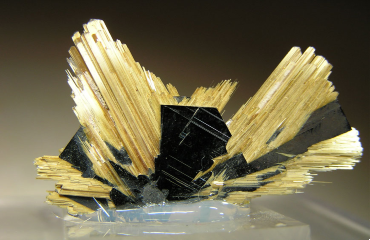
Rutile - Image Credit: Robert M. Lavinsky, CC-BY-SA-3.0 Novo Horizonte is a small municipality in central Bahia, in the Chapada Diamantina / Serra do Espinhaço region, that became internationally known among collectors for golden rutile. Much of the best material comes from workings in the Remédios area (near Vila dos Remédios), a locality long mislabelled as “Ibitiara, Bahia” until recently corrected. Artisanal mining expanded the district’s activity from the 1980s onwards, when gem traders and visitors began exporting ‘golden rutilated quartz’ to the wider gem market. Geologically, the specimens are linked to hydrothermal quartz veins that cut volcanic rocks in the region. Recent mineralogical work describes late-stage veins crosscutting metarhyolites of the Rio dos Remédios Group, with rutile and hematite among the associated phases. Collectors prize two signature styles of rutile from the area. The first are clear to smoky quartz crystals packed with rutile needles pointing in various directions, known as ‘rutilated quartz’. The second are world-class, yellow-orange, metallic, rutile sprays grown epitaxially on lustrous-black hematite, often forming starbursts and fan-like clusters with black hematite centres. |








Brazil’s mineral localities show how geology, history and human enterprise intertwine. Ancient cratons, mountain-building events and later volcanic episodes created the settings for iron formations, emerald schists, alkaline complexes and world-class pegmatites. From the gold and diamond rushes that shaped Minas Gerais to modern demand for lithium and rare earths, the country’s resources have repeatedly influenced settlement, industry and scientific study. For collectors, Brazil remains unmatched in the range of specimen styles—neon tourmalines, imperial topaz, cathedral amethyst, metallic hematite and rare phosphate suites. Yet large areas remain lightly explored, ensuring Brazil will continue to surprise future researchers and collectors alike.
If you are interested in adding specimens from Brazil to your collection, click HERE
