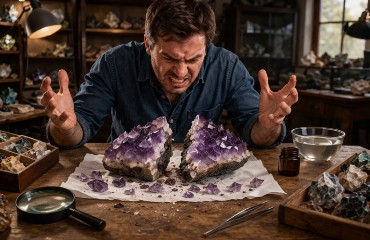
The vast majority of minerals are usually safe to own and display, and there’s a good reason for that. In general, the strong chemical bonds that hold a crystal structure together make most minerals largely insoluble in water, so they’re unlikely to dissolve, be absorbed, and enter the human body under normal display and handling. The small number that do present risk tend to do so because of how exposure happens - most problems come from dust, fibres, and a few soluble or reactive minerals, not from simply storing or looking at a specimen in a cabinet.
Dust is the big one. Sawing, sanding, trimming, crushing, grinding or even vigorous dry brushing can release fine particles. Silica-rich rocks and many common minerals can produce fine dust that irritates lungs over time. When a mineral also contains toxic elements, that dust can be more concerning because it can be inhaled or transferred from hands to mouth.
Fibrous habits deserve special caution. If a specimen contains needle-like or fibrous material, avoid any action that could shed fibres, and don’t display it where it can be knocked, abraded, or handled frequently.
Soluble minerals and salts are another pathway. A few minerals can dissolve slightly or leave residues that transfer easily to skin - often bright secondary copper minerals from oxidised ore zones. The main issue here is accidental ingestion (touching your face, eating, smoking) after handling.
Heavy-metal minerals
Some minerals contain lead, arsenic, cadmium, mercury, thallium, antimony, and similar elements. In solid, stable form they’re often low-risk, but the risk rises with powdery material, dust, soluble crusts, or heating (which can change chemistry or release fumes). Treat these as “handle with care” pieces rather than everyday desk specimens.
Radioactive minerals
Radioactive specimens vary widely in risk depending on the mineral, size, activity, and storage conditions. Most concerns relate to distance, shielding, and ventilation (especially for enclosed spaces). Many of the common radioactive minerals only emit alpha-radiation, which is easily stopped by thin plastic or glass - so little danger there, unless ingested or inhaled. The main concern happens when large numbers of radiactive specimens are stored together in confined spaces because their radioactive decay can lead to the accumuation of radioactive radon gas - which should not be inhaled. Consequenly, good ventilation should be provided. If you’re unsure, treat these specimens carefully and consider a basic radiation check for peace of mind.
Sensible safety measures for all mineral specimens
- Avoid cutting/grinding/plishing without air extraction and a suitable respirator.
- Don’t dry-brush dusty pieces; use wet methods where appropriate.
- Handle with clean, dry hands or when wearing gloves; wash hands after handling and before eating.
- Keep specimens away from food prep areas and especially from children and pets.
- Store friable, fibrous, dusty, heavy-metal, or radioactive pieces in sealed display boxes.
- Label “handle with care” specimens clearly, and keep original labels with locality/species notes.
If you feel unwell after working with minerals or suspect significant exposure, seek medical advice and explain exactly what you handled and how.