
The geology and mineralogy of South Africa is one of the richest and most diverse in the world, due mainly to its unique geology. Much of the country consists of the ancient Kaapvaal Craton, a stable block of Earth’s crust that formed more than three billion years ago. Because this crust is so old, it preserves a huge variety of early geological environments and rock types, ranging from some of the world’s earliest volcanic rocks in the Barberton Greenstone Belt to younger sedimentary basins like the Witwatersrand, where massive amounts of gold accumulated in ancient river systems.
Then, over millions of years, changes in the Earth’s oceans, climate, and tectonic movements created enormous manganese deposits in the Northern Cape, diamond-bearing kimberlite pipes across the interior, and rare carbonatite intrusions such as the one at Palabora. These processes left behind not only valuable ores but also spectacular mineral specimens that are now famous among collectors worldwide.
Mining has played a major role in South Africa’s history and economy. The diamond discoveries of the 1860s and the gold strikes of the 1880s shaped the development of modern cities, drove industrialisation, and positioned the country as a global mining powerhouse. Today, South Africa remains a place where geology, industry, and mineral beauty all come together – and its mines continue to produce the country’s considerable wealth and some of the world’s most remarkable and desirable mineral specimens.
For a Map of Mineral Locations in South Africa click HERE
|
Kalahari Manganese Field, John Taolo Gaetsewe District Municipality, Northern Cape
Sugilite - Image Credit: Géry Parent, CC BY-ND 2.0 The Kalahari Manganese Field near Kuruman is one of the world’s most unique localities. Its ore body lies within the 2.2-billion-year-old Hotazel Formation of the Transvaal Supergroup and represents the largest manganese deposit on Earth. The mineralisation began as sediments on the floor of an ancient ocean, where manganese and iron settled out in repeating layers of carbonates and oxides. During the Paleoproterozoic Great Oxidation Event, rising oxygen levels altered these sediments and helped create the thick manganese-rich beds seen today. Subsequent regional metamorphism recrystallised the layers into massive, high-grade ore. A later phase of faulting and hydrothermal circulation dissolved and redistributed manganese into fractures and cavities, forming the exceptional mineral species for which the field is famous. This combination of sedimentation, oxidation, metamorphism, and hydrothermal enrichment has led to one of the most colourful and varied manganese mineral suites known to science. Among these are world-class, sharp crystals of rhodochrosite, canary yellow ettringite, lustrous manganite, highly crystalline braunite and numerous rare type-locality minerals. Overall, the deposit is known for almost 200 different mineral species, of which nearly 30 were first discovered here. Approximately 30 to 40 separate mines and quarries work or have worked the area’s manganese deposits since mining began in the late 1930s, but the Hotazel, N’Chwaning, and Wessels mines deserve individual attention. |
|
Hotazel Mine, Hotazel, John Taolo Gaetsewe District Municipality, Northern Cape
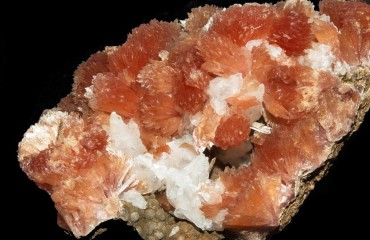
Inesite on Calcite - Image Credit: Géry PARENT, CC BY-SA 4.0 Located just outside of the Hotazel mining settlement, the Hotazel Mine was one of the earliest operations of the Kalahari Field and has given its name to a large part of the region’s manganese formation. Legend says that visiting surveyors in 1915 during a particularly hot summer reportedly described the place as ‘hot as hell’, leading to the name ‘Hotazel.’ Mining began in the late 1930s, and although primarily an ore producer, the mine quickly became famous for its striking associations of pinkish-red rhodochrosite, purple-black hausmannite, and metallic manganite. Hotazel specimens are typically embedded in a dark manganese matrix, providing superb contrast to their vivid crystal colours. The mine also produced delicate crystals of the rare minerals hollandite and jacobsite. Today the old workings are largely inaccessible, but its minerals remain highly sought after, representing a formative chapter in South Africa’s mineralogical story. |
|
N’Chwaning Mines, Kuruman
Rhodochrosite - Image Credit: Robert M. Lavinsky , CC BY-SA 3.0 The name N'Chwaning Mine is applied collectively to a group of neighbouring deep mines known as N'Chwaning I, N'Chwaning II and N'Chwaning III. Operations started in 1972, 1981 and 2006, respectively, and these mines work on one of the largest manganese reserves in South Africa. Apart from their ore-producing significance, the N'Chwaning mines are notable and famous among mineral collectors for crystals of exceptional sharpness, transparency, and colour – many ranking among the finest in existence for their species. These include brilliant red rhodochrosite scalenohedrons, radiant yellow sprays of ettringite, lustrous black manganite, sparkling hausmannite, and delicate pink to orange spheres of olmiite, a mineral first described here. Indeed, of the 100 or so valid minerals from this location, 8 others are also type-location species, including guidottiite, saccoite, and tanajacoite. Minerals occur in cavities within the metamorphosed manganese ore and associated carbonates, where hydrothermal fluids precipitated spectacular crystal growth. The mines remain active for ore, and superb mineral specimens continue to emerge from occasional pockets carefully preserved by skilled miners and collectors. |
|
Wessels Mine, John Taolo Gaetsewe District Municipality, Northern Cape
Celestine - Image Credit: Robert M. Lavinsky , CC BY-SA 3.0 Another part of the Kalahari manganese system, the Wessels deposit, was discovered in 1951, and ore extraction began in 1973. The mine soon became noted for an even greater abundance of mineral species than other workings in the area. The geological conditions of low-temperature hydrothermal alteration within manganese-rich host rocks created a hugely diverse suite of secondary minerals. To date, almost 130 individual mineral species have been recorded, with 18 of them being type location minerals. Many of these have formed as well-defined crystals, making them highly prized by collectors, both for their rarity and aesthetic appearance. The mine itself has reached a depth of 400 m, and the ore extracted is primarily composed of bixbyite, a manganese iron oxide mineral, while the waste material is mainly clay. The activities at the mine contribute to the extraction of valuable manganese resources in the region and play a significant role in the local and national economy. Apart from those already described, other mines in the Kalahari Manganese Field include the Makulu, Santoy, Paling, Glouchester and Middelplaats deposits, but few match the quality and diversity of the mineral specimens from Hotazel, N’Chwaning and Wessel. |
|
Okiep Copper District, Namakwa District Municipality, Northern Cape
Okiep Copper Mine - Image Credit: Andrew Hall , CC BY-SA 3.0 Okiep grew around rich copper deposits first noted in 1685, when the first governor of the Dutch Cape Colony, Simon van der Stel, arrived at the area’s ‘mountains of copper’ led by the local Nama people. Though early shafts revealed rich ore, the region’s isolation meant little development for nearly 200 years. Serious mining only began after James Alexander revisited the old workings in 1852, sparking a rush of prospectors and the arrival of skilled Cornish miners. Their stone buildings and the remains of the Namaqualand Railway, opened in 1876 to haul the ore to Port Nolloth, still survive. Okiep briefly became the world’s richest copper source, but the fluctuating prices caused repeated closures. Nevertheless, between 1852 and 2002, the district’s 60 to 70 mines yielded about two million tonnes of ore from hydrothermal veins in local gneiss and granite. Known as the Koperberg Suite intrusions, spread over a large area of 2,500 square kilometres, these veins carried several copper-sulphide ores, including chalcopyrite, bornite, and chalcocite with secondary malachite and azurite. Today, collectors value the sharp native copper crystals, blue chrysocolla coatings, and malachite pseudomorphs that formed through weathering of the ancient ores. Though mining has ceased, the dumps continue to yield fine specimens that recall the heydays of South African copper mining. |
|
Cullinan Mine, Cullinan, Tshwane Metropolitan Municipality, Gauteng
Cullinan Diamond Mine - Image Credit: NJR ZA , CC BY-SA 3.0 The Cullinan Mine, formerly known as the Premier Mine, is one of the world’s most famous diamond-producing localities. It was discovered in 1902 by prospectors looking for metal ores, who instead found diamonds in local river gravels. Following the trail upstream, they uncovered their source, a large kimberlite pipe that intruded the ancient rocks of the Kaapvaal Craton around 1.2 billion years ago. These kimberlite eruptions transported diamonds from deep in the mantle, over 150 kilometres below the surface, where high pressure and temperature crystallised carbon into diamond. The mine gained international fame in 1905 with the discovery of the Cullinan Diamond, a 3,106-carat crystal that remains the largest gem-quality diamond ever found and produced several stones now set in the British Crown Jewels. The Cullinan pipe continues to yield sharp octahedral and cubic diamonds. Still active, it has produced over 800 stones above 100 carats, and a quarter of all its diamonds are over 400 carats. It is the world’s premier source of rare blue diamonds and is also famed among geologists and mineral collectors for mantle-derived xenoliths with garnet, chrome diopside and ilmenite-bearing harzburgites and lherzolites. |
|
Kimberley and Koffiefontein Diamond Fields, Northern Cape and Free State
Kimberley Big Pit - Image Credit: Andrew Hall, CC BY-SA 3.0 The diamond fields around Kimberley are central to the story of South African mining and the world diamond trade. In 1869 the discovery of the 'Star of South Africa' diamond triggered a huge rush of prospectors. This led to the excavation of the famous “Big Hole” at Kimberley, one of the largest hand-dug mines on Earth. Nearby, several other diamond pipes were also found, giving rise to the De Beers, Kampfersdam, Bultfontein, Dutoitspan and Wesselton mines. All these pipes formed from ancient eruptions of kimberlite through the Kaapvaal Craton, carrying diamonds and other deep mantle minerals to the surface. Even though the mines lie only a few hundred metres apart, their diamonds can differ greatly in size, shape and colour. Despite this, they share broadly similar accessory minerals, including mantle xenoliths and classic diamond indicator minerals like pyrope garnet, chrome diopside and ilmenite. In addition, the Kimberley area is particularly rich mineralogically and is noted for around 70 different mineral species, including 7 type locality minerals, namely afwillite, bultfonteinite, hawthorneite, lindsleyite, mathiasite, mountainite, and rhodesite, although most of these only come from Bultfontein. The Koffiefontein Mine is located about 80 km south of Kimberley and has led a chequered history of repeated openings and closures. However, its diamonds are renowned for their excellent quality, with Edwin Streeter commenting in 1898 that its stones were of the ‘first water’, meaning of exceptional clarity. Today, although production at all sites has diminished, the Kimberley region remains the epicentre of the world diamond industry and continues to contribute valuable geological insight into kimberlite formation and diamond transport from deep within the Earth’s mantle. |
|
Palabora Mine, Phalaborwa, Mopani District Municipality, Limpopo
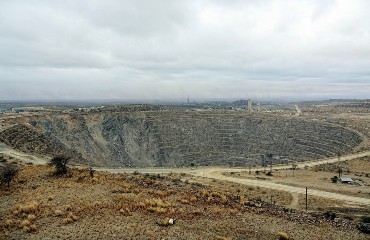
Palabora Mine - Image Credit: Bjørn Christian Tørrissen , CC BY-SA 4.0 The Palabora Mine, located near Phalaborwa in Limpopo, is one of the world’s best-known carbonatite-hosted mineral deposits and a unique feature of South African geology. Formed by the intrusion of a large alkaline carbonatite complex around 2 billion years ago, the deposit contains an unusual concentration of copper, tin, zinc, uranium, platinum-group metals, and rare-earth elements. The carbonatite magma originated deep within the mantle and rose rapidly, carrying with it a distinctive suite of minerals rarely found in more typical igneous systems. Subsequent hydrothermal fluids further enriched the intrusive body with phosphorus, barium and arsenic, followed by oxidation and weathering. Together, these processes produced over 100 different mineral species, among them sharply terminated green fluorapatite crystals, lustrous aegirine needles, crystalline magnetite specimens and occasional rare element species such as baddeleyite (Zr), fergusonite (Nd/Nb) and bastnäsite (Ce). For collectors, Palabora is best known for its large, gemmy fluorapatite prisms often associated with magnetite and feldspar. For geologists, it provides an important natural laboratory for studying deep mantle chemistry, alkaline magmatism and carbonatite evolution. Originally the mine was mainly worked as an open pit for copper, apatite (phosphorous) and vermiculite, but also for small amounts of uranium, zirconium and platinum. Nowadays the work has moved underground, and Palabora stands as one of South Africa’s most scientifically significant and mineralogically prized mineral localities. |
|
Messina (Musina) Copper Mines, Vhembe District Municipality, Limpopo
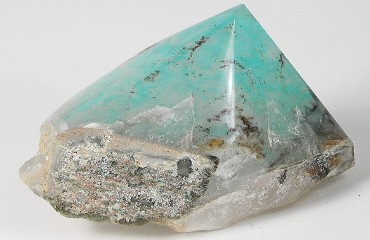
Ajoite in Quartz - Image Credit: Robert M. Lavinsky , CC BY-SA 3.0 The Messina mining district, situated near the Zimbabwe border, was one of South Africa’s most valuable sources of copper and is also celebrated by mineral collectors for its spectacular quartz and rare copper silicate minerals. Mining began centuries ago along the banks of the Limpopo River by indigenous African communities. These early workings attracted attention after the Anglo-Boer War, leading to the formation of a mining company in 1905 and the development of several shafts, often sunk directly beside ancient mines. Large-scale production began in the 1910s, and before its closure in 1992, the mine produced an estimated 40 million tonnes of ore, yielding roughly 700,000 tonnes of copper. Geologically, the ore bodies occur in highly metamorphosed gneisses of the Beit Bridge Complex and developed in major shear zones that channelled copper-rich hydrothermal fluids. The mineralisation formed veins, lodes, and breccia pipes with strong zonation from pyrite outward to chalcopyrite, bornite, chalcocite, and native copper. Intense alteration produced zones of sericite, albite, epidote, and chlorite. Today, the mine is famous among mineral collectors for its exceptional quartz crystals, ranging from small prismatic groups to half-metre giants. Many contain vivid blue inclusions of shattuckite, papagoite or ajoite, along with hematite, epidote, and kaolinite phantoms. These striking combinations make Messina one of Africa’s most iconic collector localities. |
|
Witwatersrand Gold Field, Germiston, Ekurhuleni Municipality, Gauteng
Auriferous, pyrite & quartz-pebble - Image Credit: James St. John, CC BY-SA 2.0 The Witwatersrand Gold Field is one of the most valuable mineral regions on Earth, responsible for more than a third of all the world's gold ever produced. Its discovery in 1886 transformed the region almost overnight, leading to the founding of Johannesburg and marking the start of South Africa’s economic boom. Although early workings focused on easily accessible outcrops, large-scale underground mining soon followed as the immense extent of the “Rand Reefs” became clear. Over the next century, the Witwatersrand became the backbone of the country’s economy, with dozens of major mines operating along the famous gold-bearing belt. Mining operations are noted for their extreme depths. The Mponeng gold mine, for instance, is the deepest in the world, reaching over 4 kilometres below the surface. Geologically, the gold occurs within the Witwatersrand Supergroup, a sequence of sandstones and conglomerates deposited between 3.0 and 2.7 billion years ago in river, delta, and shallow marine environments. The gold is concentrated in specific layers known as 'Banket Reefs', where dense particles of gold, pyrite, and pyrrhotite accumulated with rounded quartz pebbles. Later burial, compaction, and hydrothermal activity further redistributed and enriched the gold along bedding planes and fractures. Mineralogically, the field is best known for native gold occurring as wires, grains, and leaf-like plates within quartz-pyrite matrices. Although many mines have closed, the deposit remains one of the world’s greatest and most scientifically significant gold provinces. |
|
Namaqualand Pegmatite Belt, Namakwa District Municipality, Northern Cape
Quartz with hematite phantoms - Image Credit: Parent Géry, CC BY-SA 3.0 The Namaqualand Pegmatite Belt, also known as the Orange River Pegmatite Belt, is one of Southern Africa’s most important pegmatite regions. Stretching for about 450 km along the Orange River, it contains more than 30,000 individual pegmatite bodies, making it one of the largest pegmatite concentrations in the world. These pegmatites were first discovered in the late 1800s, when miners found unusually large crystals of quartz, feldspar and beryl. These early finds soon made the region famous for fine aquamarine, smoky quartz and tourmaline specimens. However, although many pegmatite bodies also contained the ores of copper, lead, zinc, tungsten and uranium, their relatively small size and scattered distribution limited large-scale mining. Some of the pegmatites in the north of the belt carry diamonds, but their quantities are far smaller than the far more productive kimberlite pipes around Kimberley. Geologically, the pegmatites formed around 1,000 million years ago during the Namaqua–Natal Orogeny, when granitic magmas and metamorphic processes shaped the region. As these magmas cooled, various elements in these fluids separated out and filled fractures, forming pegmatite dikes. An interesting feature is that the separation has a gradient so that the western part of the belt has pegmatites particularly rich in lithium, tantalum and caesium, whereas the central and eastern regions are enriched in rare-earth elements like niobium and yttrium. These different pegmatite regimes have created a wide variety of minerals and crystal habits across the region. To date, more than 220 different minerals have been recorded, including four type locality species: bismoclite, ferrokinoshitalite, hotsonite, and werdingite. The presence of rare earth metals has raised considerable recent interest in the area for future mining of these elements. Meanwhile, collectors prize Namaqualand for its clear aquamarine crystals, pink elbaite tourmaline, transparent calcite, green prehnite, columbite-tantalite and rare minerals from the most evolved pegmatites. Many old workings remain accessible, making it a classic and highly valued mineral-collecting locality. |
|
Barberton Greenstone Belt, Mbombela Municipality, Ehlanzeni District, Mpumalanga
Blyde River Canyon, Mpumalanga - Image Credit: South African Tourism, CC BY-SA 2.0 The Barberton Greenstone Belt is one of the oldest and most important geological regions on Earth. It stretches for about 150 km across Mpumalanga, along the eastern edge of the Kaapvaal Craton, with the town of Barberton at its centre. The rocks here are over 3.4 billion years old, formed when Earth’s crust was still young and conditions were very different from today. Layers of lava, ash and early ocean sediments were later squeezed, folded and heated, creating the complex greenstone belt now exposed at the surface. Geologists and paleobiologists study Barberton because it preserves some of the earliest evidence of life, including microscopic structures in ancient sediments. The area is also famous for its ultramafic komatiite lavas, named after the Komati River that flows through the area, formed at much higher temperatures than modern volcanic rocks. For collectors, Barberton yields fine quartz crystals, green fuchsite, serpentine, gold-bearing quartz, and chromite. More than 100 mineral species are known from the region, including seven type-locality minerals such as bonaccordite, nimite, trevorite and willemseite. Though less famous than other South African districts, Barberton’s great age, unusual minerals and scientific value make it a truly exceptional geological site. |





South Africa is one of the world’s most geologically and mineralogically important regions thanks to the extreme age of its rocks. The 3-billion-year-old Kaapvaal Craton hosts the Witwatersrand Gold Field, the source of more than a third of all gold ever mined, and the Kimberley diamond fields, which transformed global diamond supply and helped shape modern South African history, including the rise of Johannesburg. These discoveries all played major roles in global finance, industrialisation and colonial-era geopolitics. Beyond their economic impact, South Africa’s mines, such as the Kalahari Manganese Field, Palabora, Messina and Namaqualand pegmatites, produce world-class mineral specimens prized by collectors and scientists, making the country one of the most interesting and fascinating mineral localities in the world.