
Russia spans eleven time zones and embraces nearly every major geological province found on Earth. Its immense landmass, from the ancient crystalline shields of Karelia and the Urals to the volcanic arcs of Kamchatka and the Kuriles, contains one of the richest and most varied mineral endowments in the world. Across these vast territories, mineral deposits formed under every conceivable condition - igneous, metamorphic, sedimentary, hydrothermal, and even volcanic - producing a dazzling range of minerals that have fascinated scientists and collectors for centuries.
The story of Russian mineralogy begins in the 18th century with the discovery of gold and malachite in the Urals, quickly followed by emerald and alexandrite, whose vivid colours made them jewels of imperial prestige. The subsequent exploration of the Kola Peninsula revealed alkaline complexes at Khibiny and Lovozero, yielding an astonishing number of very rare and new mineral species, many still known only from those localities. Further east, the discovery of the Mir kimberlite pipe in Yakutia in 1957 transformed the world diamond industry, while the Norilsk deposits became a cornerstone of global nickel and platinum production.
Today, Russia remains both a mineralogical laboratory and a collector’s paradise. Its deposits include everything from gem-quality crystals of emerald, topaz, and alexandrite to extraordinary rarities found only in volcanic fumaroles or alkaline pegmatites. Many sites continue to yield new species that expand scientific understanding of mineral formation.
This article surveys twenty of Russia’s most notable mineral localities - selected for their historical importance, geological diversity, and contribution to mineral collecting. Together they illustrate the extraordinary scope of Russia’s mineral wealth and its enduring role as one of the great heartlands of world mineralogy.
For a Map of Mineral Locations in Russia click HERE
|
Malyshevskoe (Emerald deposit), Malysheva (Малышева), Yekaterinburg, Sverdlovsk Oblast
Beryl var. Emerald - Image Credit: The Assay House, Public Domain Discovered in 1830 by Maxim Stefanovich Kozhevnikov, the renowned Malysheva emerald deposit lies in the heart of Russia’s Ural Mountains. Kozhevnikov found green crystals along the Tokovaya River, which were later identified as emeralds in nearby Yekaterinburg. Despite harsh winter conditions, an expedition led by Yakov Kokovin in January 1831 uncovered a mica vein rich in emeralds, soon followed by dozens more. Several mines were opened in quick succession, including the Troitsky (1832), Mariinsky (1833), and Hitny (1838) workings. The Mariinsky Mine – renamed Malysheva to honour a revolutionary hero – remains active today and produces about 80% of the region’s emeralds. The deposit occurs where pegmatitic veins intersect talc-carbonate and mica schists enriched in chromium, forming emeralds of vivid bluish-green colour. Quartz, fluorite, apatite, phlogopite, and colourless beryl accompany the emeralds, creating striking mineral associations. Once mined mainly for beryllium during the Soviet era, Malysheva now yields gem-quality crystals destined for jewellery and the specimen trade and stands as a lasting symbol to Russia’s mineralogical pioneers. |
|
Izumrud & Krupskoye (Alexandrite deposit), Malysheva (Малышева), Yekaterinburg, Sverdlovsk Oblast
Chrysoberyl var. Alexandrite - Image Credit: Parent Géry, Public Domain Just south of Malyshevskoe lies an extensive area of almost identical veins in mica schists, but where the composition of the circulating hydrothermal solutions was altogether different. The apparent lower concentration of chromium and silica resulted in a colour and composition shift so that the mineral crystals that grew as green emerald beryl (Be₃Al₂(SiO₃)₆) at Malyshevskoe now grew as blue or yellow chrysoberyl (BeAl₂O₄), in particular the variety alexandrite. Otherwise, the nearly identical geological environment resulted in a very similar suite of accessory minerals that include quartz, phlogopite and magnetite, again forming beautiful paragenetic assemblages. The alexandrite itself often occurs twinned, forming the classic symmetrical hexagonal clusters. Curiously, the mineral’s first discovery has long been controversial. Although Niels Gustav Nordensköld formally described and named the gem in 1842, he never found it himself – the stones were supplied by Count Lev Perovsky. Evidence later showed that Yakov Kokovin, overseer of the Ural emerald mines, had actually discovered the mineral years earlier, around 1831–1832. Perovsky, ambitious and influential, took credit, naming the gem ‘alexandrite’ in honour of Tsarevich Alexander, soon to be Tsar Alexander II. Kokovin was later disgraced on false charges of stealing emeralds, and his role was forgotten until modern researchers restored him as the true discoverer. Whatever the case, alexandrite is the national gemstone of Russia. |
|
Dalnegorsk (Дальнегорск), Primorsky Krai
Fluorite - Image Credit: Masha Milshina, CC BY 4.0 Dalnegorsk, a lead-zinc-fluorite district in the Russian Far East, has been internationally famous since the 1960s for producing exceptionally clear fluorite cubes, prismatic quartz, lustrous galena, rhodochrosite, and calcite crystals. The deposit formed when granitic intrusions altered Paleozoic limestones to skarn and hydrothermal veins, creating complex mineral parageneses. Collectors particularly prize specimens combining transparent fluorite with mirror-bright galena or calcite rosettes on dolomite. The district’s consistent specimen quality makes Dalnegorsk one of the most celebrated mineral localities in Eurasia and one of the world's premier localities for crystallised sulfides. Within the Dalnegorsk region, the Nikitovka or Nikolaevsky mine produced some of the finest Russian specimens of the 20th century. Here, open cavities in skarned limestone yielded sharp galena cubes, transparent fluorite, and clear calcite scalenohedra coating drusy dolomite. These combinations exhibit remarkable lustre and symmetry, forming classic lead-zinc mineral suites. Although commercial mining has declined, Nikolaevsky remains an iconic name among collectors for its aesthetic, museum-grade specimens. The name ‘Tetyukhe’ or ‘Tetjuche’ (meaning the ‘valley of the wild pigs’) is the old Chinese name for Dalnegorsk and can be encountered on a few old mineral labels. |
|
Lovozero Massif, Lovozersky District, Kola Peninsula, Murmansk Oblast
Raslakite - Image Credit: David Hospital, CC BY-SA 4.0 The Lovozero Massif, located in the centre of the Kola Peninsula of northwestern Russia, is one of the world’s most remarkable alkaline intrusive complexes and a focal point of rare-element mineralogy. Discovered in the mid-19th century and studied intensively since the 1930s, Lovozero forms an enormous upwelling of Late Devonian (365–360 mya) igneous rocks measuring over 40 km across. They crystallised from silica-deficient magmas to form agpaitic nepheline syenites, especially lujavrites – rocks rich in sodium, zirconium, niobium, and rare-earth elements, creating at least 400 separate mineral species – more than 110 of them first described here. The detailed structure of the massif consists of three main units: the Layered, Eudialyte, and Poikilitic complexes – each with its own suite of distinct rocks and minerals. Mining began in the Soviet era, primarily for loparite ore, a valuable source of niobium and various rare earths, while the associated pegmatite minerals became legendary among mineralogists and collectors. The massif’s agpaitic nature, layering and pegmatitic zones host vividly coloured eudialyte, loparite, aegirine, natrolite, sodalite, and ussingite, as well as rare type location species like lomonosovite and lovozerite. Lovozero remains an unparalleled natural laboratory for studying alkaline magmatism and continues to yield new and exotic minerals unique to Russia’s far north. |
|
Khibiny Massif, Kola Peninsula, Murmansk Oblast
Astrophyllite - Image Credit: Modris Baum, Public Domain The Khibiny Massif, located adjacent to the Lovozero complex, is another of Kola’s vast intrusive bodies. Despite its proximity, it has a notably different composition, although both crystallised from silica-undersaturated alkali magma. Khibiny is slightly older (370-365 mya) and contains significantly more potassium but far less sodium, zirconium and rare-earth elements. As a result, its rocks are mostly miaskitic nepheline syenites – types of feldspathoid rocks which include foyaite, nepheline, sodalite, cancrinite, and foidolite, arranged into a series of concentric layers. The foidolite zone is enriched in phosphorous, giving rise to the mineral apatite and other related phosphate species. The overall diversity of minerals in Khibiny exceeds Lovozero, with around 540 different species – almost 130 of them were first described here. Although discovered at roughly the same time as Lovozero, the area initially gained little interest because of the perceived shortage of useful commodities, especially rare-earth elements. However, by the 1920s, mining of the apatite began, rapidly becoming a major source of phosphate – an activity that remains vital for Russia’s fertiliser and chemical industries. Today, Khibiny’s pegmatites and contact zones continue to yield spectacular crystals of apatite, titanite, cancrinite, sodalite (including fluorescent hackmanite), aegirine, and eudialyte. It also hosts some rare-earth-bearing minerals like andrianovite (cerium), isolueshite (niobium), strontianite (strontium) and tuliokite (thorium). The massif continues to be both a key mineral resource and a natural laboratory for studying alkaline magmatism, metasomatism, and carbonatite evolution. |
|
Kovdor Massif, Kovdorsky District, Murmansk Oblast
Kovdorskite - Image Credit: Robert M. Lavinsky, CC BY-SA 3.0 Kovdor is another important geological feature on the Kola Peninsula, although it is smaller and stands alone by the border with Finland. Discovered in the early 20th century and explored in detail after World War II, Kovdor is roughly 15 km in diameter and consists of dunite, phoscorite, and carbonatite intrusions in Precambrian gneisses. These rocks formed from magmas rich in volatile components, producing extensive metasomatic zones. Mining began in the 1950s, primarily for apatite and magnetite, and later for baddeleyite (ZrO₂) - Kovdor is one of the few global sources of this ore of zirconium. As with the other two massifs on Kola, the deposit is mineralogically diverse, but slightly less so, hosting 260 identified species, including phlogopite, perovskite, titanite, forsterite, magnetite, and vermiculite, along with rare phosphates such as kovdorskite and monazite. It also serves as the type location for 26 minerals. The phoscorite-carbonatite association is of special geological interest, revealing the processes of alkaline and carbonatitic magmatism in deep crustal environments. Collectors value Kovdor’s large, sharply formed crystals of apatite and phlogopite, while geologists regard it as a model for carbonatite ore genesis. |
|
Murunskii Massif, Olekma-Chara region, Aldan Shield, Southern Yakutia
Charoite and Aegirine - Image Credit: Ra'ike, GNU FDL The Murunskii (Murun) Massif is yet another of Russia’s alkaline intrusive complexes and the sole known source of the ornamental purple silicate charoite. The massif was first geologically mapped in the 1940s, but charoite was not officially described until 1978 and was named after the nearby Chara River. The massif consists primarily of nepheline syenites, foidolites, and carbonatites, intruded into Cambrian limestone and dolomite, producing extensive metasomatic alteration zones known as charoitites. These purple, fibrous aggregates formed through the interaction of alkaline fluids with carbonate rocks at high temperature and pressure. Associated minerals include tinaksite, canasite, aegirine, pectolite, and microcline, creating striking display combinations. Type location minerals include murunskite, olekminskite, tinaksite and tokkoite. Mining for charoite began in the late 1970s, primarily at the Sirenevy Kamen (‘Lilac Stone’) deposit. Today, charoite remains a prized collector’s mineral and a symbol of Siberian geology. |
|
Mirny, Avhkal and Udachnaya Diamond Mines, Sakha Republic, Yakutia
Mirny Mine - Image Credit: Jean-Daniel Paris, CC BY 3.0 The Mirny, Aykhal, and Udachnaya pits form the core of Russia’s diamond-producing region and rank among the most important kimberlite fields on Earth. The Mirny pipe, discovered in 1957, was the first major diamond deposit found in Russia, sparking the rapid development of the Yakutian diamond industry. It is a vertical kimberlite diatreme intruding Archean metamorphic rocks, rich in olivine, pyrope garnet, chrome diopside, ilmenite, and diamond. The nearby Aykhal and Udachnaya pipes, discovered in 1959 and 1955, respectively, are even larger and continue to yield exceptional gem-quality stones. These deposits formed from deep-mantle magmas ascending explosively to the surface, carrying mantle xenoliths and indicator minerals that provide valuable insights into the Earth’s interior. Together, they account for much of Russia’s diamond output and remain vital to global gem and geological research. |
|
Norilsk (Нори́льск), Taimyr Peninsula, Taymyrskiy Okrug, Krasnoyarsk Krai
Norilsk Oktyabrsky Mine - Image Credit: Shishaev Kirill, Unknown The city of Norilsk is the world's northernmost settlement with more than 100,000 inhabitants and the second-largest city, after Murmansk, inside the Arctic Circle. Most of the population is employed in mining and processing local mineral deposits that rank among the world’s richest nickel-copper-platinum-palladium complexes. These lie within a vast mafic intrusion into carbonaceous shale. The deposits stretch north to south over a distance of nearly 120 km, although most of the mining takes place at Komsomol'skii, Taimyrsky, Mayak, Oktyabrsky and Skalisty deep mines in close proximity to the city. The primary sulfide ores, pentlandite, chalcopyrite, and pyrrhotite, occur alongside approximately fifteen rare platinum minerals, including native platinum. The number of palladium minerals is even greater, standing at approximately 45, of which half are type locality species. The oxidation zones yield colourful azurite, malachite, cuprite, and bornite. Collectors regard them as Russian classics, especially those extracted during the mid-20th-century mining boom. Norilsk remains vital to both mineralogy and Russia’s industrial economy. |
|
Nizhny Tagil (Нижний Тагил), Central Urals, Sverdlovsk Oblast, Russia
Cuprite - Image Credit: Masha Milshina, CC BY-SA 4.0 Nizhny Tagil, near the Europe–Asia boundary, is one of Russia’s oldest and most important industrial centres. Its origins trace to the mid-16th century, when the Stroganov family founded early settlements along the Chusovaya River. In 1696, soon after the discovery of iron deposits, Tsar Peter the Great ordered mining to begin, marking the start of iron production in the Urals. The region’s rich magnetic iron lodes, rivers, and abundant forests provided ideal conditions for smelting and metallurgy. Over the following centuries, Nizhny Tagil became a centre of Russian industrialisation, producing iron, steel, and later, machinery. In 1833, factories here built Russia’s first steam locomotive, and later the Uralvagonzavod factory gained fame for its T-34 tanks during World War II. Besides iron, local deposits also held copper, producing dark-green zoned malachite specimens highly prized by collectors. In addition, the area is famous for its nuggets of native platinum, which occur in scattered placer deposits. Today, Nizhny Tagil remains a symbol of Russia’s industrial heritage as the cradle of Russian metallurgy, industrial development and mineral collecting. |
|
Dodo Mine and Puiva Deposits, Saranpaul, Berezovo, Khanty-Mansi Okrug
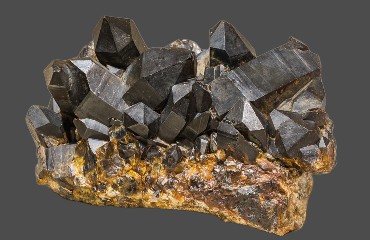
Axinite - Image Credit: Robert M. Lavinsky, CC BY-SA 3.0 The region, situated in Russia’s Subpolar Urals, is renowned for its pegmatite minerals, especially for quartz crystals of exceptional size and clarity. The largest measure over 2 metres in length and are used for optical equipment because of their flawless transparency. Dodo is an active mine between the Narodnaja and Nerojka mountain peaks and is worked mainly for such quartz. The Puiva area, together with around 100 other smaller locations, consists of alpine fissures containing various types of quartz, including the aforementioned optical quartz as well as stunning smoky and gwindel-type specimens. Lower on the slopes, along river valleys, lie numerous placer deposits of quartz weathered from the rocks, but also many other pegmatite minerals, often of gem quality, including axinite, moissanite, brookite, rutile and titanite. Geological studies have focused on their unique formation environments and temperature conditions, offering valuable insights into quartz crystallisation and pegmatite evolution in the northern Urals. |
|
Ilmen Mountains, Southern Urals, Chelyabinsk Oblast
Makarochkinite - Image Credit: David Hospital, CC BY-SA 4.0 The Ilmen Mountains are frequently considered the cradle of Russian mineralogy. Exploration of local deposits began in the early 18th century, the first to be scientifically studied in Russia, and by the 1820s, the region was already recognised as one of Europe’s richest sources of pegmatite minerals. The mountains are composed mainly of syenites, granites, and pegmatites, which host a wide variety of minerals, including orthoclase, zircon, microcline, topaz, samarskite, fergusonite, and monazite. Over twenty new mineral species were first described here, notably ilmenite, named for the locality. Declared a mineralogical nature reserve in 1920, all mining and extraction of specimens in this region are now prohibited. Nevertheless, old specimens are highly prized by collectors for their historic value, and the Ilmen Mountains remain a hub for education and research, preserving the geological legacy that shaped modern Russian mineralogy. |
|
Adun-Cholon Mountains, Nerchinsky District, Zabaykalsky Krai (Transbaikalia)
Smoky Quartz - Image Credit: Raimond Spekking, CC BY-SA 4.0 Transbaikalia is a vast region of Siberian Russia east of Lake Baikal towards the border with China. Also called Dauria (Даурия), in its midst lie the Adun-Cholon Mountains, whose geology is dominated by granite, metamorphic rocks, and pegmatites. Exploration of the region began in the early 18th century, which led to the rapid discovery of several gemstone deposits. The first mines began operating as early as 1723 on the slopes of three mountain peaks: Hoppevskaya Gora (Schorl Mountain), Sherlovaya Gora, and Soktuj Gora, and also further north near the Urulga River. Sherlovaya Gora is particularly famous for its crystals of blue to green topaz, which occur in greisen veins within granite. Other striking minerals from the area include aquamarine, heliodor, and smoky quartz. Soktuj Gora is the type locality for large crystals of yellow and blue jeremejevite. The majority of the minerals from the area, however, are destined for the gem trade, which means that precise location details are seldom recorded. The town of Nerchinsk itself is known for its lead-silver-zinc deposit, which has been extensively mined and is the type location for the mineral bindheimite. Both the gem and mineral deposits make the Nerchinsky District a cornerstone of Siberian mineral history. |
|
Tolbachik Volcanic Field, Milkovsky District, Kamchatka Peninsula, Kamchatka Krai
Tolbachik Volcano - Image Credit: Anton Korablev, CC BY 4.0 The Tolbachik volcanic complex comprises two adjoining volcanoes: Plosky (Flat) Tolbachik, rising to 3,085 meters, and Ostry (Sharp) Tolbachik, reaching 3,682 meters. Plosky Tolbachik forms a broad, flat-topped shield volcano, while Ostry Tolbachik is a steep-sided stratovolcano that dominates the landscape. Because Ostry represents the highest summit of the complex, the entire massif is often collectively referred to as Ostry Tolbachik. The area is remarkable for its wealth of rare and unusual mineral species. A recent count shows over 370 individual minerals, of which 150 are type location species, and many are found nowhere else on Earth. Many minerals, like the colourful avdoninite, cesiodymite, ozerovaite, and bright cuprous salts crystallise directly from volcanic gases. The combination of vivid colours and scientific novelty has made Tolbachik a magnet for volcanologists and mineralogists. Ongoing eruptions continue to create new species, adding to Russia’s already vast mineral menagerie. |
|
Kudriavy Volcano, Iturup Island, Kurilsky District, Kuril Islands, Sakhalin Oblast
Rheniite - Image Credit: Robert M. Lavinsky, CC BY-SA 3.0 This island has been occupied by Russia since 1945 but is still officially claimed as part of Japan by the Japanese. The Kudriavy Volcano is the world’s only known locality where native rhenium occurs naturally. Active fumaroles here also produce unique minerals containing cadmium, molybdenum, and indium formed by gas condensation at high temperature. The volcano’s unique geochemical environment has made it a focal point of modern mineralogical research and a prime example of ongoing mineral formation in extreme conditions. |
|
Aldan Shield, Sakha Republic, Yakutia
Chrome-Diopside - Image Credit: James St. John, CC BY 2.0 The Aldan Shield, located in northeastern Yakutia (Sakha Republic), forms one of the oldest and most geologically significant parts of the vast Siberian landmass. Composed mainly of Archean and early Proterozoic gneisses, schists, and granitoids over 3 billion years old, it provides a rare window into the early Earth’s crustal evolution. The shield’s basement rocks – mainly granulite and amphiboles – are intruded by granites and pegmatites that host numerous mineralisations. As a result, the region is exceptionally rich in mineral resources. However, its remoteness means that much of the area lies poorly explored and is massively underexploited for its mineral wealth. Nevertheless, where exploration and mining have taken place, the region has yielded large deposits of high-grade iron ores, gold, apatite, diamond-bearing kimberlite pipes and rare-earth elements, as well as pegmatites containing beryl (aquamarine), topaz, tourmaline, and quartz. So far, more than 600 mineral species have been identified, including 50 type locality minerals. The region’s mica pegmatites, mined since the early 20th century, have produced some of the world’s largest muscovite sheets and fine gem-quality beryl crystals. Iron ore mining has been taking place since the 1920s, supporting the metallurgical industries of eastern Siberia. The region’s combination of ancient rocks, ore deposits and gem-bearing pegmatites showcases Russia’s deep geological history. |
|
Krasnokamensk, Krasnokamensky District, Zabaykalsky Krai
Bauranoite - Image Credit: Thomas Witzke, CC BY-SA 3.0 DE Located in southeastern Siberia, the Krasnokamensk district is the largest uranium-producing region in Russia and one of the most significant in Eurasia. Discovered in 1963, the deposit lies within Mesozoic volcanic rocks composed mainly of rhyolites and tuffs that host an extensive hydrothermal uranium mineralisation. Ore bodies occur as veins and lenses enriched in pitchblende (uraninite), along with autunite, torbernite, coffinite, and meta-uranocircite. The deposit formed from hydrothermal fluids circulating through faults and fractures after volcanic activity, concentrating uranium in silica-rich zones. Industrial mining began in 1968, leading to the establishment of the city of Krasnokamensk, and the deposit continues to yield uranium ore for both nuclear fuel and research into low-temperature hydrothermal uranium systems. Though less decorative than gem minerals, many of the area’s radioactive phosphates are highly coloured and are scientifically valuable for understanding uranium mobility and mineral formation in granitic systems. |
|
Demidoff Mine, Mednorudyanskoye Cu Deposit, Sverdlovsk Oblast
Malachite at the Hermitage Museum - Image Credit: Richard Mortel, CC BY 2.0 The Demidoff Mine, together with the neighbouring deposits at Nizhni Tagil and Gumeshevo, are amongst the world’s most famous sources of malachite and were once the most important copper mines of Imperial Russia. The malachite is celebrated for producing the richly banded green ornamental stone that once adorned palaces and cathedrals across Russia and Europe. Mining began in the 18th century for copper carbonate ores formed through the oxidation of primary sulfides such as chalcopyrite and bornite. These deposits occur in Devonian to Carboniferous limestones and sandstones that were intruded by copper-bearing hydrothermal fluids, creating near-surface oxidation zones rich in malachite, azurite, cuprite, and native copper. During the 19th century, the Urals supplied almost all of Europe’s decorative malachite, much of it used in St. Petersburg’s Winter Palace and St. Isaac’s Cathedral. Today, while large-scale mining has ceased, the Ural deposits remain legendary among mineral collectors and art historians for their exceptional colour, craftsmanship, and historical and cultural significance. |




From the emerald veins of the Urals to the rare-earth massifs of the Kola Peninsula, the frozen diamond pipes of Yakutia, and the fiery fumaroles of Kamchatka, Russia’s mineral localities represent nearly every mineral-forming process known to science. Each tells a story of discovery, exploration, and scientific progress, reflecting centuries of Russian ingenuity and geological curiosity.
Many of the world’s type localities and some of its most beautiful specimens originate here, preserved in the great collections of Moscow and St Petersburg. For mineralogists and collectors alike, Russia remains an inexhaustible source of study and wonder – a vast natural archive where science, history, and beauty unite in the crystalline architecture of the Earth itself.