

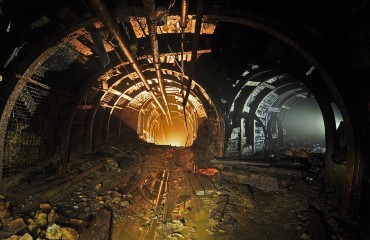

The Weardale valley in County Durham, England, lies at the heart of the Northern Pennine Orefield and has been famed for centuries for both its mining heritage and world-class mineral specimens. Lead mining in Weardale dates back to medieval times, but it was during the 18th and 19th centuries that the area flourished, largely under the control of the London Lead Company. The mines of Weardale supplied vast quantities of galena, the main ore of lead, which supported Britain’s growing industrial growth and local communities alike. Some sphalerite, the ore of zinc, was also mined at this time, but mostly along the fringes of the main orefield, where the presence of zinc increases.
The richness of the mineralisation is the result of Weardale's complex geology, where underlying Carboniferous limestone and dolostones provide a perfect environment for metallic ores and large gemmy fluorite crystals to form, usually accompanied by calcite and quartz. The mineral veins occur mainly within the limestone, where hydrothermal fluids rich in metals and fluorine upwelled through natural fractures millions of years ago. As these hot fluids cooled, they deposited layers of galena (PbS), fluorite (CaF₂), barite (BaSO₄), and sphalerite (ZnS) within the fissures. Since these were mostly horizontal, they became known as 'flats'.
When the metallic ores began to run out in the early 20th century, mining activities turned to the previously ignored deposits of fluorite. The mineral is used as an antifluxing agent in steelmaking, and local supplies proved far easier and less expensive to extract than importing the material from abroad. Many of the former lead mines reopened under the ownership of British Steel, which operated them until the sharp decline of the British steel industries in the 1970s.
As mining continued, striking specimens of crystalline fluorite, galena, quartz and calcite began to emerge, initially removed by the miners as souvenirs. Some were also offered for sale, eventually earning Weardale international fame among mineral collectors for the beauty and variety of its crystallised minerals. Fluorite became the district’s signature mineral, found in colours ranging from deep purple to bright emerald green, often with remarkable daylight fluorescence.
The Rogerley Mine, near Frosterley, is particularly renowned for its brilliant green fluorite that glows blue under sunlight, a feature unique in the mineral world. Nearby, the Boltsburn Mine at Rookhope produced large gemmy purple and yellow fluorites, while the Heights Mine at Westgate yielded sharply defined cubic crystals often associated with galena and quartz.
Other notable sites include the Middlehope, Blackdene, West Pastures, Cambokeels, and Groverake mines, most of which produced their own characteristic form of fluorite while also producing fine examples of barite, calcite, sphalerite, and quartz. The combination of aesthetic minerals and scientific importance has made Weardale a cornerstone of British mineralogy. Although commercial mining ceased in the late 20th century, small-scale specimen recovery continues at places like the Rogerley and Greenlaws mines, keeping the region’s mineral legacy alive.
Today, Weardale stands not only as a reminder of Britain’s industrial past but also as a world-famous mineral locality. Its fluorite, in particular, remains among the most admired in the world, treasured for its vivid colour, transparency, and glowing fluorescence that captures the spirit of this historic mining valley.
The Assay House—Mineral Dealers of quality Mineral Specimens
Image Credits - CC Lech Darski & Robert M. Levinsky