
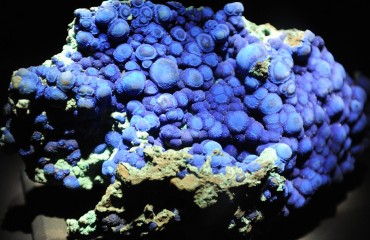


Azurite is one of the most striking and sought-after copper carbonate minerals, having the chemical formula Cu₃(CO₃)₂(OH)₂. It is treasured by collectors because of its intense blue colour and numerous crystal forms.
The mineral has been known since ancient times and was mentioned in Pliny the Elder's Natural History under the Greek name 'kuanos' (κυανός: "deep blue", root of the English word 'cyan') and the Latin name 'caeruleum'. The mineral later became known as Chessylite, after the modern type location, Chessy-les-Mines near Lyon, France, before becoming Azurite, after the Persian word lazhward, meaning "blue".
Azurite forms in the oxidised zones of copper ore deposits, where copper-bearing solutions react with carbon dioxide-rich waters, often along with its green sister mineral, malachite. The two frequently occur together, although overall azurite is less common, creating stunning blue-green mineral combinations that are highly prized by collectors.
Azurite crystallises in the monoclinic system. Large crystals are dark blue, often prismatic. However, azurite is well known for a wide variety of other habits, from sharp, tabular crystals to radiating clusters and massive nodules. To date, there are over 45 well-known forms, and in total, over 100 have been described. Its deep blue colouring is caused by the way copper ions absorb portions of the visible light spectrum.
Unfortunately, azurite's chemical sensitivity means that it can slowly alter to malachite when exposed to air and moisture, making long-term preservation a challenge for collectors. With a Mohs hardness of only 3.5–4, it is relatively soft and unsuitable for jewellery, but it remains one of the most visually stunning display minerals.
Historically, ground azurite was used as a pigment since the time of ancient Egypt. Later, during the mediaeval period and the Renaissance, it was mixed with egg yolk or oil to produce a range of paint hues depending on the degree of fineness to which it was ground and its content of copper carbonate. Known as mountain blue, Armenian stone, and azurro della Magna (blue from Germany in Italian), artists such as Leonardo da Vinci and Albrecht Dürer relied on it before synthetic pigments became available. In ancient China, azurite was carved into ornaments and used in ceremonial objects to symbolise wisdom and heaven.
Some of the world’s most famous azurite localities include the legendary Tsumeb Mine in Namibia, known for its perfectly formed lustrous crystals; the Milpillas Mine in Sonora, Mexico, which produced a modern flood of deep blue specimens of extraordinary quality; and Bisbee and Morenci in Arizona, USA, both classic American sources. Other notable occurrences include Chessy-les-Mines in France – where the mineral was first described in modern times – the Burra Burra Mine in South Australia and the ancient copper mines in Lavrion, Greece. In the UK, large crystals are uncommon. Instead, azurite is found as thin layers of small crystals on other minerals from the copper mines in Cornwall and Alderley Edge in Cheshire.
From ancient pigments to museum masterpieces, azurite continues to dazzle collectors and artists alike with its rich colour, historical significance, and aesthetic beauty.
The Assay House—Mineral Dealers of quality Mineral Specimens
Image Credits - CC Géry PARENT & Ed Uthman