
Italy’s landscape is a product of immense geological forces. Lying at the collision boundary of the African and Eurasian plates, the country has been sculpted by mountain-building, volcanic eruptions, and metamorphism. From the high Alps in the north and the Apennine chain through central Italy to the active volcanoes of Vesuvius and Etna in the south, this dynamic setting has created a distinctive range of mineral environments.
Unlike the countries in Central Europe, where deep-seated granite intrusions and hydrothermal activity produced extensive metallic vein mineralisations, much of Italy’s mineral wealth mostly stems instead from three dominant geological processes: Alpine metamorphism, volcanic activity, and contact metamorphism associated with intrusive rocks. These processes have yielded a mineral heritage that is more aesthetic than industrial - favouring the formation of collectible crystals rather than vast ore bodies.
For instance, in the Alpine regions of Piedmont, Lombardy, and Trentino, tectonic pressures and high-temperature fluids created classic Alpine fissure (cleft) deposits, producing flawless quartz, titanite, albite, and epidote crystals. In volcanic areas such as Mount Vesuvius and Mount Etna, rapidly crystallising magmas and fumarolic gases have generated a dazzling array of rare minerals, including vesuvianite, bassanite, and verneite. Meanwhile, in metamorphic and skarn environments like those of Elba Island, Carrara, and Val Malenco, the interaction of granitic intrusions with limestones or ultramafic rocks produced vesuvianite, diopside, garnet, and a host of rare silicate species.
From the volcanic brilliance of Sicily to the elegant Alpine clefts of the north, Italy’s mineral localities reflect a country shaped more by fire and pressure than by water and weathering - producing mineral specimens renowned for their beauty, variety, and scientific importance.
For a Map of Mineral Locations in Italy click HERE
|
Elba Island, Livorno Province, Tuscany
Elbaite - Image Credit: Didier Descouens, CC BY-SA 4.0 Elba Island, the largest of the Tuscan Archipelago, has a remarkably complex and diverse geology resulting from its location on the collision zone between two continental plates. Geologically, the island is split into two distinct areas. Western Elba is dominated by younger, 6.8-million-year-old intrusive igneous rocks, known for their spectacular pegmatite minerals like the tourmaline variety elbaite (named after the island), beryl, orthoclase, and quartz. In contrast, central and eastern Elba are characterised by a jumbled stack of metamorphic and sedimentary rocks, intruded by the slightly older Porto Azzurro monzogranite. This complex tectonic history created abundant and concentrated mineral deposits, especially those of iron, which have been mined since the Etruscans and Romans. The eastern side of the island is particularly famous for vast iron ore bodies, primarily hematite, limonite, and magnetite. Highly prized specimens of pseudooctagonal pyrite come from these deposits. The rare silicate mineral ilvaite was also first discovered here, named after the island's ancient name, Ilva. Much of the island is protected as part of the Tuscan Archipelago, and mineral collecting is restricted in most areas. |
|
Mount Somma–Vesuvius, Naples, Campania
Vesuvianite - Image Credit: Lech Darski, CC BY-SA 4.0 Mount Vesuvius and Mount Somma form a single volcanic complex, with Vesuvius rising from within the older, semicircular crater of Somma - the remnant of a much larger ancient volcano that partially collapsed in prehistoric eruptions. Vesuvius itself has been sporadically active since Roman times, and the mineral specimens from fumaroles, lava vesicles, and volcanic cavities have drawn collectors since the 18th and 19th centuries. Geologically, the setting is of a stratovolcano on continental crust, with high-temperature volcanic gases producing sublimation and late-stage cavity minerals. The site is the famous type locality for vesuvianite, first described from the contact zones of Somma. Other type location minerals discovered here include hauyne, humite, leucite, meionite, anorthite, and more than 15 others, from a total number of recorded valid species exceeding 130 minerals. Many are highly prized specimens and sought after by Italian collectors. |
|
Baveno, Verbano-Cusio-Ossola Province, Piedmont
Baveno Pink Granite - Image Credit: Khruner, CC BY-SA 4.0 The town of Baveno on Lake Maggiore sits in the Southern Alps of Piedmont and has been a noteworthy mineral locality since the 19th century. The ‘Baveno granite’ quarries nearby have produced the famous pink stone for the columns of the Cathedral of Milan, the church of San Paolo fuori le Mura in Rome, and other important Italian buildings. More importantly, cavities in the granite intrusions and pegmatites are notable for several minerals of very rare elements. Apart from unremarkable orthoclase twins, albite, smoky quartz, and topaz, Baveno quarries have produced six of the nine known scandium minerals (bazzite, cascandite, jervisite, kristiansenite, scandiobabingtonite, and thortveitite), niobium minerals (aeschynite, euxenite, fersmite, and vigezzite), at least eleven minerals containing elemental yttrium, as well as several minerals of beryllium, including the type locality mineral bavenite. The location is thus a treasure trove for collectors specialising in systematic minerals. |
|
Lanzo Valleys (Valle di Viù & Val d'Ala), Balme, Turin, Piedmont
Grossular - Image Credit: Robert M. Lavinsky, CC BY-SA 3.0 The Lanzo Valleys are a group of four converging valleys in the northwest of Piedmont in the Graian Alps of Piedmont: Valle di Viù, Val d'Ala, Val Grande, and Val Tesso. By virtue of being surrounded by steep sides and thanks to their proximity to Turin, the area has been the cradle of Italian mountain sports and a popular destination of summer and winter tourism. Visiting naturalists in the early 19th century soon began to notice that the high-Alpine metamorphic rocks, especially those of the Val d’Ala, are crossed by brittle-fracture clefts, which once hosted late-stage high-pressure hydrothermal fluids. Digging out these rodingite dykes, they began to expose superb mineral specimens, including titanite, adularia, andradite, prehnite, and many others. Of particular interest were crystals of highly distorted ‘gwindel’ quartz, exhibited in many museums worldwide. Also notable was the discovery of the calcium-magnesium silicate diopside in gneiss and schist, for which the Ala Valley is regarded as the type location. The Valle di Viù is known for its exposures of truly ancient rocks - serpentinite, metagabbro, and metabasalt - that were once part of the now-vanished Tethys Ocean. For geologists, these rocks give a visible and accessible record of the processes that formed the Alps. For mineral enthusiasts, these rocks are interesting because they carry minerals formed under extreme conditions and sometimes rare phases in the fissures and veins that opened up during deformation. Although alpine cleft collecting in Lanzo peaked in the late 19th century, it remains popular today, with modern collectors bringing new specimens into circulation. |
|
Val Malenco, Chiesa, Sondrio Province, Lombardy
Perovskite - Image Credit: Raimond Spekking, CC BY-SA 4.0 Val Malenco in northern Italy lies within one of the most geologically complex regions of the Alps, created where the European and Adriatic tectonic plates collided. During this mountain-building process, peridotite from the earth’s mantle was pushed upward together with fragments of the old carbonate-rich oceanic crust. Later, both rock types were buried again and subjected to temperatures approaching 450 °C and intense pressures, transforming the peridotite into serpentinite and the carbonate rocks into marble and dolomite. At the contact zones between these rock masses, chemical reactions produced calc-silicate and skarn formations, yielding minerals such as tremolite, actinolite, talc, and chlorite. Where the serpentinite is exposed, it has long been quarried as ‘Serpentino della Valmalenco,’ an attractive ornamental stone. Gem-quality serpentine and pink clinozoisite (clinothulite) are also found in these quarries. Other quarries worked the contact zones between the serpentinite and carbonate rocks for asbestos (chrysotile), actinolite, and talc, which often occurs as highly prized gem-like pale green crystals. In addition, the area’s many Alpine fissures - cracks created by tectonic forces – were filled with hot hydrothermal fluids that deposited an exceptional variety of minerals. More than 250 mineral species have been recorded here, including olivine, diopside, spinel, garnet, magnetite, and traces of copper, lead, and zinc, making Val Malenco one of Italy’s richest and most scientifically important mineral localities. |
|
Carrara, Massa-Carrara Province, Tuscany
Marble Quarry - Image Credit: FlorianJung, Public Domain Carrara, in the Apuan Alps of northern Tuscany, is the most important marble district in Italy and one of the most intensively quarried areas in the world, with up to seven quarries per square kilometre in parts of its territory. Quarrying has taken place here since Roman times, and today about 90 of 167 known quarries remain active, including some underground operations. The district is divided into four main quarrying basins – Pescina-Boccanaglia, Torano, Miseglia-Fantiscritti, and Colonnata – descending from Monte Sagro and Monte Maggiore toward the city of Carrara. The region’s pure white metamorphosed limestone, transformed by heat and fluids into fine marble, also contains zones of skarn and calc-silicate rocks rich in calcite, dolomite, tremolite, and about 120 other mineral species. Among these are a large suite of species containing copper and smaller ones containing lead and zinc. The area is the type location for zaccagnaite and zincalstibite. Mineral specimen hunting has benefited from exposed walls and workings alongside the prized sculptural marble that has made Carrara world-famous. |
|
Val di Fassa, Trento Province, Trentino-Alto Adige
Fassa valley - Image Credit: Unknown, Public Domain Val di Fassa, located in the Dolomite Mountains of northern Italy, lies at the centre of a wider system of eight smaller valleys that branch from it into the surrounding mountain peaks. Its geology is dominated by Triassic dolostones and limestones that formed in ancient tropical seas and were later uplifted and intruded by hydrothermal fluids circulating during the creation of the Alps. These fluids deposited veins of galena, pyrite, and chalcopyrite, often accompanied by beautiful crystals of calcite, dolomite, spinel, and fluorite. The uplift also resulted in local metamorphism, resulting in many altered silicate minerals, including garnets, axinite, spinel, talc, tremolite and zeolite minerals like heulandite and stilbite. The area is also known for two type location minerals, pectolite and gehlenite, as well as giving its name to fassite, a titanium-rich variety of augite first described at Monzoni. Small-scale mining for lead and copper began in the Middle Ages and continued intermittently until the early 20th century. Today, the old workings are abandoned, but collectors still find fine examples of fluorite, dolomite twins, sulfide minerals and many various silicates on the dumps and natural exposures. Val di Fassa remains a classic Italian locality combining spectacular scenery with rich mineralogical diversity. |
|
Valle d'Aosta, Aosta
d'Aosta valley - Image Credit: Sergiba, CC BY-SA 3.0 The Valle d’Aosta, in Italy’s northwestern Alps, is the country’s smallest and least populated region but one of its richest in mineral diversity. The collision of the African and European plates created intense metamorphism and hydrothermal activity, forming Alpine-type fissure veins within a complex ensemble of rocks, including gneiss, schist, serpentinite, and gabbro. These veins host spectacular crystals of smoky, amethyst, faden, and gwindel quartz; hematite “iron roses”; epidote; adularia; titanite; rutile; and many rare silicates - over 280 mineral species in total, including several type locality minerals like bonacinaite, piemontite, and braunite. Where metallic deposits were laid down, historic mines like Colonna, Liconi, and Larsinaz near Cogne produced iron magnetite, while Servette at Saint-Marcel yielded copper and iron, and Praborna produced manganese ore with at least 25 distinct associated manganese minerals. It is a remarkable fact that hydrothermal circulation produced such different metallic mineralisations within such close proximity to each other. Another famous location is the Triolet Glacier, near the French border, notable for alpine cleft minerals including quartz, anatase, fluorite, monazite-group REE phosphates, and synchysite-(Ce). While collecting here requires mountaineering expertise, the locality is renowned for well-formed micro- to cabinet-size crystals. As a whole, it is not surprising that mineral collecting in the Aosta Valley dates back to the 18th century, with rare metallic species and alpine cleft minerals still prized today for their colour, clarity, and perfection. The combination of complex rock geology, metamorphic processes, and circulating hydrothermal fluids has made this area one of Italy’s most classic localities for rare and alpine mineral specimens. |
|
Montecatini Val di Cecina, Pisa Province, Tuscany
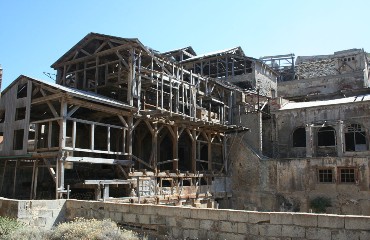
Montecatini Caporciano Mine - Image Credit: LigaDue, CC BY-SA 3.0 At Montecatini Val di Cecina in central Tuscany lies one of Europe’s oldest copper-mining districts. Extraction of ores dates to Etruscan and Roman times and continued to bring prosperity to the region in the Middle Ages. The 19th century saw major expansion by the Montecatini Company, but falling copper prices caused the mines to close in 1907, and they never reopened. The geology of the area involves hydrothermal replacement veins in limestone, the main copper ores being chalcopyrite, chalcocite, and bornite. These were oxidised in the upper parts of the veins into azurite, malachite, and a range of rare secondary copper sulfates, including linarite, langite, and posnjakite. Other mineral resources in the area were salt, alabaster, chalcedony, and lignite. Today, the area’s long history of mining has been preserved as a number of old mine and processing buildings, which have been turned into a museum. |
|
Argentiera, Sassari Province, Sardinia
Argentiera Silver Mine - Image Credit: Jimmy Flink, CC BY-SA 2.0 Argentiera, on the northwestern coast of Sardinia, is a historic silver-mining district once famed for its argentiferous lead and zinc ores. The deposit consists mainly of galena veins containing silver – with sphalerite, barite, gypsum, smithsonite, hemimorphite, and hydrozincite also present. A further 40 mineral species have been described from the main deposit, various prospecting excavations, and old dumps, which continue to be visited by field collectors. The main vein reached depths over 500 m and widths up to 15 m. Mining began in Roman times, continued through the Middle Ages, and flourished in the late 19th and early 20th centuries under Belgian and French ownership. Operations declined after World War II and ceased in 1963. Today, Argentiera is preserved as part of the UNESCO-recognized Historical and Environmental Geomineral Park of Sardinia, celebrated for its striking coastal scenery and heritage of industrial archaeology. The former mining village now hosts a museum, where restored buildings and exhibitions document the region’s rich geological and mining history, making it a major cultural and geotourism site in Italy. |
|
Mount Etna, Etna Volcanic Complex, City of Catania, Sicily
Cinder Cones and Lava on Mount Etna - Image Credit: Kai Boggild , CC BY 3.0 The active volcano Mount Etna in Sicily is not only a striking landscape but also a prolific mineral locality. Fumarolic and sublimation processes produce native sulfur, sal ammoniac, halite, gypsum, various igneous silicates, rare iron chlorides and other exotic species around vents and craters. Among these is the iron azide, siderazot, for which Etna is the type and possibly the only world location. While casual collecting of minerals on Mount Etna is fairly common, it is technically illegal to take natural materials from here or other Italian natural parks and coastal areas. Fines can be substantial, and items may be confiscated. |
|
Sulfur Mines, Sicily
Sulfur Complex - Image Credit: Archeo, CC BY-SA 3.0 The sulfur mines of Sicily form a dramatic chapter in the island’s geological and industrial history. Situated mostly between the provinces of Caltanissetta, Enna and Agrigento, and the city of Palermo, these deposits originated in sedimentary layers rich in evaporites and native sulphur – remnants of the Messinian salinity episode and volcanic activity. Mining began in Roman times, accelerated in the 19th century using the infamous ‘Sicilian method’ of ignition and melting, and by the late 1800s Sicily had become the largest sulfur producer in the world. Key locations included the Lercara Friddi, Aragonà and Agrigento basins, with hundreds of mines employing thousands of workers. The industry declined sharply in the 20th century due to competition from abroad, new extraction methods (the Frasch process) and poor infrastructure. Today, abandoned shafts, surface pits and mining museums preserve the legacy of this once-huge industry, and collectors prize native sulphur and associated minerals like gypsum, barite and smithsonite from these once-famous mines. |
|
Gambatesa Mine, Reppia, Ne, Genoa
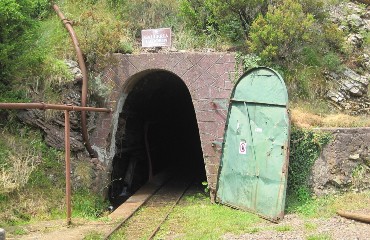
Entrance to the Gambatesa Mine - Image Credit: Wormcast, CC BY-SA 3.0 The Gambatesa Mine is one of Europe’s most important historic manganese deposits. Situated in the Graveglia Valley, it exploited braunite-rich ore hosted in altered volcanic–sedimentary rocks. Mining began in the 18th century with pyrite extraction, and from 1876, operations expanded to include iron and copper before focusing on braunite for steel production. By the 1960s, production reached 50,000 tonnes per year, employing over 600 workers. The mine closed in 1971 but later reopened as a mining museum with guided underground tours using restored mining trains. Classic minerals include braunite, rhodochrosite, rhodonite and pyroxmangite. Type location minerals include belmonteite, cavoite, gravegliaite, poppiite, reppiaite, saneroite and vanadomalayaite, making the mine an important location for systematic collectors and stands as a unique monument to Italy’s industrial and mineral heritage. |
|
Levane, Bucine, Arezzo Province, Tuscany
Aragonite and Kutnohorite Geode - Image Credit: Didier Descouens, CC BY-SA 3.0 Near Levane, hollow carbonate nodules in Pleistocene silt hold open cavities lined by delicate aragonite crystals commonly accompanied by pinkish kutnohorite. The nodules formed by the cementation of silt and subsequent dissolution of cores, creating geodes with late low-temperature mineral growth. No mining is recorded, but the area is a field locality for collectors of these distinctive aragonite–kutnohorite geodes. |
|
Colline Metallifere (Metalliferous Hills), Tuscany
Gypsum - Image Credit: Didier Descouens, CC BY-SA 3.1 The Colline Metallifere are a cluster of neighbouring mountains in the central-western part of Tuscany, divided between the provinces of Livorno, Pisa, Siena and Grosseto. The area is known for its polymetallic sulfide deposits, whose mineralisation is linked to Miocene hydrothermal and skarn systems associated with intrusive granitic activity. Ancient mining since Etruscan times took place at sites including Niccioleta and Boccheggiano, but the Serrabottini Mine is the best known. Ore extraction continued through medieval times until the late 19th century for copper, lead, silver, and later pyrite, which was used for smelting and sulfuric acid production. The ore bodies occur in limestones and dolomites altered by contact metamorphism, producing typical skarn minerals such as garnet, pyroxene, olivine and epidote, alongside metallic species like pyrite, galena, sphalerite, chalcopyrite, and minor native copper and silver. Archaeological remains, slag heaps, and tunnels testify to centuries of mining. Today, the area, especially Serrabottini, attracts both geologists and mineral collectors interested in its well-crystallised sulfides and secondary copper minerals and the broader industrial history of the Colline Metallifere. |






Italy’s mineral diversity stems from its complex geology, shaped primarily by Alpine mountain-building, widespread volcanic activity, and intense metamorphism. Most notable specimens formed through Alpine fissure, volcanic, and metamorphic processes rather than large hydrothermal ore systems. Classic sites include Elba Island for tourmaline, Vesuvius and Etna for volcanic sublimates, while the Alpine valleys yield superb quartz, titanite, and other metamorphic minerals. Yet, Sardinia’s Argentiera and Tuscany’s Colline Metallifere represent the few economically important metallic mineralisations, producing some lead, zinc, and silver. Sicily’s vast sulfur deposits were once world famous and crucial to the island’s economy. Other key areas, such as Val Malenco, Val di Fassa, and Caldè, display exceptional mineralogical variety, illustrating how Italy’s fiery and metamorphic past created mineral treasures prized by collectors and scientists alike.