
India has played a pivotal role in the global history of gems and minerals for more than two millennia. From the fabled diamond mines of antiquity to the sapphire-rich Himalayan valleys and the zeolite-rich basalts of the Deccan, the subcontinent has long captivated traders, geologists, and mineral collectors alike. Ancient Sanskrit texts such as the Arthashastra describe methods of gem testing and mining, while early explorers like the 17th-century French gem dealer Jean-Baptiste Tavernier recorded India’s reputation as the world’s premier source of diamonds long before Brazil or South Africa were discovered. The country’s geology – spanning Precambrian shields, vast volcanic plateaus, folded mountain belts, and young Himalayan intrusions – has produced an extraordinary diversity of mineral environments.
Today, India remains an important region for both historical localities and active specimen-producing mines. The Deccan Traps continue to yield world-class zeolites valued by collectors everywhere, while mineral belts in Rajasthan, Jharkhand, and Karnataka provide significant metallic ores alongside fine crystallised specimens. The Himalayan ranges still produce rare gemstones, and the country’s numerous pegmatite fields supply beryl, tourmaline, and mica on a commercial scale.
The following list highlights India’s most important mineral specimen localities, each notable for its geological significance, mining history, and contribution to mineral collecting. While economic extraction is the primary purpose of most Indian mines today, many continue to yield specimens of scientific and aesthetic value – a heritage that continues to shape the world of mineralogy and gemology.
For a Map of Mineral Locations in India click HERE
|
Deccan Traps (Pune-Nashik-Jalgaon), Maharashtra
Pentagonite - Image Credit: Robert M. Lavinsky , CC-BY-SA-3.0 The Deccan Traps of western India form one of the largest volcanic provinces on Earth, created by immense basaltic eruptions around 66 million years ago at the end of the Cretaceous. They reach a maximum thickness of 3,000 meters along the Mumbai coast, although individual lava flows average 5 meters, but some reach 30 meters. These stacks of layered basalt contain countless gas cavities that later filled with secondary minerals carried by circulating hydrothermal fluids. Over millions of years, these cavities developed into spectacular crystal-lined vugs containing many of the world’s most admired zeolite minerals. Localities around the cities of Pune, Nashik, and Jalgaon are world famous for producing brilliant green apophyllite clusters, delicate white okenite ‘cottonballs’, radiating sprays of needle-like mesolite and scolecite (formerly called poonahlite – after the colonial name for Pune), and richly lustrous stilbite and heulandite sheaves, often associated with contrasting calcite. The quarries around the town of Wagholi on the outskirts of Pune are especially famous for their vivid blue cavansite and pentagonite rosettes, coloured by dissolved vanadium salts carried by the hydrothermal solutions in this area. Quartz is very common throughout the area, found as well-formed crystals or as agate, chalcedony, bloodstone, carnelian, and jasper. Other minerals known from the Deccan Traps include mordenite, cristobalite, gyrolite, and powellite. Less commonly encountered are thomsonite, epistilbite, prehnite, and chabazite. Many of the Deccan zeolites occur in close association with green glauconite (sometimes called ‘green earth’), which often lines cavities. The presence of glauconite within the basalts is a distinctive feature of many Deccan specimens. Flakes of chlorite are also common and occasionally fill entire small cavities. Continuous quarrying for road metal and construction stone ensures that new pockets are regularly discovered, making the Deccan Traps one of the most prolific, diverse, and scientifically important mineral specimen regions anywhere in the world. Interestingly, the zeolites, besides being sold as mineral specimens, were first used in the late 19th century by the sugar beet industry to increase the yield of sugar crystals by replacing the potassium compounds present in sugar juices with calcium. |
|
Deccan Traps (Malad Quarries, Khandivali, Mumbai), Maharashtra
Okenite - Image Credit: Tiia Monto, CC-BY-SA-3.1 These famous quarries of the Malad area, located north of Mumbai on the western edge of the Deccan Traps, were once among India’s most productive sources of zeolite minerals, producing their own very distinctive suite of specimens. Most notably an exceptional range of different species, including okenite, gyrolite, laumontite, calcite, prehnite, hydroxyapophyllite, stilbite, scolecite, babingtonite, pyrite, gypsum, and yugawaralite. The specimens of okenite and gyrolite are especially renowned – the okenite forming soft, white, silky balls up to 10 cm across, occasionally studded with tiny apophyllite crystals, while gyrolite appeared as spheres up to 6 cm in colours from white and pale green to deep brown. Laumontite was abundant, typically forming crystals about 2 cm long but occasionally reaching 20 cm. Prehnite formed both botryoidal masses and casts after laumontite, often associated with pseudocubic apophyllite. Calcite appears in many habits – tabular, prismatic, or rounded – up to 10 cm, sometimes twinned and accompanied by quartz and zeolites. Some minerals are rarer: stilbite, pyrite, and gypsum occur infrequently, while babingtonite and yugawaralite are unique to these quarries. Yugawaralite crystals, up to 3 cm and water-clear, are considered the world’s finest examples. Once mined for building material and mineral specimens, these quarries are now permanently closed due to encroaching urbanisation, making specimens increasingly rare and prized by collectors. |
|
Deccan Traps (Panvel & Chinchwad), Raigad, Maharashtra
Heulandite - Image Credit: Didier Descouens, CC BY-SA 4.0 Panvel and Chinchwad lie between Bombay and Poona and are well-known for their productive quarry exposures. The quarries around Panvel have yielded attractive white heulandite crystals up to 2.5 cm long, along with white stilbite bowties reaching 2 cm across. Calcite, apophyllite and chalcedony frequently accompany these specimens. The area is also one of the few Indian localities for chabazite, which appears as white, glassy rhombohedra up to 1 cm, occasionally forming penetration twins. Near Chinchwad, well-coloured amethyst crystals occur, sometimes associated with calcite. Apophyllite and clear, glassy heulandite are also found in pockets lined with chlorite. The district has additionally produced outstanding botryoidal mordenite and cristobalite specimens, making it an important source of diverse and finely crystallised minerals. |
|
Singhbhum Copper Belt, Jharkhand
Singhbhum Copper Mine - Image Credit: Vikash Singh, Public Domain The Singhbhum Copper Belt in northeastern India is one of the country’s most important and longest-mined metal provinces. It sits within the ancient 3.5-billion-year-old terrains of the Singhbhum Craton, made up of schists, quartzites, metabasalts and volcanic tuffs that have been repeatedly deformed and altered by tectonic activity. Hydrothermal flows during these periods created an exceptionally mineral-rich region containing much of India’s iron ore, as well as manganese, chromium and platinum-group elements. Copper, however, remains the most economically significant resource, occurring specifically in the sedimentary rocks of the Singhbhum Shear Zone, which extends for more than 150 kilometres through the craton. Chalcopyrite is the principal copper ore, accompanied by bornite, pyrite and occasional chalcocite, while oxidised zones yield malachite and brochantite prized by collectors. Although small workings existed earlier, modern mining began in the late 19th century and expanded through the 20th, with major mines such as Rakha, Mosabani and Surda supplying much of India’s copper. In addition to copper, the Jaduguda mine is notable for a mineralisation of uranium, which occurs mainly as uraninite. Despite fluctuating output, Singhbhum remains central to India’s copper industry and a classic example of a Precambrian metal mineralisation. |
|
Zawar Mines, Udaipur, Rajasthan
Retort for zinc smelting - Image Credit: Shyamal L., Public Domain The Zawar Mines south of Udaipur form one of the world’s oldest zinc-lead mining districts, with mining and smelting activity dating back to the 8th century BCE. The deposits occur in ancient carbonate rocks of the Proterozoic Aravalli Supergroup, containing sphalerite and galena with pyrite and chalcopyrite as common associates. Although modern underground mining greatly expanded production in the 20th century, the locality remains best known for its role in early zinc metallurgy, where ancient retort-based smelting techniques were remarkably advanced. Currently four underground mines continue to operate in the area: Mochia, Balaria, Zawarmala, and Baroi. Specimens from Zawar are valued for their colour, form and crystallisation. While access to specimen-rich zones is limited today, the district remains an important location for understanding base-metal mineralisation and early metal production in ancient India. The site is now declared a National Geological Monument. |
|
Salem District, Tamil Nadu
Sapphire - Image Credit: James St. John, CC BY-SA 2.0 The Salem District lies within the Eastern Ghats mountain belt along India's east coast, a region known for its complex geology and high-grade metamorphic rocks like granulites, gneisses and schists, which form coarse-grained bodies with well-developed mineral zoning. The ultrahigh-temperature (UHT) metamorphism experienced by these rocks has resulted in a number of pegmatite minerals that include beryl (including emerald), corundum (sapphire), diopside, olivine, tourmaline, garnet, quartz, feldspar, and muscovite. Gem mining began in the early 20th century and continues on a small scale, with artisanal diggings still uncovering crystal-bearing pockets. Emeralds from Salem are especially prized for their clarity and colour, often associated with microcline and muscovite books. Geologically, the locality provides valuable insight into pegmatite evolution under high-temperature metamorphic conditions, illustrating fluid-rich crystallisation processes typical of the Eastern Ghats. Though large-scale extraction has declined, the area remains prized by mineral collectors and the gemstone trade. |
|
Jaipur–Ajmer–Udaipur Pegmatite Belt, Rajasthan
Emeralds - Image Credit: Gerd Eichmann, CC BY-SA 4.0 The Jaipur–Ajmer–Udaipur pegmatite belt extends more than 400 kilometres from north to south along the Aravalli Craton of northwest India, a piece of ancient continental crust some 3 billion-years-old. Intense metamorphism of the craton’s schists, gneisses, and granites has subsequently produced a wide variety of pegmatite minerals, including beryl (including emerald), garnet, diopside, dravite, feldspar, quartz, muscovite, and occasional apatite and tourmaline. The zoned structure of the host rocks has allowed the formation of large, well-formed crystals. Mining began over a century ago and has historically supplied gemstones, and feldspar for ceramics, with many small quarries still intermittently active. In addition to pegmatite minerals, the Aravalli Craton also hosts various metallic mineralisations, including copper, gold, silver, uranium, and some rare earth metals, especially in the Udaipur region, though none occur in large quantities. Geologically, the belt is significant because it reflects Proterozoic crustal reworking and fluid-rich granite intrusion events. Though most older workings are now inactive, quarrying of construction stone continues to reveal new mineral pockets, ensuring the locality remains important both economically and mineralogically. |
|
Ballari–Hospet Iron Ore Belt, Karnataka
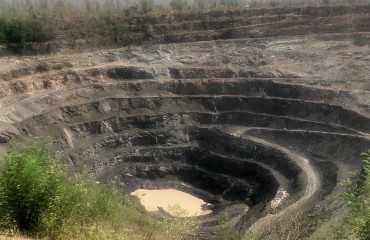
Ballari - Image Credit: Robert Helvie, CC-BY-SA-3.0 The Ballari–Hospet belt in Karnataka hosts major deposits of high-grade hematite within the ancient Banded Iron Formations of the Dharwar Craton. These formations, over 2.6 billion years old, consist of repeating bands of iron oxides and chert created during early Earth oxygenation events. Large open-pit mines have worked these deposits for more than a century, supplying ore to India’s steel industry and export markets. Mining exposes strikingly patterned hematite, along with several manganese minerals, including pyrolusite, braunite, coronadite, jacobsite, pyrochroite, ramsdellite, and woodruffite. The district is scientifically important for its well-preserved examples of Precambrian sedimentary iron formation and the metamorphic processes affecting them. Despite environmental damage linked to large-scale extraction, the belt remains vital to India’s economy and a classic locality for studying banded iron formation (BIF) geology. |
|
Makrana & Kishangarh, Rajasthan
Fragment of Taj Mahal - Image Credit: Rejaul 2cool, CC BY-SA 4.0 Makrana and Kishangarh are globally renowned for their high-purity white marbles, quarried for centuries and famously used in the Taj Mahal. These marbles are part of the metamorphic sequences of the Aravalli–Delhi Fold Belt and occasionally host mineral pockets containing calcite, microcline, fluorite, nepheline, titanite, and zoisite. Transparent scalenohedral calcite crystals and pale purple or green fluorite veins sometimes appear in fresh quarry exposures, offering attractive specimens contrasting with the pure white marble. The region’s marble owes its quality to intense metamorphism of exceptionally clean limestone, making it a key reference locality for studying carbonate metamorphism. Quarrying remains active for construction stone, and mineral specimens emerge sporadically from newly opened areas. |
|
Panna Diamond Field, Madhya Pradesh
Panna Diamond Mines - Image Credit: Ajay Sud, CC BY-SA 4.1 India was the world’s only known source of diamonds from the 7th century BC until 1728 AD, when the first modern sources were discovered in Brazil. Most of India’s largest and finest diamonds were discovered during this early period. Indian diamonds were well-known in the classical world, appearing in the writings of the Greek and Roman authors Pliny and Ptolemy. Early Sanskrit texts, including the Mahabharata and the Arthasastra, also mention them. The first detailed account of the Indian diamond fields came from Jean Baptiste Tavernier (1605–1689), the French gem dealer and explorer who visited India six times between 1631 and 1668 and handled several of history’s most famous diamonds. India’s major diamond districts lie along the eastern margin of the Deccan Flats, stretching from the Penner River at about 14°N to the lower tributaries of the Ganges near 25°N. Today, the Panna Diamond Field in the north of the diamond belt is India’s only active diamond-producing region, worked since the Mughal era in the 16th century. Diamonds occur in ancient, severely weathered kimberlite pipes and the alluvial gravels derived from them, hosted within the sandstones and shales of the Rewa Group. The most productive mines were in the 1860s and were found in Sakaria, around 32 kilometres from Panna. While the diamond-bearing gravels are generally very thin, they yield diamonds known for their clarity and occasional pale colour. Associated indicator minerals such as ilmenite, chromite, pyrope, spinel, and magnetite are common in both primary and secondary deposits. Mining today is carried out through both government-regulated leases and artisanal operations. The diamonds unearthed are all collected by the district magistrate of Panna and are auctioned in the month of January. These auctions are open to the public and provide both gemstones and collector specimens. Panna is geologically important for illustrating kimberlite emplacement within stable continental crust and for the processes that concentrate diamonds in river gravels. Despite declining production of large stones, the locality remains economically active and historically significant. |
|
Golconda Diamond Field, Hyderabad, Telangana
Koh-i-Noor diamond - Image Credit: aiva, CC BY 2.0 The key diamond mines of the Golconda District, at the southern end of the Indian diamond belt, were located along the Penner, Krishna, and Godavari rivers in southern India, with important localities including Cuddapah, Kurnool, Guntur, Mahbubnagar, Kollur, and Nandyal. Golconda itself was not a mining centre but a major hub for cutting and trading diamonds from surrounding regions. The most renowned workings were the Kollur mines, described by Tavernier, who noted their discovery began with a chance find of a 25-carat stone. At their peak, up to 60,000 people worked these shallow deposits, where the diamond-bearing layer was only about 30 cm thick. Tavernier observed that the finest stones often had a green skin but cut to pure, colourless gems. Famous diamonds such as the Koh-i-Nur, the Great Mogul, and the Hope are traditionally linked to Kollur. The mine is now exhausted and abandoned. Other notable workings included the Partial mines on the Krishna River, the source of the Regent (Pitt) diamond, and the ancient Wairagarh mines in Maharashtra, known for diamonds in reddish alluvial soils. Several kimberlite pipes have been found in India since the 1960s, but none have produced worthwhile diamonds. |
|
Kolar Gold Fields, Karnataka
Kolar Gold Mine - Image Credit: Shyamal, CC-BY-SA-3.0 The Kolar Gold Fields in southern India lie within the ancient Archean rocks of the Dharwar Craton and rank among the world’s most historically significant gold-producing regions. The metal occurs mainly in quartz veins cutting through 2.5-billion-year-old schists, basalts, and granites. Although the mineralised belt extends for 65 kilometres, the richest production came from a short 6-kilometre area containing four major veins: Champion, Oorgaum, Nundydorog, and Mysore. Mining at Kolar began in ancient times but expanded dramatically under British control from the 1880s until the 1950s, during which an estimated 900 tonnes of gold had been produced. The Champion Reef Mine on the Champion vein reached a depth of about 3 kilometres, making it one of the deepest mines ever worked. Alongside gold, which often appeared as wires and flakes of the native metal in quartz, the mines produced notable mineral associations, including well-formed arsenopyrite, pyrite, and chalcopyrite. Kolar’s mines also yielded rare gold tellurides such as radhakrishnaite and kolarite, both first discovered there. After the major ore bodies were exhausted in the late 1950s, the mines eventually closed in 2001. Despite this, Kolar remains an iconic locality in global gold mining history and an important reference site for understanding gold mineralisation in Archean greenstone belts. |
|
Padar District, Kishtwar, Jammu and Kashmir
Machail village in Padar - Image Credit: Yash raina, CC BY-SA 4.0 The Padar District of Kashmir is one of India’s main sapphire sources, first discovered in 1880 in the remote Zanskar range of the northwest Himalayas near the line of perpetual snow. The locality was initially kept secret, but the Maharajah of Kashmir soon took control of the area. The first scientific examination by the Geological Survey of India placed the primary deposits in a high alpine valley about 160 km southwest of Srinagar, at an elevation of around 3,300 metres. The mineralised zone occupies a small valley roughly 300 metres long and 120 metres wide. Sapphires were first found where a landslide exposed sapphire-bearing granite. Early mining yielded numerous crystals from the matrix and later from the gravels on the valley floor. The host rocks consist of garnetiferous gneiss, mica-schist and limestone, intruded by granite veins carrying sapphire, kyanite, tourmaline and euclase – an assemblage typical of high-grade Himalayan metamorphism and alpine pegmatites. Crystals up to 30 cm long were reported, with waterworn stones in the gravels reaching 300 carats. The finest examples showed the intense “cornflower blue” that made Kashmir sapphires famous. Mining flourished briefly in the late 19th and early 20th centuries but declined when the richest material was exhausted. Only minor sapphire occurrences are known elsewhere in Kashmir today. Nevertheless, besides occasional specimens, the locality is important geologically for understanding metamorphism, deformation, and fluid activity in collisional mountain belts. |
|
Rajpura–Dariba–Rampura–Agucha Belt, Rajasthan
Rajpura Gold Mine - Image Credit: Nitin Kirloskar, CC BY 2.0 This metal-bearing region stretches north-south along the Aravalli mountain range for almost 250 kilometres. It features some of Asia’s richest sulfide deposits, dominated by copper in the south at Rajpura-Dariba, gradually turning to zinc and lead in the north at Rampura-Agucha. The ores are dominated by chalcopyrite, sphalerite, galena and pyrite, often associated with baryte. The Dariba copper mine at Rajpura is one of the oldest mining sites in India, dating back to the 13th century BC. The Rampura-Agucha mining area is far more recent and is significant as one of the world’s largest zinc mines and also features as India’s largest opencast mine. The deposits are ancient, metamorphosed sea-floor sediments, infiltrated by metal-bearing fluids. Mining began in the 1980s, transforming the region into a major industrial centre. Although specimen recovery is limited by modern mechanised mining, the area has yielded sharp sphalerite, galena, pyrite, schorl, dravite and calcite-barite combinations. Around 60 other mineral species have been recorded. The district remains vital to India’s non-ferrous metal output and widely cited in studies of Proterozoic metallogeny. |
|
Koderma and Giridih, Jharkhand
Mica Flakes - Image Credit: James St. John, CC BY 2.0 Koderma and Giridih are India’s most historically significant mica-producing districts, once supplying much of the world’s muscovite. Other mica-bearing areas in India include the states of Bihar, Rajasthan and Andhra Pradesh. The pegmatite-bearing area in Koderma and Giridih is collectively known as the Pihra Block. The pegmatites, intruding ancient gneisses and granulites, produce large muscovite books along with lepidolite, kyanite, beryl, garnet, quartz, feldspar, and black tourmaline. Mining expanded rapidly in the 19th and early 20th centuries due to global electrical-industry demand for clear mica sheets. Although large-scale production has declined, artisanal and often illegal operations continue to expose mineralised pockets, and many abandoned former commercial pits still produce specimens. The district is also an important geological example of lithium-bearing pegmatite formation and giant mica crystal growth. Koderma remains culturally and mineralogically important despite reduced industrial relevance. |
|
Ambaji-Deri, Sirohi, Jodhpur, Rajasthan
Chalcopyrite - Image Credit: James St. John, CC BY 2.1 The Ambaji–Deli area hosts hydrothermal lead-zinc-copper veins within schists, quartzites, and phyllites of the northern Aravalli mountain belt. Although mining never reached a large industrial scale, the deposits have been worked intermittently since antiquity and more actively during the colonial period. The veins contain galena, sphalerite, chalcopyrite, quartz, and calcite, often forming open-space crystals with distinctive banded or brecciated textures. Collectors prize sharp galena cubes, brown sphalerite clusters, and chalcopyrite with iridescent tarnish. The locality is geologically important as an example of structurally controlled Proterozoic hydrothermal mineralisation, influenced by regional shear zones and faulting. Although commercial mining has largely ceased, Ambaji–Deli remains significant for mineral collecting and scientific study. |
|
Banswara–Dungarpur, Rajasthan
Banswara Marble Mine - Image Credit: The Assay House, Public Domain Banswara–Dungarpur is part of the lead and zinc mineral belt of Rajasthan. However, their quantities are low, so they were never mined in significant amounts. Instead, mineral production focused on more abundant manganese and iron ores, and especially on quarrying ornamental soapstone and also for limestone for use in cement. These mines and quarries lie in the dolomitic limestones and metamorphic rocks of the southern Aravalli mountain range. Although small in scale, these altered carbonate rocks also host occasional pockets of fluorite in vivid greens and purples, often accompanied by barite blades, calcite crystals, quartz, and dolomite. These minerals formed from late-stage hydrothermal fluids circulating through these fractured rocks. Specimens are valued for their clarity and colour contrast, especially when associated with white calcite or quartz. Mining has been episodic, with small quarries revealing pockets during the 20th century and occasional artisanal work continuing today. The locality is also significant for producing phosphate. |
|
Neyveli Lignite Field, Tamil Nadu
Neyveli Lignite Mine - Image Credit: NLC India Ltd, CC BY-SA 4.0 The Neyveli Lignite Field is a major Tertiary basin worked through large open-cast operations since the 1960s. Although primarily an energy resource, the mines frequently expose evaporite minerals such as gypsum, aragonite, halite, and native sulfur, formed in ancient brackish-water and shallow marine environments. Gypsum occurs as rosettes and tabular crystals, while aragonite forms radiating sprays; halite appears as clear cubic crystals, and sulfur as bright yellow crusts. These delicate minerals are uncommon in India’s otherwise hard-rock settings, making Neyveli a distinctive locality for collectors and geologists. The basin provides insights into Tertiary coastal sedimentation, evaporation cycles, and paleoenvironments. |




India encompasses an extraordinary range of geological environments, from ancient Archean cratons and Proterozoic fold belts to vast volcanic plateaus and the young, rising Himalayas. This diversity has created a wealth of mineral localities renowned for both scientific and collector importance. The Deccan Traps are globally celebrated for their exceptional zeolite crystals, while the Kolar and Singhbhum belts stand as classic centres of gold and copper mineralisation. Rajasthan contributes major lead–zinc deposits, fluorite veins, and gem-bearing pegmatites, and Kashmir and Tamil Nadu produce notable sapphires and beryl. Panna remains India’s historic diamond source. Together, these regions highlight the country’s rich mineral heritage.