
Chechia, or the Czech Republic, positioned at the heart of Central Europe, boasts one of the oldest and most prosperous mining heritages on the continent. Formed by the merger of the historic kingdoms of Bohemia in the west and Moravia in the east, the region's mineral wealth has profoundly influenced local economy, culture, and scientific progress. From the silver mines of Kutná Hora and Příbram that financed the medieval Bohemian Kingdom to the uranium ores of Jáchymov that gave birth to the study of radioactivity, Czech minerals have influenced European history. In fact, it was from Jáchymov’s pitchblende that Marie and Pierre Curie first isolated radium and discovered polonium in 1898 – an achievement that revolutionised physics, chemistry and medicine.
Geologically, Czechia is dominated by the Bohemian Massif, a complex tapestry of ancient metamorphic rocks, granitic intrusions, and mineralised fault zones dating back to the Variscan orogeny. These varied terrains have led to one of the most diverse mineral deposits in Europe, from the silver-tin-tungsten greisens in the Krušné Hory (Erzgebirge in German – Ore Mountains in English), near the German border, to gem-bearing pegmatites in Moravia and uranium-rich veins of the Bohemian Highlands. The country’s mines have produced myriads of classic specimens prized by collectors worldwide, and many sites – now part of the wider UNESCO Ore Mountain Mining Region shared with Germany – continue to yield insights into ore formation, mining technology, and the story of human endeavour to exploit these hidden resources.
For a Map of Mineral Locations in Czechia click HERE
|
Příbram Mining District, Příbram, Central Bohemia Region
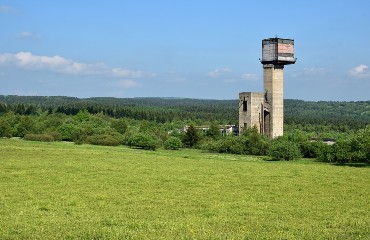
Pitchblende (Uraninite) - Image Credit: Weirdmeister, CC BY-SA 4.0 The Příbram ore district lies within ancient pre-Cambrian metamorphosed sedimentary rocks along the contact zone with Central Bohemian granite intrusions. It comprises two principal ore domains – the Březové Hory silver-lead-tin district and the Příbram uranium district. Over 2,500 hydrothermal veins (1,641 carrying uranium) have been documented, with more than 23 km of vertical shafts and 2,100 km of adits. Mining began in Bronze and Medieval times for silver and lead, followed by a change of focus to uranium between 1947 and 1991. An estimated 48,500 tonnes of uranium was extracted for the Soviet nuclear programme. Collectible minerals from the region include galena, sphalerite, pyrite, fluorite, calcite and quartz, plus native silver and proustite from the older workings. Many colourful uranium minerals, including uraninite and autunite, were obtained in the later stages. Key operations in the region include the Bytíz, Háje and Brod mines, all major workings for uranium. The district remains a global reference site for vein-type uranium and base metal mineralisation. |
|
Jáchymov (Joachimsthal), Karlovy Vary District, Western Bohemia Region
Jáchymov Svornost Mine - Image Credit: Lubor Ferenc, CC BY-SA 4.0 Mining in the Jáchymov area began in the early 16th century after the discovery of rich silver veins, leading to the town’s founding in 1516. The deposits occur in hydrothermal fissure veins cutting granite and schist within the Saxothuringian Zone of the Bohemian Massif. As silver output declined in the 19th century, the discovery of pitchblende and uraninite ushered in a new era of uranium mining. Ores from Jáchymov provided the material for Marie and Pierre Curie’s groundbreaking studies, leading to the discovery of polonium and radium in 1898. Minerals include native silver, bismuth and cobalt-nickel arsenides, uraninite, and vivid secondary uranium species such as autunite and torbernite. Mining peaked in the 1950s and 60s when the region supplied uranium to the USSR, with forced labour camps marking its dark history. The Svornost (Einigkeit) mine – claimed to be the world’s oldest uranium mine – has yielded over 40 uranium minerals, 15 of which were first described there. Today, the mine is part of the UNESCO Ore Mountain Mining Region and open for guided visits. |
|
Horní Slavkov (Schlaggenwald) & Krásno, Karlovy Vary Region, Western Bohemia Region
Horni Slavkow Barbora Adit - Image Credit: Lubor Ferenc, CC BY-SA 4.0 The Horní Slavkov and Krásno tin and tungsten districts lie within a Late Variscan granite body (about 324–295 million years old) known as the Slavkovský les or Krudum granite. Over time, the upper parts of this granite were transformed by hot mineral-rich fluids into greisen – a fine-grained rock rich in quartz and mica – which became host to tin (cassiterite) and tungsten (wolframite) veins, along with gem-quality topaz, fluorite, tourmaline, and quartz. Mining in the area began as early as the Bronze Age and continued well into the 20th century, producing both industrial ores and fine mineral specimens. Localities such as Hub Stock and Vysoký Kámen are especially noted for their beautiful topaz crystals and complex mineral assemblages. The mineral specimens from Krásno are especially highly prized, consisting of well-formed cassiterite, topaz on quartz, and fluorite often showing colour zoning. The district remains one of Europe’s classic examples of granite-related tin–tungsten mineralisation. |
|
Cínovec-Zinnwald, (Czechia–German border), Western Bohemia Region
Zinnwaldite - Image Credit: Lubor Ferenc, CC BY-SA 4.0 Cínovec and Zinnwald are twin towns separated by the Czech-German border. Historically a single community, they were separated by the Treaty of Eger in 1459 into Cínovec on the Bohemian side (now part of Czechia) and Zinnwald on the Saxony side (now part of Germany). This medieval frontier has remained unchanged for centuries and continues as a dividing line between the two countries despite numerous political upheavals. Notwithstanding the artificial divide, the mineralisation on both sides is identical. It consists of a greisen-type tin–tungsten–lithium deposit within the Saxothuringian Zone of the Bohemian Massif, formed by the extreme metamorphism of topaz–albite granite. These greisen bodies produce ores and striking specimens of cassiterite, wolframite, topaz, fluorite, and notably the lithium mica zinnwaldite, for which the area is the type locality. Tin and tungsten were mined here for centuries until the 1960s, but the area is now gaining attention for its lithium mineralisation – an increasingly valuable metal for modern energy technologies – reviving interest in this historic mining region. |
|
Měděnec (Medenec) District, Ústí nad Labem Region, Western Bohemia Region
Měděnec Mine - Image Credit: Petr Kinšt, CC BY-SA 3.0 Unlike other mining areas in Western Bohemia and the Krušné Hory, Měděnec is known for copper, not silver. Its long copper-mining tradition focussed on sulphide-rich vein systems containing chalcopyrite, bornite and pyrite, with associated secondary supergene minerals (malachite, azurite and cuprite) in gossan zones. The geological setting is also within the Variscan metamorphic host rocks and greisen/vein systems of the Ore Mountains, but these veins, in contrast, lacked silver and had very little uranium. Mining here extends back to medieval times, and the oxidised zones often display vivid greens and blues (malachite/azurite) that appeal to collectors. The district illustrates typical copper-sulphide vein mineralisation in metamorphic terranes and the development of secondary carbonate minerals in weathered gossans. |
|
České Středohoří (Bohemian Central Mountains), Central Bohemia Region
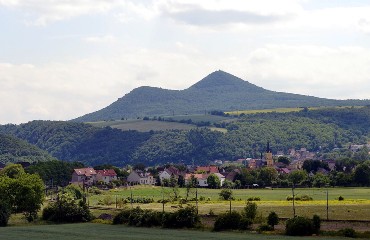
Mount Lovoš in České středohoří - Image Credit: Sefjo, CC BY-SA 3.0 České Středohoří, or the Bohemian Central Mountains in English, form a distinctive range stretching northeast–southwest across northern Czechia between Kamenický Šenov and Most. They are built mainly of Tertiary volcanic rocks formed during three major eruptive phases. Basalt, trachybasalt, trachyte and phonolite dominate the region, with the Mariánská Hora area known for its mineral-rich phonolite. The mountains are famed as a classic European locality for zeolites, which crystallised from hydrothermal fluids within cooling lava cavities. Many old quarries once yielded striking specimens of natrolite, chabazite and gyrolite, notably at Puchavec Mountain near Provodín, where natrolite needles reached 5 cm in length. Although most collecting sites are now exhausted, the area remains important in mineralogical history for its abundance of well-formed zeolite minerals and their scientific study. Fortunately, many old-time specimens have been preserved and circulate amongst collectors. |
|
Kutná Hora (Kuttenberg), Central Bohemia Region
Bukovskyite - Image Credit: Antonio Angelo, CC BY 3.0 Kutná Hora’s story begins around the 13th century as another of Central Europe’s leading silver-mining districts and towns. The host geology is Palaeozoic gneiss and crystalline rocks, with quartz–sulfide hydrothermal veins containing silver, galena, sphalerite, chalcopyrite and pyrite cutting the metamorphic rocks. From the 14th to the 16th centuries the town minted the famous Prague groschen from its silver. Besides native silver, the veins yielded important silver secondary minerals, including acanthite and proustite. All are highly prized by collectors. Silver mining declined sharply in the 18th century as ore quality fell and flooding increased. For a period, mining turned to lead and zinc ores, before this too became problematic. A medieval drainage adit discovered in 1967 has been opened to visitors as part of the town’s Museum of Silver. It demonstrates the key features of a classic hydrothermal Ag–Pb–Zn vein mineralisation. |
|
Stříbro (Mies), Tachov District, Plzeň Region, Western Bohemia
Miesite on Quartz - Image Credit: Bergminerale, CC BY-SA 3.0 The town’s name – literally meaning ‘silver’ in Czech – reflects its longstanding mining heritage. Silver was first extracted here in the 12th century, followed later by lead and zinc ores from more than 50 hydrothermal vein systems cutting through Proterozoic metamorphic rocks. The mineralisation is dominated by galena and sphalerite, often associated with pyrite and marcasite, while oxidation zones produced striking specimens of cerussite and anglesite. Stříbro is also the type locality of ‘miesite’, a calcium-rich variety of pyromorphite first described from the district. Mining gradually declined in the 19th century. Today, the area remains a classic locality for mineral collectors and an important example of the long Bohemian tradition of silver-lead-zinc vein mining that helped shape the economic and geological history of western Czechia. |
|
Kozákov, Liberec Region, Northern Bohemia
Agate from Doubravice u Jičína - Image Credit: Marie Čcheidzeová, CC BY-SA 4.0 The Ještěd-Kozákov Mountain range is a celebrated mineral locality that draws collectors and geologists alike. The uplands are heavily forested and consist of various quartzites, though some parts are also formed from sandstone. Situated on the 744 m Kozákov Ridge is the old Votrubec quarry, where dozens of semi‐precious stones and minerals were once retrieved. Among the finds are superb agate specimens, as well as jasper, amethysts, and olivine, reflecting the region’s complex volcanic and metamorphic geology. Designated as a protected natural monument, the Kozákov area combines scenic hiking and nature with the thrill of discovering classic mineral treasures. |
|
Barrandium, Central Bohemia
Cacoxenite - Image Credit: Zbynek Burival, CC-BY-SA-4.0 The Barrandium district (also known as the Barrandian Zone) in the centre of Czechia between Prague and Plzeň is a remarkable geological region renowned for its Early Paleozoic sedimentary and volcanic rock sequences. Named after the French geologist Joachim Barrande, it is actually better known for its fossils than mineral deposits. Nevertheless, it contains a uniquely rich iron mineralisation that once formed the most important source of iron in the Austro-Hungarian Empire. The main ores were oolitic hematite and siderite, but more significantly, the small iron mine, Hrbek' in Svatá Dobrotivá near Hořovice was a classic locality for rare phosphates in the 19th century. It is the type locality for cacoxene, which occurred abundantly as golden to yellowish-brown, acicular crystals in geodes, and beraunite was also found there as dark reddish-brown, well-formed crystals. Although no longer available at the site, specimens of these phosphates circulate amongst collectors. |
|
Mähren Pegmatites, Southwestern Moravia
Hermanov Ball - Image Credit: Ra'ike , CC BY-SA 3.0 In the area between Velké Meziříčí and Žďár nad Sázavou lies a sizeable region with numerous pegmatite outcrops that have yielded some of the most beautiful minerals in Europe for several decades. The number of these pegmatites is high, and many important finds have been made in recent years. However, many field collectors keep them secret or provide inaccurate or false information about the locations. For example, the source of a recent discovery of an enormous smoky quartz crystal weighing 204 kg was not disclosed. Nevertheless, the area has produced many aesthetic pegmatite minerals, including different rare habits of quartz (Babylon, Tessin and sceptre), elbaite, lepidolite and corundum (ruby). However, the area around the Heřmanov contract zone between pegmatite and serpentinite is particularly famous for spherical clusters of phlogopite and astrophyllite, known as ‘Heřmanov Spheres’. |
|
Zlaté Hory (Zuckmantel), Jeseník District, Olomouc Region, Northern Moravia
Zlaté Hory Měděná Adit - Image Credit: Lubor Ferenc, CC BY-SA 4.0 Zlaté Hory, whose name literally means “Golden Mountains”, is a district on the border with Poland whose mining story stretches back to at least the 13th century, with the earliest documents referencing gold-panning and underground mining in the area. These operations continued with various degrees of success throughout the centuries, largely depending on the availability of water for washing gold from its ores. Large gold nuggets were common; the largest cluster, weighing 1.78 kg, was discovered in 1590 and presented to Emperor Rudolf II for his mineral collection in Prague. The 17th and 18th centuries saw a major decline due to increasingly difficult underground mining conditions, making most operations highly unprofitable. Nevertheless, some activity continued into the 20th century, supplemented by lead, zinc and copper, until all operations ceased in the early 1990s. The district is characterised by the complexity of its gold-bearing quartz-carbonate veins within a metamorphosed Devonian mixed volcanic and sedimentary complex. Today, Zlaté Hory stands as a heritage mining locality – its old workings now attract visitors and tell the region’s rich geological and industrial legacy. |
|
Dolní Bory, Žďár nad Sázavou, Vysočina Region, Western Moravia
Dolní Studenec - Image Credit: Lubor Ferenc, CC BY-SA 4.0 The Dolní Bory pegmatite district lies in the Bohemian Massif, where high-grade metamorphic host rocks have been intruded by granite and pegmatite dikes, producing lenticular gem-mineral-rich zones with beryl (aquamarine), topaz, garnet, tourmaline and approximately 50 accessory minerals. Feldspar and quartz were mined for ceramic uses at Hatě from the 1890s until 1930. These activities resumed after WW2 until 1972. Nowadays, mining and extraction are mostly small-scale and collector-orientated, rather than for industrial purposes. Parts of the pegmatite contain cavities with minerals containing rare elements, including cerium, niobium, scandium, tantalum and zirconium. Among their specimens are monazite, rutile-Nb, petulite, ixiolite and zircon, making the area well-known among both gem/collector and systematic mineral enthusiasts in Central Europe. |
|
Rožná Uranium District, Žďár nad Sázavou District, Vysočina Region, Central Moravia
Lepidolite - Image Credit: Zbynek Burival, CC-BY-SA-4.0 In the Bystřice nad Pernštejnem area of Moravia lie the important uranium deposits of Rožná–Olší and Dolní Rožínka, discovered in 1954 and mined since 1958. These deposits, among the last active uranium mines in Czechia, still contain significant reserves. The ore occurs in graphitic fault zones cutting gneisses, amphibolites, and marbles. During the 1960s, unique selenide assemblages – formed later than the uranium ores – were found in the upper mine levels, though such finds are now rare. Examples of these minerals include the type minerals bellidoite, bukovite, kvačekite, petrovicite and sabatierite. The site typifies low-temperature hydrothermal uranium vein systems in Central Europe and offers excellent display specimens of rare bright green and yellow uranium minerals, including liebigite, zinczippeite, ĉejkaite, cuprosklodowskite and schröckingerite. |
|
Jeseníky Mountains, Olomouc Region, Northern Moravia
Jeseníky Mountains - Image Credit: Slavek78, CC BY-SA 4.0 The geology of the Jeseníky Mountains comprises high-grade metamorphic rocks cut by alpine-type quartz veins along fault zones. Fine transparent quartz crystals – often with chlorite phantoms, hematite or chalcopyrite inclusions – are common. Other prized minerals include superb yellow beryls, chrysoberyl, epidote and bertrandite. The mineralisation reflects cooler hydrothermal fluids during late stages of Variscan orogeny or Alpine reactivation. Although mining was not large-scale, the high-quality quartz and associated minerals make the locality a favourite among hobby collectors and illustrate the vein-type quartz mineralisation typical of uplifted metamorphic terranes. |
|
Zálesí (Waldek), Javorník, Jeseník District, Olomouc Region, Northern Moravia
Uraninite & Secondaries - Image Credit: Jaroslaw Grolik, CC BY-SA 4.0 Zálesí is a small locality in the Javorník area. The site is notable for its historic uranium mine, which operated on a hydrothermal vein-type uranium deposit in the Rychlebské Hory region. Initially an iron mine from around 1900, uranium was discovered and extracted from the 1950s, producing significant uranium output until its ores were exhausted in 1968. Mining activity left behind dumps rich in secondary minerals, including U-, Bi-, Co-, Ni- and Ag-bearing species. The site is valued by mineral collectors for its suite of more than 30 rare colourful uranium species, including kasolite, schrockingerite, zeunerite, wölsendorfite and the type-locality mineral zálesíite. Designated an important geological locality, the area now draws attention for its mineralogical diversity and mining heritage rather than active extraction. |




From the medieval silver mines of Kutná Hora and Příbram to the uranium veins of Jáchymov and Rožná, Czechia’s mineral wealth has shaped its history and contributed greatly to the science of mineralogy. The country’s varied geology – ranging from ancient metamorphic terranes to granitic intrusions and alpine-type veins – continues to produce minerals of great beauty and scientific value. For collectors and geologists alike, these classic localities form a remarkable cross-section of European mineral heritage and demonstrate why Czechia remains one of the continent’s most important centres for the study and appreciation of minerals.