
China’s enormous size and varied geology have made it one of the richest and most diverse mineral-producing nations on Earth. Ranging from ancient granite intrusions and deep metamorphic belts to volcanic fields and immense hydrothermal systems, the country hosts nearly every known geological and mineral-forming environment.
For much of its history, Chinese mining focused exclusively on industrial resources such as copper, tin, iron, tungsten, lead, and mercury, but from the late 20th century onwards, the discovery of exceptional crystal specimens has helped China transform the global mineral market. Collectors were astonished by the colour, size, and quality of minerals coming from Chinese sources, especially fluorite, pyromorphite, stibnite, cassiterite, cinnabar, quartz, and scheelite, which often match or exceed the best examples from Europe.
Today, China stands at the forefront of mineral collecting, supplying museums and private collections with world-class specimens that not only display remarkable beauty but also provide invaluable insights into mineral formation processes and the country’s rich geological heritage.
For a Map of Mineral Locations in China, click HERE.
|
Yaogangxian Mine, Yizhang County, Chenzhou, Hunan Province
Fluorite - Image Credit: Robert M. Lavinsky, CC-BY-SA-3.0 Mining here began in 1914 for tungsten and tin, but commercial activity has sharply declined because the deposits are now mostly depleted. The region's mineralisation arose when granite intruded into Cambrian–Devonian sandstones and Jurassic limestones, forming hydrothermal vein systems containing rich ores of antimony, tin, and tungsten along with approximately 70 accessory minerals. The Yaogangxian Mine is especially well known for its superb arsenopyrite, boulangerite, bournonite, and stannite crystals, but it is world-famous for its exceptional scheelite and fluorite specimens. The scheelite typically forms tetragonal-bipyramidal crystals in various shades of brown whilst having a strong adamantine lustre. The fluorite comes in many colours including purple, blue, or green and often beautifully zoned. Crystals are often complex with sharp edges and are regarded as among the finest found anywhere. They occur with cassiterite, topaz, sphalerite, scheelite, bright quartz, and arsenopyrite – combinations that create some of the most striking and collectible fluorite specimens known to mineral enthusiasts. |
|
Shangbao Mine, Leiyang, Huangshi, Hunan Province
Fluorite on Dolomite - Image Credit: Robert M. Lavinsky, CC-BY-SA-3.0 Originally developed for iron ore extraction, the Shangbao Mine gained international recognition in the 1990s when strikingly large, transparent fluorite crystals began to reach the collector market. These specimens originate from the skarn zone between Carboniferous–Permian limestones and the intrusive granite body. The fluorite crystals are notable for their exceptional clarity and vivid colour zoning, which ranges from emerald green and sky blue to deep violet, often resting on a matrix of quartz and calcite. The locality is equally famous for its superb sceptre quartz crystals, among the finest of their kind. Other associated minerals include calcite, pyrite, sphalerite, dolomite, and bismuthinite. Although the mine is now largely inactive and fine specimens have become increasingly rare, renewed exploration is underway following the recent discovery of a potentially economic tungsten–tin mineralisation and an indication of niobium–tantalum orebodies – rare metals of growing industrial importance. |
|
Daoping and Yangshuo Mines, Gongcheng County, Guilin, Guangxi Province
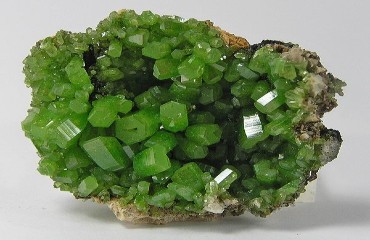
Pyromorphite - Image Credit: Robert M. Lavinsky, CC-BY-SA-3.0 Both mines are celebrated as one of the world’s premier localities for spectacular pyromorphite. They are situated on two sides of Mount Haiyang but connect underground. Developed in the late 1950s for lead and zinc, the geology of the area consists of hydrothermal deposits within Devonian limestone, shale, and sandstone sedimentary rocks. Subsequent oxidation and weathering of these primary ore deposits has created superb green and yellow pyromorphite crystals of exceptional colour, form, and lustre. Mimetite, wulfenite, and cerussite are also common. Rarer minerals include dundasite, hawleyite, and willemite. Plumbogummite has also been reported. The mines' best pyromorphite clusters, often forming hexagonal prisms in parallel growth, rival or surpass the famous specimens from Bunker Hill, Idaho. |
|
Leiping Mine, Guiyang County, Chenzhou, Hunan Province
Calcite with Hematite inclusions - Image Credit: Robert M. Lavinsky, CC-BY-SA-3.0 Leiping is another famous Chinese lead and zinc deposit but is even better known for some of the world's most striking calcite specimens, rivalling those of Elmwood, Tennessee, USA. The deposits are hydrothermal in origin, resulting from granitic intrusions into Paleozoic and Mesozoic sedimentary rocks. There are many different forms of calcite, ranging from double-terminated twinned crystals to flattened discs displaying the classic 'Mercedes' star pattern. Some are transparent, whereas others are particularly attractive due to their fine coatings or inclusions of hematite, ranging from orange-brown to blood-red. The mine is also known for a highly unusual form of spheroidal, snow-white smithsonite. |
|
Tongbei and Yunling Quarries (Wushan Spessartine Mine), Zhangzhou, Fujian Province
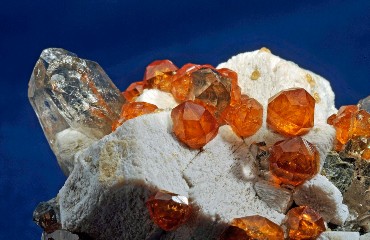
Spessartine and Quartz - Image Credit: Géry PARENT, CC-BY-SA-3.0 The two sites are open granite quarries situated about 15 kilometres apart. Discovered in the mid-1990s, these pegmatites quickly gained fame for their extraordinary spessartine garnets, bringing the area international recognition. Collectively, the district is often called the “Wushan Spessartine Mine”, though no single mine by that name actually exists. The deep orange-red, gem-quality spessartine crystals from here typically rest on clusters of smoky quartz, often accompanied by microcline feldspar and muscovite. The vivid contrast between the fiery garnets and dark quartz makes these specimens particularly striking. Both quarries also yield fine topaz, microcline, muscovite, and occasional manganite crystals from small pegmatite pockets. Most specimen recovery is undertaken by local artisanal miners, whose efforts continue to sustain the region’s economy. |
|
Daye Mining Area, Huangshi, Hubei Province
Azurite - Image Credit: Eric Hunt, CC BY-SA 2.5 The extensive Daye district has been mined for copper for over three millennia, making it one of China’s oldest mining regions. There are dozens of mines locally, but the most important ones for collectible specimens are the Tongshankou copper mine and the Fengjiashan wollastonite mine. Both deposits are skarns, resulting from numerous granitic intrusions into sedimentary rocks. Subsequent weathering and oxidation of these hydrothermal deposits have produced numerous copper secondary minerals. The Tongshankou mine is particularly famous for world-class azurite specimens, whose crystals often reach several centimetres in size and display deep, lustrous blue hues. The mine has also produced striking specimens of chalcocite and chalcopyrite, some of the most beautiful examples of their kind from Asia. The Fengjiashan mine is itself a notable source of azurite but is even better known for superb crystals of inesite, as well as being the type location for the iron-manganese silicate hubeite. Other notable minerals from both locations include large stacked crystals of red-coloured calcite and stunning clusters of delicate pink-violet amethyst quartz. |
|
Wuning Mine, Qingjiang, Jiujiang, Jiangxi Province
Stibnite - Image Credit: Robert M. Lavinsky, CC-BY-SA-3.0 The mine is best known for its extraordinary stibnite crystals, some exceeding 60 centimetres in length. Antimony has been mined in the wider area since the Qing dynasty, but the Wuning mine itself is relatively recent, having opened in the 1960s. The region's hydrothermal veins, cutting through Cambrian and Ordovician carbonate rocks, are rich in antimony sulfides and associated minerals, which include realgar, orpiment, and calcite. The stibnite crystals are famed for their mirror-like metallic lustre and perfect prismatic form, ranking among the finest in the world. Apart from forming single individual crystals, the area is also known for hedgehog-like clusters of smaller crystals prized by collectors. |
|
Huanggang Mines, Hexigten Banner, Inner Mongolia
Fluorite - Image Credit: Géry PARENT, CC BY-SA 4.0 Discovered only in recent years, the Huanggang mine complex has rapidly become one of China’s most productive and celebrated mineral localities. Its polymetallic iron–tin skarn deposits, formed by granitic intrusions into Permian carbonate rocks, have yielded an extraordinary range of mineral species. Fluorite, in particular, occurs here in nearly every conceivable colour and form, frequently associated with magnetite, arsenopyrite, scheelite, and beryl. The crystals often display intricate habits, with complex growth patterns and striking phantom zoning. Beyond fluorite, the district’s seven active mines exploit rich metallic deposits that have collectively produced close to seventy distinct mineral species – an exceptional diversity that has made Huanggang a cornerstone of both modern mineral collecting and scientific study. |
|
Pingwu Beryl Mine, Xuebaoding Mountain, Pingwu County, Mianyang, Sichuan Province
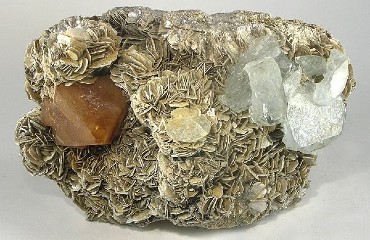
Scheelite on Muscovite - Image Credit: Robert M. Lavinsky, CC-BY-SA-3.0 The Pingwu region is celebrated worldwide for producing some of the finest scheelite crystals ever discovered. Although scheelite occurs throughout the district, the best specimens come from the Pingwu Beryl Mine on the slopes of Xuobaoding Mountain. Here, as elsewhere in the region, hydrothermal fluids rich in tungsten, tin, and beryllium infiltrated Lower Triassic schists and marbles, forming striking mineral assemblages. The scheelite crystals are highly sought after for their clarity, sharp tetragonal geometry, and vivid honey-orange colour, often showing intense blue fluorescence under ultraviolet light. They are usually embedded in plates of pale brown, crystalline muscovite mica, adding to their enormous aesthetic appeal. Originally worked industrially for its tungsten ores, local miners have, since the 1980s, largely turned their attention to producing specimens for the collecting trade. The locality is almost equally renowned for beautiful sky-blue aquamarine beryl crystals and large, lustrous cassiterite crystals, commonly also resting on the same shimmering mica matrix. |
|
Tongren & Wanshan Mines, Bijiang, Tongren, Guizhou Province
Cinnabar and Dolomite - Image Credit: Robert M. Lavinsky, CC-BY-SA-3.0 Several mines in the wider Guizhou region are known for cinnabar crystals. However, those from the Wanshan and Tongren mines are among the best in the world. Like those in the wider area, they arose by slow crystallisation of mercury-rich hydrothermal solutions within limestone and dolomite sedimentary rocks. The crystals are especially noted for their vivid scarlet colour and sharply defined rhombohedral or twinned form, usually perched on a contrasting white dolomite or quartz matrix. Although the area was once exploited primarily for mercury used in medicine and metallurgy, Guizhou is now celebrated as one of the world’s foremost sources of collector-quality cinnabar, prized for its brilliant colour and outstanding crystal perfection. |
|
Jinlong Iron Mine, Longchuan County, Heyuan, Guangdong Province
Quartz on Hematite - Image Credit: Robert M. Lavinsky, CC-BY-SA-3.0 The Jinlong Iron Mine is a major skarn-type iron deposit formed when granitic intrusions upwelled into the surrounding carbonate rocks. The mine’s mineralogy is dominated by hydrothermally deposited magnetite and hematite ores, with accessory minerals including pyrite, goethite, and helvine. Mining began in the mid-20th century to support China’s growing steel industry. However, since the 1990s, Jinlong has become famous for its clusters of jet-black, blade-like, specular-hematite crystals associated with transparent columns of crystalline quartz, whose tips are often stained red by hematite, creating very aesthetic display combinations. |
|
Pingtouling Lead-Zinc Mine, Liannan County, Qingyuan, Guangdong Province
Mimetite - Image Credit: Robert M. Lavinsky, CC-BY-SA-3.0 The Pingtouling Mine lies within a polymetallic skarn zone formed by the interaction of granitic intrusions with dolomitic limestone. It has yielded abundant ores of sphalerite, galena, and pyrrhotite, frequently accompanied by delicate crystals of calcite and quartz. Discovered in the 1950s, the mine soon became a major source of zinc during China’s early industrial expansion. What sets Pingtouling apart, however, is the unusual presence of arsenic in the mineralising fluids, which reacted with lead ores to create stunning golden-yellow crystals of the lead arsenate, mimetite. These crystals, renowned for their vivid colour and exceptional form, are considered among the finest examples of mimetite ever found on the planet. |
|
Taiping Mine, Xianghualing-Xianghuapu Region, Linwu, Hunan Province
Fluorite - Image Credit: Robert M. Lavinsky, CC-BY-SA-3.0 This region ranks among China’s leading centres for non-ferrous metal mining, where Upper Palaeozoic limestones and sandstones have been intruded by granite. Simultaneous hydrothermal circulation gave rise to an exceptionally diverse mineral assemblage, including quartz, greisen, albite, and a complex suite of sulfide ores. The latter contain copper, tin, lead, and tungsten, together with beryllium-bearing minerals. The resulting mineral wealth has been exploited since antiquity – records of copper mining date back to the late Tang Dynasty. The 1950s marked the start of modern operations, primarily concentrating on the extraction of tungsten and tin. As work advanced, miners uncovered cavities lined with striking crystals of green fluorite, cassiterite, and scheelite. The most outstanding fluorite specimens – transparent, gem-like crystals ranging from delicate apple-green to deep emerald – come from the Taiping Mine and are regarded among the finest examples of the species ever discovered. |
|
De'an Fluorite Mine, Wushan, Jianhxi Province
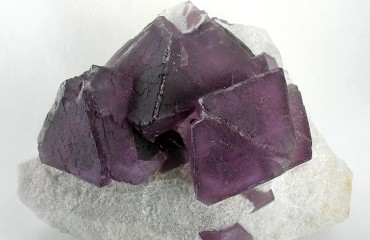
Fluorite on Quartz - Image Credit: Robert M. Lavinsky, CC-BY-SA-3.0 The De’an fluorite deposit consists of three large quartz veins cutting through local limestone and karst. The fluorite is embedded in the quartz and has been mined for many years to provide flux for China's steel industry. As the work progressed, miners eventually began to recognise the exceptional quality and value of some of the fluorite crystals and started preserving them rather than sending them to the crusher. Since the fluorite is encased in quartz, both hydrofluoric acid and careful mechanical methods are used to uncover individual crystals and groups. Three main fluorite types occur: purple to violet octahedra (often twinned), bottle-green crystals edged with vivid purple, and the most prized – large, transparent, deep purple-red pseudo-octahedra with stepped faces. Since all three were originally embedded in quartz, their preparation usually leaves them perched on bases of brilliant white quartz, creating dramatic and visually stunning contrasts of colour. |







From the richly mineralised skarns of Hunan to the ancient pegmatites of Tongbei and Yunling, China’s mineral localities encompass nearly every geological environment. The dazzling colours of fluorite and pyromorphite, the metallic brilliance of stibnite and cassiterite, and the rare perfection of spessartine and cinnabar reflect the nation’s extraordinary geological heritage. These localities have elevated China to the forefront of modern mineralogy and collecting, supplying museums and enthusiasts around the world with specimens of unrivalled beauty.